Weekend tells the story of two people. In the coming months it will be labelled and marketed as a gay movie, and it is – and probably the first time contemporary gay life has been depicted with such accuracy and sensitivity – but first and foremost, it’s a story of these two specific people, at this specific time in their life, and what transpires between them.
Nadine Labaki’s first feature, Caramel, was a pretty crude but fairly likeable sitcom/soap – a Beirut-set Cutting It or Beauty Shop, notable mostly for being the rare middle-eastern film seen in the UK that doesn’t primarily deal with the region’s volatile politics. Her deeply silly follow up, which won the People’s Choice award at this year’s Toronto Festival (thereby joining a recent lineage of really lousy movies that people – and Oscar voters in particular – really love: the previous two winners were Slumdog Millionaire and The King’s Speech) finds her turning her attention to Christian-Muslim sectarian tension in Lebanon, through the story of one unnamed village, and finds her massively overmatched by her subject material.
I Wish is an absolute delight. It tells the story of two young brothers whose parents have split up; the mother took the elder brother to live with her parents, leaving the father and younger brother behind. The split was acrimonious, and so the boys must communicate by phone, in secret. The mother’s family live in a town across the water from an active volcano; its looming presence fills the sky and ash falls more or less all the time, coating the town in a dull film that has to be constantly cleaned up. It’s a state of depressed limbo that reflects the lives of the family; things are unresolved. The film centres around the elder boy’s desire to bring the family back together; he decides that if the volcano exploded it would resolve things once and for all by forcing an evacuation of his town, and his parents to reunite. He ends up leading an expedition of children, each bringing a desire of their own, on a quest to reach a magic place where two Shinkansen trains will pass each other for the first time, which the kids believe will create enough energy to make wishes come true.
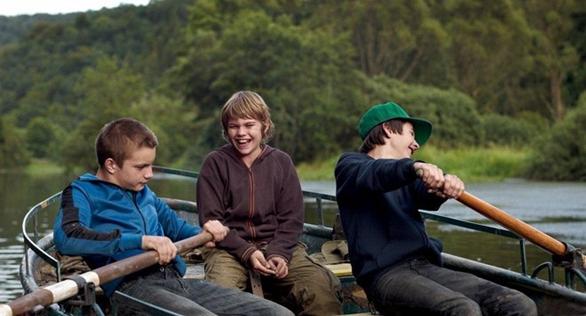
A joy, from the first frame to the last. Director Bouli Lanners will be familiar to LFF audiences from his apearance as a transsexual assassin in Gustave de Kervern and Benoît Delépine’s anarchic Louise-Michel, and his last film, Eldorado, was one of our recommended obscure gems.
Next week, MostlyFilm goes film festival crazy, with reports from San Sebastian, the London Spanish Film Festival, and Raindance, as well as the start of our daily London Film Festival coverage. Clearly, a disco nap is in order.
The London Film Festival starts in just over a week. MostlyFilm will be going big on coverage of the festival, bringing you daily reports for the duration. We’re doing this for many reasons, but one reason is that, in a way, MostlyFilm owes its existence to the LFF. Many of our contributors first met on the LFF messageboards over a decade ago, which went on to become the Guardian’s film talkboards, where more of us joined. This blog was started when the Guardian closed those talkboards earlier this year. We’re sentimental about the LFF.
So here’s the thing – we want our readers to be part of the festival coverage as well. We want MostlyFilm to be the first place you come to during the festival to get our writers’ reactions on the films and events, but also to be the first place you’ll come to share your reactions.
What we’re looking for is capsule reviews. 200 to 500 words. We’ll be running as many as we sensibly can every day, no deadlines, so you can send your first reactions or let things percolate a bit before you write. We’ll happily run more than one review of films that are worth talking about, so don’t worry about what we’ve already got; write about what inspires you (positively or negatively). We’d love to run reviews from “pro” critics who might have something their main outlets can’t use, but if you’ve never reviewed a film before, we’d love to run your work too.
Boring T&Cs stuff. We can’t pay (or get you into screenings, or reimburse you for tickets), but you retain the copyright in your work. We don’t promise to run everything submitted.
Drop me a line, then, if you fancy getting involved? Or just send me your reviews. Either way, the address is editor@mostlyfilm.com and I’m looking forward to hearing from you.
Thomas Pratchett is neither scared nor excited by Torchwood.
The pain! The pain!
“I’m sick of Torchwood acting like amateur clowns!” – Rex Matheson
So, once again the Torchwood juggernaut… hmm, too strong a word. The Torchwood pick-up truck? Smart car? No, definitely not smart. Let’s say the Torchwood clownmobile – because the Extra-Terrestrial Intervention Community’s most stupid and bungling group are back, and it’s been a bigger and more global shambles than ever before.
After two series of discrete episodes with only a loose overall arc, Torchwood changed course for its third series, 2009’s Children of Earth, telling a single story in five hour-long episodes over five consecutive nights. Torchwood had become proper event television, at least in its own mind. With the fourth series, Miracle Day, this self-conscious sense of being event TV has been amped up even further, and with it the level of self-delusion. Ten episodes, over ten weeks, telling the same story. Wasn’t there a risk of the plot not being thick enough to cover that many hours? As it turns out, it was more than a risk. Continue reading Death, where is thy sting?→
Paul Shuttleshoots, thinks and shoots, then thinks again.
Adam Jensen in Human Revolution: “single-handedly dragging us back to an era of arms-perpetually-folded, mid-90s tough guy protagonists”. Like that’s a bad thing.
Note:this post contains minor spoilers for the Deus Ex series and Mass Effect.
Riding the elevator down into the depths of an unassuming textiles factory, the glass walls afforded me a glimpse at what awaited on the floor below. A handful of armoured FEMA agents were dotted around, either on patrol or huddled in a small group to the left. In the centre of the room, a rhythmic mechanical thud signalled the familiar presence of an unwieldy ED-209 replica, with its pair of slowly rotating turrets scanning the open, multi-level storage area. As the lift doors pinged open, I darted for the cover of a nearby raised platform, eyes fixed on the HUDs pulsing suspicion meter. Nothing.
Up above laid a series of catwalks, from where a red sniper dot flirted perilously close to my position. I pulled up my inventory and selected one of the two gas grenades I’d stolen from a newly-unlocked cabinet. Leaning out from cover, I tossed an explosive towards the amassed troops, whose immediate rasping was just enough of a distraction for to break for the central stairwell, by now hopelessly unguarded. Suddenly, a piercing siren began to ring out. My pace quickened as I ducked from shadow to shadow, timing my steps to avoid the curiosity of the lingering two-man patrol. Reaching the relative safety of the far side, I crawled slowly back down the stairs, now standing across from where I’d started.
A solitary guard lingering close to the exit, completing a cursory lap of the area; deliberate looks around and behind as he went. Pausing nearby, I held my breath, convinced he’d seen me. A moment passed. Then two. Finally, he turned back towards the door and I exhaled, inching out from behind the railing to strike him in the back of the neck, sending this 3-days-to-retirement badge crashing to the floor with a bone-crunching thud that left him otherwise unharmed. As a nearby surveillance camera began its slow sweep back towards the door, the body was already halfway back into the darkness. Somewhere in the distance I could hear agents muttering about another false alarm. They hadn’t found their unconscious friend yet, but they would soon enough. By then, I’d be gone. Continue reading Deus Ex: Human Revolution→
The current National Portrait Gallery exhibition, Glamour of The Gods, sets out to ‘demonstrate photography’s decisive role in creating and marketing the stars central to the Hollywood mystique.’
The Tramp thinks the execution falls far short of the goal.
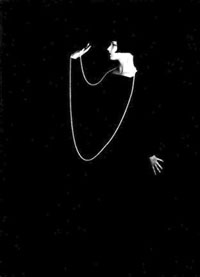
Louise Brooks by Eugene Robert Richee
In my mind, Hollywood’s Golden Age runs anywhere between 1915 and 1950. I’ve had pictures of film stills and film stars from this era on my walls since I was old enough to dictate what pictures I could have on my walls. They are almost fairytale images: glimpses of impossibly glamorous women in the most beautiful clothes. So it was nice to see one of my favourite images from childhood here: Louise Brooks, her jet-black hair in its iconic fringed bob, her lithe dancer’s body clad all in black, her porcelain white face and hands and a long string of pearls all you can see – this is glamour and art. I didn’t want to be a princess when I was little, but I did want to be Louise Brooks. Continue reading Glamour of the Gods→
September sees the release of The Eye of the Storm, directed by Fred Schepisi and based on the novel by Patrick White. It’s Schepisi’s first film in eight years (not including the award-winning HBO mini-series Empire Falls), and his first film made in Australia since A Cry in the Dark in 1988. MarvMarsh takes a look back at one of his best films, while other MostlyFilm contributors choose some of their own favourite Australian films. Sadly, The Crocodile Hunter: Collision Course didn’t make the cut. Continue reading Cult Australian Cinema→







 MostlyFilm