Spank The Monkey introduces the Scala Forever season by looking back at the history of one of London’s most-beloved fleapits
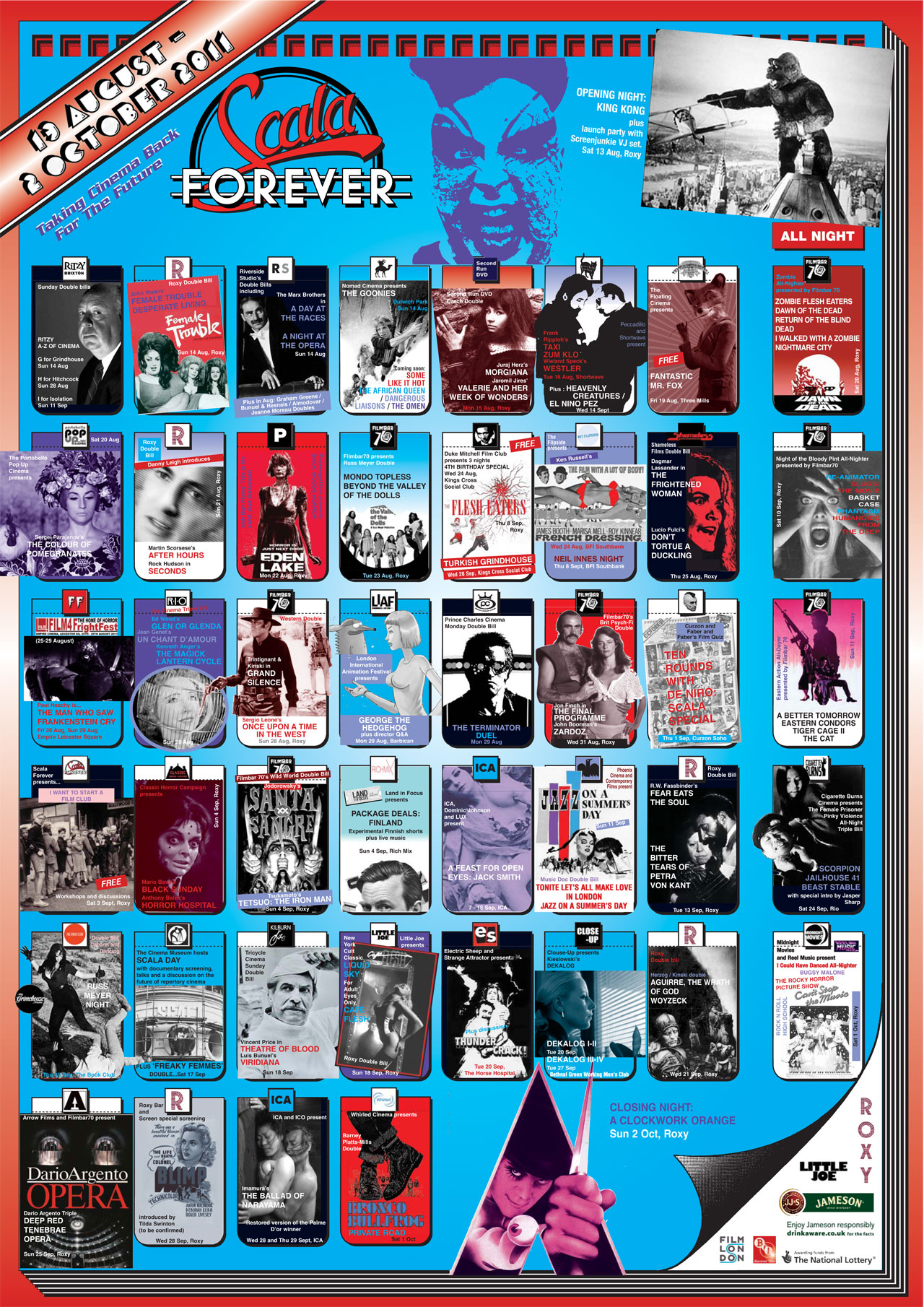
Trust me, this is one picture you really need to click on to enlarge
Screw Proust and his madeleines: that picture there takes me back a quarter of a century, and it doesn’t require a tea chaser in order to do it. Twenty-five years ago, I virtually lived at the Scala cinema in King’s Cross, and eagerly awaited the monthly arrival of a programme flyer very much like the one shown above.
The Scala was possibly the greatest of London’s repertory houses, back in the days when the capital had around a dozen of them. As the London-wide festival Scala Forever commemorates the opening of the cinema thirty years ago, I’ve been looking back fondly at the time I spent there watching all the underground greats. Russ Meyer. John Waters. Herschell Gordon Lewis. Jörg Buttgereit. Tsui Hark.
So it annoys me a little to be reminded that the first film I saw there was Garry Marshall’s The Flamingo Kid. Continue reading Scala Forever*→
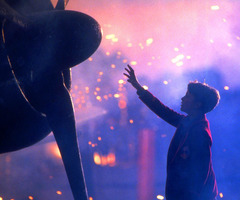
Christian Bale in Empire of the Sun, filmed at Shepperton Studios
“Next time you see a Spitfire in a museum, run your fingers over its skin… you might be touching a vanished masterpiece.”
When producer Cecil Hepworth went bankrupt in 1924, his entire stock of film negatives was melted down and turned into waterproof resin for military aircraft. Many of these negatives were unique, and some 80% of all British films from 1901 to 1929 were lost forever as a result. Shepperton Babylon: The Lost Worlds of British Cinemais Matthew Sweet’s attempt to reconstruct this forgotten history, and the other forgotten histories of British cinema: the artistic, industrial and folkloric achievements that always seem to get overshadowed by those in Hollywood. Continue reading CAMERA OBSCURER: The Return of the Mostly Film Book Club→
Mostly Filmwriters pause and reflect on the blink-and-you’ll-miss em parts that make the film work.
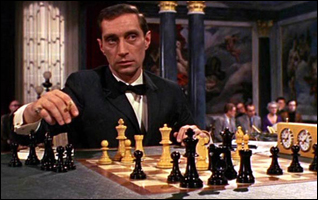
Kronsteen – From Russia With Love.
By Paul Duane
“Congratulations, sir. A brilliant coup.”
In a vast hall, a creepy, languid character resembling Ren the cartoon chihuahua plays chess against somebody who seems to be called Canada MacAdams. Kronsteen has only one word of dialogue here – “Check” – but it’s impossible to look away from him. See him manipulate chesspiece and cigarette in one hand with movements that hint he’s skilled in horrible varieties of martial arts. Observe the way his mouth opens impossibly wide to receive the cigarette, as if he was a deep-sea fish that somehow, eerily, smokes. Watch the impossibly slow movement of his head, then his eyes, as they register the fact that some lackey has brought him an unrequested glass of water. See the thought form as if in a bubble of noxious gas above his head – “he will suffer before I allow him to die” – while his eyes slide to the glass. And now look – who in the history of drinking has ever drunk like that, holding up the little paper napkin that sits under the glass as he drinks? The next shot explains why, but there doesn’t need to be an explanation – this is just part of the ineffable creepiness of Kronsteen. He probably eats his mashed potatoes with one single black obsidian chopstick. Reading the message on the napkin, he mops his fishlips, then – without warning – that cigarette is back, perched, languid. How the FUCK did he do that? Never mind, soon he’ll be dead. Continue reading Mostly Minor Characters→
Jessica Chastain in the Tree of Life. Also pictured: a panentheistic god
It’s not the most obvious reference point from which to start thinking about The Tree of Life and how it fits into Terrence Malick’s filmography, but I keep coming back to what John Peel said about The Fall: always different, always the same. Malick has worked in the same distinctive mode at least since 1978’s Days of Heaven. He builds sequences from fragmentary and extended moments rather than from dramatically discrete scenes. He forages for indelible images in the margins of his setups, turning the restless eye of the steadicam into a participant in the story. More and more, he prefers non-expository voiceover to dialogue. He has returned to similar themes repeatedly throughout his career, but the specific narrative strategy of each film is distinct. He is always different, always the same. Continue reading The Tree of Life→
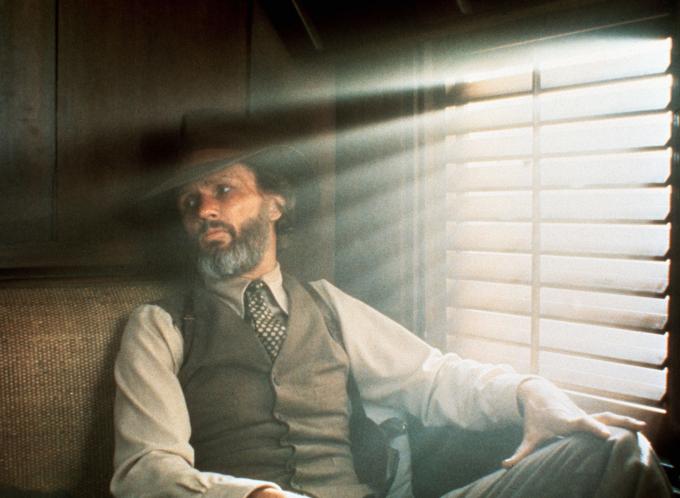
“Does anyone want to switch seats?” Kris Kristofferson wonders what he’s got himself into.
Can Heaven’s Gate ever be rescued from its reputation? For thirty years the film has been marked by the stench of failure, its production having passed into legend alongside Apocalypse Now as an example of how not to make a movie. In the case of Francis Ford Coppola’s film, at least he could cite circumstances beyond his control – a sudden typhoon, Martin Sheen’s heart attack – and the director somehow managed to find a powerful, spectacular film amid the chaos. Heaven’s Gate has no such natural disasters to hide behind and the scathing critical reaction upon its release sealed the film’s fate. This flop wasn’t just viewed as just another bad movie, it was viewed as an example of directorial self-indulgence run amok and the wastefulness of Hollywood studios, and neither United Artists or the film’s young director Michael Cimino (who had reached the peak of his career just two years earlier) ever recovered from the debacle.
That was all I knew of Heaven’s Gate before I first saw the film some six years ago, and given its notorious history, I was surprised at how much I enjoyed the experience of watching it. The film has problems, for sure, but it also has considerable virtues and a sense of ambition that is frequently thrilling. Recently watching the film for a second time on the big screen, it seemed inconceivable that this bold and strikingly beautiful film had been described in the press as “an unqualified disaster” (Vincent Canby) and “the most scandalous cinematic waste I have ever seen” (Roger Ebert). Even though this film found a few ardent defenders in those early days – Robin Wood, Kevin Thomas and Nigel Andrews among them – the damage had already been done. As recently as 2008, Joe Queenan (in an article inspired by the release of The Hottie and the Nottie) claimed that Heaven’s Gate was in fact the worst film ever made. Seriously, did we all see the same fim? Continue reading Reopening Heaven’s Gate→
Welcome to the first in an occasional series, in which we will collect lovely little bundles of themed recommendations from Mostly Film contributors. To kick the series off, we asked them to recommend a film that they were pretty sure none of the rest of us had ever seen (as it went, few managed to get that obscure).
“Larger than Life” by CaulorLime
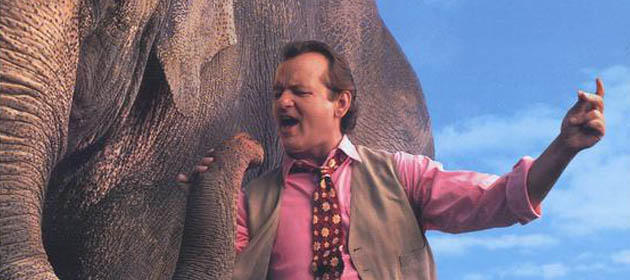
Asked to write about an obscure gem it would have been easy to write about Satyajit Ray’s Big City or something old, silent and Japanese. Easy, and wrong. Anyone can explain the appeal of a lost classic, but a failed studio comedy from 1996? That’ll take some energetic shilling.
Bob Dylan is 70 today. To mark the occasion, four Mostly Film contributors write about Dylan’s many faces on film and wonder whether any of them is his own.
Niall Anderson on “Dont Look Back”
There are probably worse introductions to Bob Dylan than Dont Look Back, but alas it was mine, so I find it hard to believe. Before I saw DA Pennebaker’s film I only knew the inescapable Dylan: the strumalong homilies, a famous line here or there, the placard-flashing promo for “Subterranean Homesick Blues”, and the fact that he was considered a genius. I was seventeen and I don’t know what I expected genius to be. I mostly expected it to be obvious. Not necessarily direct or easy, but in some way lividly apparent. I didn’t expect this.
I wanted to write a book about the Malayan communist insurrection of the 1950s, so I took a bus to the jungles of Southern Thailand, where the former guerrilla fighters all live these days. In the town of Betong, I went up to people in the street (fortunately, everyone in Betong speaks Chinese, so I didn’t need my Thai phrasebook, which is shockingly lacking in communist vocabulary) until I found someone willing to take me up the mountain on his motorbike. He didn’t have a spare helmet, but on such a steep mountain road a helmet probably wouldn’t have done me much good.
A conversation between Spank The Monkey and The Belated Birthday Girl
The US poster for 13 Assassins. The UK one simply isn’t as good, sorry.
SPANK THE MONKEY: This Friday sees the UK theatrical release of Takashi Miike’s second film, 13 Assassins. It’s been a full decade since his debut Audition was in cinemas here, and it’s hard to understand why a director with such a low work rate has achieved the reputation that … oh, I’m sorry, I can’t keep this up. I’m just trying to see if I can write the single most inaccurate opening paragraph ever published on Mostly Film. You’ve got the IMDB stats there: how many films has he made?
THE BELATED BIRTHDAY GIRL: Between Audition and 13 Assassins, about fifty. I think we’ve watched about 33 of his in total, but a couple of them pre-date Audition, so we’ve seen around half of those fifty.
STM: That’s handy. It’s always good to establish your credentials before the jump, I think.





 MostlyFilm