Category Archives: Home Video

Unleash Your Enthusiasm!

By Ron Swanson

Here at Mostly Film, we love American TV, but I hate the fact that rubbish like Two and a Half Men is stuffed down your throats for hours a day in the UK while 30 Rock and The Office are left to flounder in their one half-hour spot on Comedy Central. Still, at least there’s a chance to see the oft-neglected, forgotten gem that is Friends. E4 are so concerned you might miss out on this slice of the current cultural zeitgeist that they kindly repeat each night’s episode, um, three hours later.

Given that cultural landscape in the UK, I, and two of our regular contributors, am going to espouse the virtues of a handful of US TV comedies that haven’t received enough acclaim in the UK. Continue reading Unleash Your Enthusiasm!
Mostly Links – 1 July 2011

BY NIALL ANDERSON

Just good friends: Shia 'Shirley' LaBeouf and Megan 'Don't Call Me' Fox

Mostly Film spent last weekend at Glastonbury. Every year, millions of pixels are indiscriminately slaughtered to convince the public that it’s the best fun they never had. We will refrain. Let it just be said that your life will be made briefly but appreciably better if you watch Janelle Monáe’s astonishing performance from Saturday night. Viewers outside the UK will have to make do with edited highlights, but still, not since Prince in his absolute pomp, etc.

By coincidence, this week Mostly Film will be going to see Prince, but we promise not to mention it. Unless Tricky turns up again. Or Limahl. Or, you know, anyone who Prince bafflingly thinks is cool.

Stepping briefly away from the corporatisation of fun, we turn to taking the piss out of corporations. What should an advertisement for KFC look like? Peter Serafinowicz has an idea that I’m sure the Colonel will love. Continue reading Mostly Links – 1 July 2011

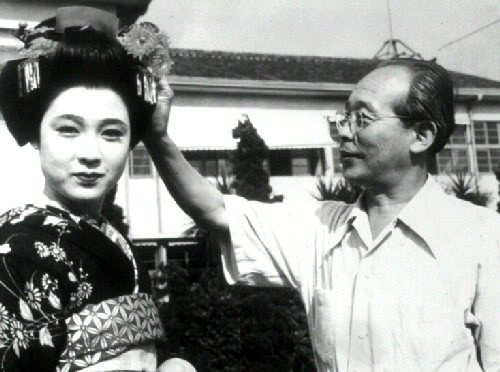
Kenji Mizoguchi – Japan’s Forgotten Master

by Philip Concannon

September 10th 2011 will mark the 60th anniversary of an auspicious event in the history of world cinema. On that date in 1951 Rashomon won the Golden Lion at the Venice Film Festival, introducing western audiences to not only Akira Kurosawa but to the riches of Japanese cinema in general. Rashomon went on to win an Academy Award and its director became an international figure, but he wasn’t the only Japanese filmmaker winning new admirers during this period. In 1952, Kenji Mizoguchi (who was apparently fiercely jealous of the younger director’s acclaim) won the International Award at Venice for The Life of Oharu and he later won back-to-back Silver Lions at the same festival with Ugetsu monogatari and Sanshô dayû. As the western world discovered Japanese cinema, these filmmakers were its twin leading lights.

At some point during the subsequent years, that perception changed. Mizoguchi died in 1956 and the stature of his work gradually seemed to fade with his passing. If you ask people to talk about the great Japanese directors today, Kurosawa will probably be their first answer with Yasujirō Ozu being the most likely second response. It seems they are now widely regarded as the two titans of that country’s cinema and as two of the most respected and influential filmmakers of all time, and while I’m not going to argue against that evaluation, I can’t help wondering why Mizoguchi’s own considerable body of work has quietly slipped out of view. I would suggest that his films are every bit as impressive and vital as anything else produced in Japan in this period. In fact, you could make a fair case for him being the greatest of all Japanese filmmakers.

Continue reading Kenji Mizoguchi – Japan’s Forgotten Master

Auto da Fé: The long life of Taxi Driver

by Niall Anderson

When we talk about iconic character shots in film, we’re generally talking about shots where something clever and technical happens. The simultaneous track-back and zoom when Roy Scheider sees Jaws at the beach. The puff of steam from the waiting train as Marilyn Monroe is revealed in Some Like It Hot. The subliminal flash of a skull on Anthony Perkins’s face at the end of Psycho. Taxi Driver is full of these sort of shots – full of elegant trickery and long fluid sequences that belie the rehearsal that must have made them possible – but the single scene that sticks in people’s minds couldn’t be simpler: the unbroken, unmoving shot of Travis Bickle taunting his imagined enemies in the mirror, goading himself into action.

Continue reading Auto da Fé: The long life of Taxi Driver

Killing the Dead: Revolution on Film

by Niall Anderson

Cuban Revolution 50th anniversary celebrations, Havana, 2009 (Reuters)

For a brief period in the late 60s and early 70s, it looked as though the revolution would be televised, and not only that, it would be produced, directed and paid for by Hollywood. These were the years of Zabriskie Point (featuring Black Panther Kathleen Cleaver), Medium Cool (which wove into its story ground-level footage of the 1968 Chicago riots) and The Strawberry Statement (which featured author James Kunen as himself, re-enacting the Columbia University protests he’d experienced as a student). Adopting the verité styles of the French New Wave and a blithe moral seriousness all their own, the countercultural success these films enjoyed was buttressed by the much larger successes of The Graduate, Easy Rider and Bonnie & Clyde. For a short moment in cinema history it looked as though revolution had made its home on Sunset Boulevard.

Since then we’ve seen a lot of films like The Graduate, Easy Rider and Bonnie & Clyde, but we haven’t seen too many like Zabriskie Point – or at least not from the mainstream. The cinemagoer who likes transgressive politics along with their popcorn has been obliged to find it in the genres, or in films by auteurs whose expressed politics (Godard’s Marxism, for instance) lead to their films being pre-ghettoised. And the sad fact for cinematic revolutionaries is that you can’t have a real revolution without popularity.

Continue reading Killing the Dead: Revolution on Film

Man vs. Chick

by Spank the Monkey 

In 1984, Alex Cox made Repo Man. It was about a suburban punk called Otto (Emilio Estevez), his induction into the repossession trade under the guidance of repo man Bud (Harry Dean Stanton), and the chaos caused by their attempts to find a vintage car with a lethal secret in its trunk. Its distributors considered it too weird for a proper release, and it spent months in limbo until the unexpected success of its soundtrack album gradually turned the film into a minor cult classic.

Twenty-five years later, Alex Cox made Repo Chick. It was about a spoilt rich girl called Pixxi (Jaclyn Jonet), her induction into the repossession trade under the guidance of repo man Arizona Gray (Miguel Sandoval), and the chaos caused by their attempts to find a vintage train with a lethal secret in its caboose. Its distributors considered it too weird for a proper release – and to give that judgement some perspective, this was a distribution company owned by David Lynch.

After nearly two years on the shelf, Repo Chick is finally creeping out on video without ever seeing the inside of a cinema. Does Cox have another minor cult classic on his hands? Comparisons are odious. Let’s make some.

Continue reading Man vs. Chick