Category Archives: Politics

Shake Your Money Maker

MarvMarsh looks at the history of big finance on screen

Gordon was very happy with his 'free calls on the beach at sunset' plan

Gordon Gekko; Larry the Liquidator; the Duke brothers. They may sound like professional wrestlers but what they actually are is nothing like as honest and noble. They are cinema’s money men. The people at the top of the writhing pile of maggots that is the financial industry. It is not an industry that Hollywood understands, or if it does then that does not translate into a willingness to portray it accurately. A few broad strokes give us a man on the edge, betting the firm in a desperate attempt to save his drink-soaked skin; a few more give us his boss, who spends his days in his gigantic office or the back of his limousine, drinking whiskey and handing out lessons on what life is really like. A final few more gives us the young Turk who realises something is badly wrong and saves his soul by bringing down the firm and walking away. And that, pretty much, is the financial industry on film.

Given that we now live in a post-apocalyptic landscape after our dreams were all laid to waste by the feckless actions of some greedy banker scum, or so the story goes, perhaps that is all the financial industry really deserves. Films have a difficult relationship with work as it is, so to accurately and interestingly cover the work of people it is going to be hard to portray as human, let alone sympathetic, is a big ask. Also, is there really an audience for a film about an individual diligently carving out a good reputation for himself in the Compliance department of an international bank? Perhaps, but I wouldn’t want to be the one pitching it. Actually, of course I would because what if it sold? I’d be a millionaire! But it wouldn’t. I can’t even get that to fly in my dreams.

Here’s an idea for an exciting scene in a film, Producer Guy. Continue reading Shake Your Money Maker
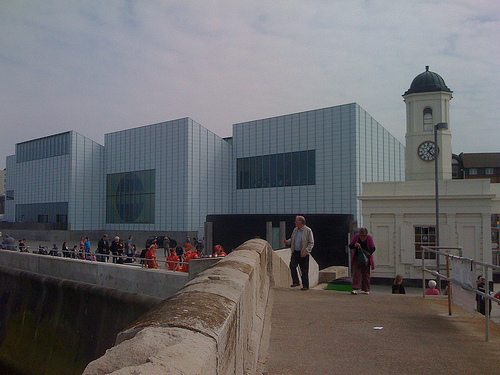
New Art Galleries: Remaking Margate

Ann Jones introduces the first of an occasional series about new art galleries.


Turner Contemporary in Margate

Over the last couple of decades art has acquired an unprecedented audience in Britain. Blockbuster museum shows still draw big crowds but contemporary art also pulls in visitors in huge numbers and the London art market is thriving – in so far as such a thing is possible in the current economic climate.

In response, towns and cities across Britain have sought to use art to attract visitors and aid regeneration either through staging festivals, commissioning landmark public art works or building new museums and galleries. The most prominent of these art works has been Antony Gormley’s Angel of the North, commissioned by Gateshead Borough Council and funded in the main by the National Lottery. The best known new museum is also in Gateshead: the BALTIC Centre for Contemporary Art. BALTIC is a converted flour mill, part of a trend for converting disused industrial spaces into galleries and museums that also gave us Tate Modern. Most of the high-profile gallery spaces opened in recent years have, however, been new buildings, often partly commissioned to attract not just art tourists but architecture fans as well. (Examples include the New Art Gallery, Walsall; Nottingham Contemporary; the Towner, Eastbourne; and Mima Middlesborough.) The spectacular success of the Guggenheim Bilbao seems to have played a part in the design and commissioning of each of these buildings, albeit tempered by a traditional British reluctance to wholeheartedly embrace contemporary architecture – the Bilbao effect versus the Prince Charles effect, if you like. This is the landscape in which Turner Contemporary has opened in Margate. Continue reading New Art Galleries: Remaking Margate

The land of the Bolsheviks: early Soviet cinema at the BFI

BY JOSEPHINE GRAHL

Eisenstein's Fantasia: a scene from Ivan The Terrible Part I

How would you go about making film propaganda in support of a new, revolutionary state? The Russian revolution coincided with the rise of the cinema as mass entertainment, a cultural development which didn’t escape the attention of Lenin or the Soviet bureaucracy. In the 1920s, the Soviet film industry was state-sponsored and subject to state interference, its propaganda function for the new Soviet state accepted as a matter of course. But surprisingly, most of the films in the BFI’s Kino season of early Soviet films transcend the sort of didactic political preaching you might expect from that set-up. Continue reading The land of the Bolsheviks: early Soviet cinema at the BFI

Art and the Political Message: Ai Weiwei and Peter Kennard

by Ann Jones

Ai Weiwei's ‘Surveillance Camera’ installed at the Lisson Gallery; Rirkrit Tiravanija’s banner outside neugerriemschneider in Berlin.

In the film that accompanied his Sunflower Seeds installation in the Turbine Hall of Tate Modern, Ai Weiwei says that he wants “people who don’t understand art to understand what I am doing”. In his recent book @earth, Peter Kennard has attempted communication that is purely visual: barring the title, the book – including both index and contents page – is without words; attempting to find a more universal visual language and create a book that needs no translation. Seeing these two things in fairly quick succession made me start to think about the degree to which art relies on verbal language – be it a title or a longer explanatory text – to help get the message across. Is visual language alone ever enough, and to what extent is it culturally specific?

Continue reading Art and the Political Message: Ai Weiwei and Peter Kennard

Osama bin Laden – Michael Bay’s Biggest Fan

by Preposition Joe

It’s simultaneously too horrible to say aloud, and too obvious to ignore. Osama Bin Laden based the 9/11 attacks on the films of Michael Bay.

Perhaps that’s not fair. He based 9/11 on the films of Michael Bay, and the films of Roland Emmerich and Mimi Leder. And possibly Tim Burton too.

Disaster movies were a staple of 70s popular culture, but they seem rather innocent today. Yes, there were burning buildings, crashing planes, cities in ruins. But their disasters were accidents or natural events, with no villain more sinister than a cost-cutting corporation or complacent authorities who won’t listen to the warnings of our hero. Audiences tired of the disaster movie after a while and the genre lived on only in parody.

And then, in the mid-1990s, the disaster movie had a resurgence, as the kids who’d grown up on Towering Inferno and Earthquake graduated from film school. Continue reading Osama bin Laden – Michael Bay’s Biggest Fan