All posts by Ann Jones

Unknown's avatar

About Ann Jones

London-based artist and educator who somehow seldom gets time to actually make any work, who writes about art, somewhat irregularly, at ImageObjectText.com and occasionally contributes to MostlyFilm.com – writing about art, mostly.

Manchester International Festival 2011: Art

by Ann Jones

Until recently I had always considered Marina Abramović to be formidable to the point of scariness and possibly not entirely of sound mind. Her work is extraordinary and utterly compelling but its intensity and seriousness seemed to leave no space for the woman herself to have a sense of humour. But then until recently, though I’d read about her work and seen it in reproduction, I’d seen very little of her work in galleries and had never seen Abramović herself in the flesh, something of a limitation when talking about the work of a performance artist. Somehow I never quite made it to Manchester in 2009 to see her piece at the Whitworth Art Gallery for that year’s MIF and, more annoyingly, was in New York a few weeks too early to see her retrospective at MOMA in 2010, for which she created a new performance The Artist is Present which saw her sitting virtually motionless facing a succession of visitors to the exhibition for the duration of the exhibition (over 700 hours in total). But last autumn, I saw her Lisson Gallery show and talk at Tate Modern, and discovered that the woman who has made uncompromising performance art for several decades, at times risking her life (usually, but not always, intentionally), is unexpectedly personable. Indeed at Tate Modern she started with a story – one of the childhood memories that featured both in Confession (2010), shown at the Lisson Gallery, and in The Life and Death of Marina Abramović (2011), which had its world premiere at MIF last week – and ended with a joke. Perhaps age is softening Abramović. Or perhaps she was never as scary as I’d assumed.

Continue reading Manchester International Festival 2011: Art
Passing Through: Mike Nelson’s “Coral Reef” and Mark Wallinger’s “Threshold to the Kingdom”

by Ann Jones

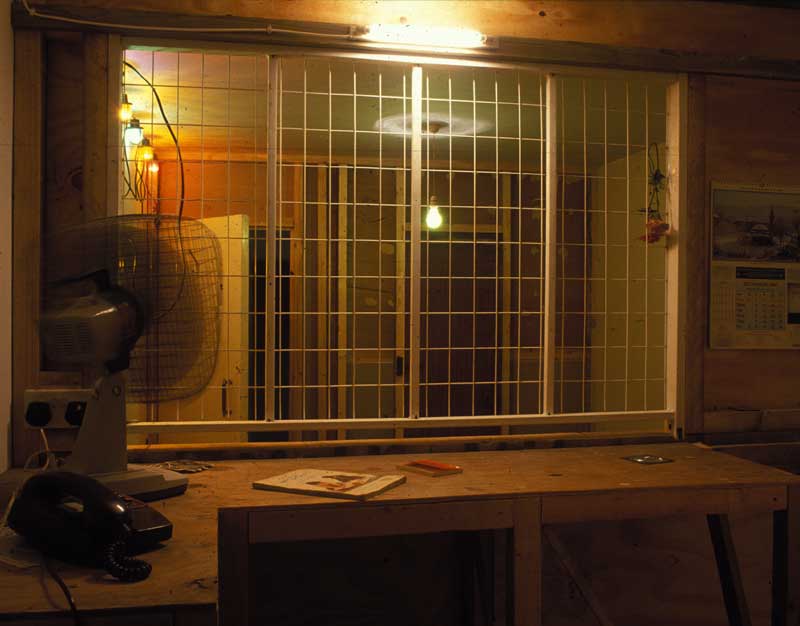
It’s often easy to get lost in one’s own thoughts looking at a piece of art; paintings and photographs can suggest stories or remind us of familiar narratives but it’s up to us to fill in the gaps and, while we might be lost in the moment, we’re inevitably on the outside looking in. In the cinema the story is easier to follow; more often than not the narrative is linear and there is dialogue drawing our attention to the things we shouldn’t miss. Films are populated by a cast of characters with whom we form some kind of connection, however short-lived. But no matter how much we suspend disbelief and get caught up in the story, we’re safely on the outside looking in. In Mike Nelson’s work all that changes.

Continue reading Passing Through: Mike Nelson’s “Coral Reef” and Mark Wallinger’s “Threshold to the Kingdom”

Art and the Political Message: Ai Weiwei and Peter Kennard

by Ann Jones

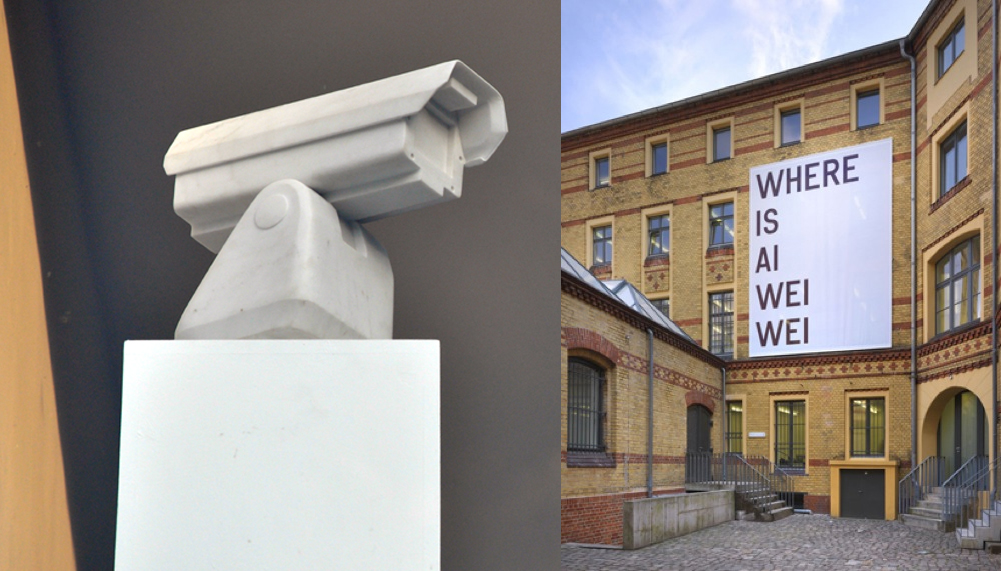
Ai Weiwei's ‘Surveillance Camera’ installed at the Lisson Gallery; Rirkrit Tiravanija’s banner outside neugerriemschneider in Berlin.

In the film that accompanied his Sunflower Seeds installation in the Turbine Hall of Tate Modern, Ai Weiwei says that he wants “people who don’t understand art to understand what I am doing”. In his recent book @earth, Peter Kennard has attempted communication that is purely visual: barring the title, the book – including both index and contents page – is without words; attempting to find a more universal visual language and create a book that needs no translation. Seeing these two things in fairly quick succession made me start to think about the degree to which art relies on verbal language – be it a title or a longer explanatory text – to help get the message across. Is visual language alone ever enough, and to what extent is it culturally specific?

Continue reading Art and the Political Message: Ai Weiwei and Peter Kennard

Unexplained Lights in the Sky: Susan Hiller’s “Witness”

by Ann Jones

Strange lights in the sky, odd saucer-shaped objects circling overhead, aliens who abduct unwitting passers by before returning them to their day to day lives… UFO sightings are familiar territory, occupying the minds of conspiracy theorists and providing the subject matter of countless films and television programmes and an interesting challenge to the ingenuity of special effects designers especially in the days before CGI. To declare my hand from the start: I don’t believe in UFOs. I believe there is always a rational explanation for lights in the sky and that it’s never the presence of space craft from elsewhere in the universe. I believe that the ghost in the tree is almost always a plastic bag, that the shadowy alien form on the television after closedown is probably tiredness, or dodgy technology, or bad weather, or almost anything but attempted communication from another world, that fact and fiction are easily blurred, especially in the presence of the human mind, and that true stories are still just stories. And I believe that you can prove practically anything with the internet if you have a mind to. So why then do I find Susan Hiller’s sound installation “Witness” – currently on display at Tate Britain as part of a retrospective of Hiller’s work – one of the most compelling art works I’ve seen in recent years?

Continue reading Unexplained Lights in the Sky: Susan Hiller’s “Witness”

Present Tense: Film, Cinema and the Gallery Space

by Ann Jones

An image from Christian Marclay's "The Clock"

With cinema the dominant artform of the twentieth century, it should come as no surprise that artists have long employed moving image media practices in their work. Increasingly, with the use of film and video by artists perhaps more prevalent then ever, artists are also making the leap from gallery to cinema. So what characterises artists’ film and what separates it from cinema? In the discussion that followed the screening of his work The Lark Ascending (2004) at the Prince Charles cinema in 2004, Mark Wallinger answered a question about why he described the work – a gradually lightening grey screen accompanied by an initially baffling soundtrack gradually rising in pitch and revealing itself to be birdsong – as a film with the words to the effect of ‘Well, if it walks like a duck and it talks like a duck, then it’s probably a duck.’ For me this response missed the mark; from where I was sitting the work had neither looked nor sounded like a film. I realised that despite sitting in a packed cinema, looking at the screen and listening to the soundtrack in the same way as I’d watched countless films before in that very space, I’d somehow experienced the work as sculpture. It’s more than possible that this was a failing on my part, but I don’t think I was alone in questioning the nature of cinema at the end of the screening.

Recently, a number of exhibitions and screenings have brought this question back to mind. Firstly Christian Marclay’s The Clock (2010), 24 hours long and constructed from clips from Hollywood films, which clearly engages with cinema by taking narrative film as its source material and reworking it to form new narratives, albeit brief and often disjointed ones. The conceit of this work is that the film features clocks throughout and that these always tell the right time. If there is an overarching story it is perhaps one about our obsession with time but as watching the film it is easy to get caught up in its micro-narratives and set the bigger picture aside for later. It’s hard not to use the words great achievement when talking about The Clock but doing so tends to focus the discussion on the research that must have gone into it and the technical achievement – see, there’s that word again – of putting the piece together when in fact the film amounts to a great deal more than these. It’s easy to enjoy The Clock without recognising the source material or understanding the way it was made, indeed my own woefully limited knowledge of film history never seemed to matter. As one clip cuts to another there are plenty of visually pleasing juxtapositions, enjoyable in their own right, as well as moments of great tension, particularly as the turn of the hour approaches. And thanks to some seriously good and well-considered sound editing, the cuts are never jarring. Music often runs across several clips, setting the mood, heightening tension, giving a sense of drama and sometimes impending doom. Mealtimes are observed; trains are waited for, met, caught or missed; ringing phones are answered; conversations take place across decades, continents and genres.

Continue reading Present Tense: Film, Cinema and the Gallery Space