The 57th BFI London Film Festival gets off to a cracking start with the Opening Gala screening of Captain Phillips. Adapted by Billy Ray (Shattered Glass) from the book “A Captain’s Duty: Somali Pirates, Navy SEALS, and Dangerous Days at Sea”, by Richard Phillips, telling the story of the hijacking of an American cargo ship; the first to be hijacked in 200 years, Captain Phillips sees Paul Greengrass behind the camera again for the first time since Green Zone in 2010.
Of course, adapting a film from the memoir of your lead character offers you some challenges as a filmmaking team, especially when working in the thriller genre. It’s harder to create suspense when the audience knows that when the ending comes, our main character is getting out of there alive. Greengrass dealt with the opposite problem, so brilliantly in United 93, when he took an ending we all knew all too well, and added swathes of raw, unavoidable human sorrow that made the film almost unbearable, so it should come as no surprise that Captain Phillips has an answer for the problem, by subtly subverting the traditional thriller structure.
That it can do so, so effectively, is largely down to a terrific central performance from Tom Hanks, who has never been better than he is here. It’s such a vanity-free performance from Hanks. Phillips’ heroism is certainly not obvious, nor the type that is traditionally sought out by Hollywood stars. In fact, in Hanks’ hands, Phillips is not a particularly likable character, phlegmatic to a fault, and hard on the men under his command. The majority of his actions are not motivated by a desire to be a hero, and as aspects of his character slip away in front of our eyes, his performance doesn’t waver at all.
He’s ably supported by a cast of mostly unknowns, with Barkhad Abdi as the leader of the skeleton crew of Somali pirates who board the ship, given the most rounded supporting character to work with, and impressing. It’s a tour-de-force performance, though, and in spite of Hanks’ unselfishness as an actor, it’s still almost impossible to take your eyes from him. With any justice, he’ll be a strong contender for an unprecedented third Best Actor Oscar come late February. Ron Swanson Continue reading London Film Festival: Day Three Update→
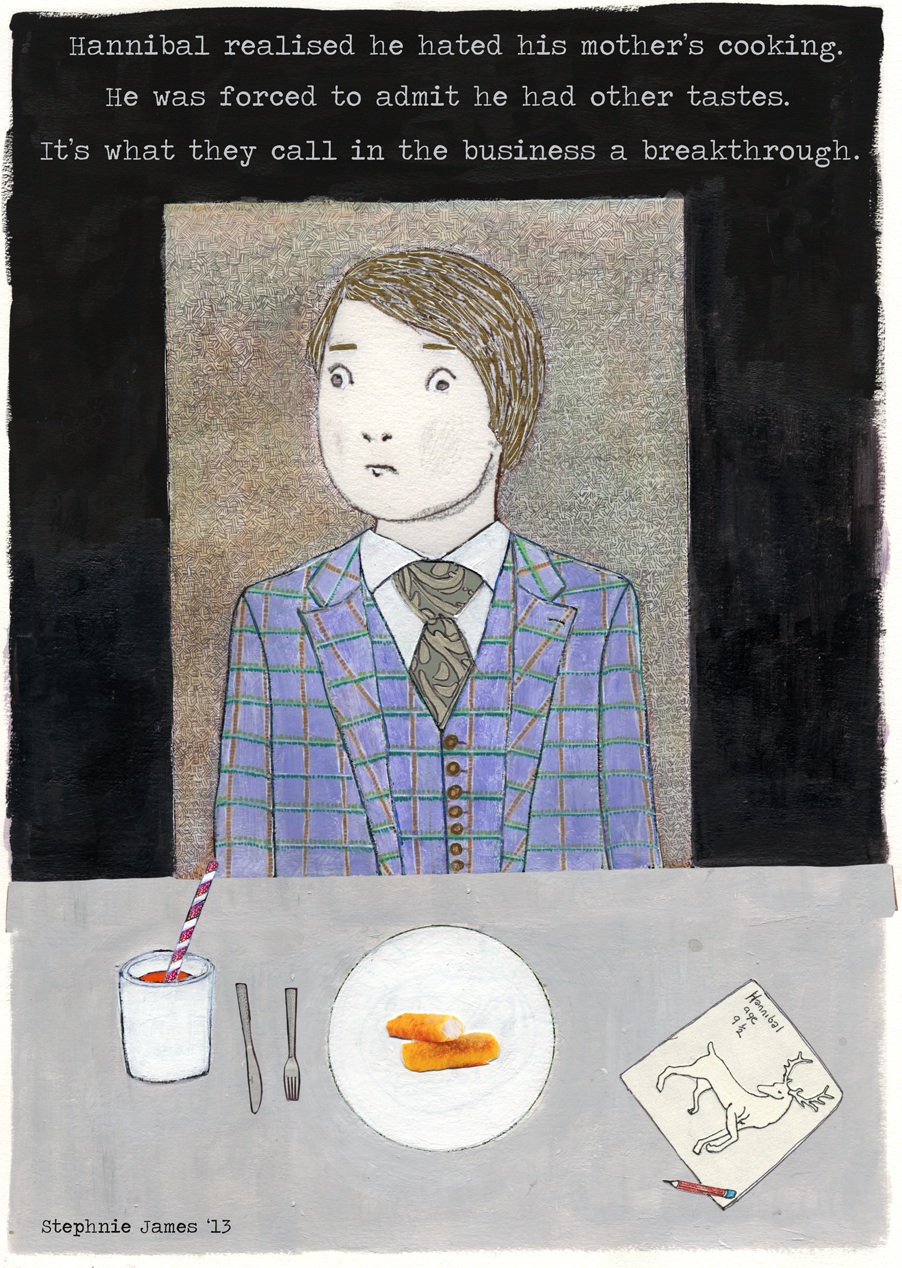
Part of a series of Hannibal illustrations. Stephnie says: ‘Most of the art I’ve seen in connection with the show depicts young Hannibal in a variety of gruesome acts (eating family pets, etc.) but I thought it might be funnier to show him as a miniature version of the dandy we see on Bryan Fuller’s show. In this illustration he is somewhat disappointed with the juvenile fare his mother has presented him with, although it has got him to thinking …’
MostlyFilmwriters pick their favourite holiday films
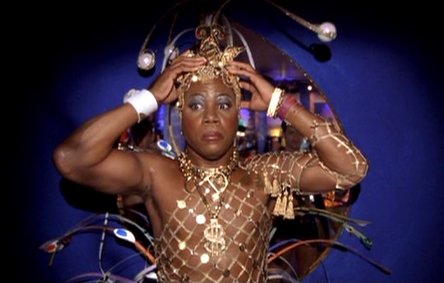
For god’s sake, somebody show him the money already
Boat Trip – Mrs Mills
In 1997 Cuba Gooding Junior won an Oscar for his role in Jerry Maguire. Five years later he starred in Boat Trip, as Jerry, a man with a comedically inept best friend and a love life that has hit the rocks. The romantically desperate duo decide to take a holiday, a cruise, a nice boat trip where they can meet women. Only the cruise turns out to be a gay cruise and herein lieth the comedy. Yes that’s right, two straight men on a gay cruise is the comedy set up, sounds bad doesn’t it, and it is and yet….
Can a film with a breakfast buffet featuring a giant ice sculpture of a penis following the line – “It’s breakfast, how gay can a breakfast buffet be?” – be all bad?
Can a film featuring Roger Moore as an elderly, lecherous, Bond-like gay lothario with an eye for Mr Gooding junior be all bad? Saying lines like “Would you like a bite of my sausage?”<Bites sausage saucily> “In England we call them bangers.” – not have moments of comedy gold?
High art it is not. A good film it is not. But I laughed, I laughed a lot, a lot more than the film deserves truth be told, and here I am recommending it. Not to everyone perhaps, but to anyone who is intrigued by the above, or who finds Rob Schneider and Adam Sandler movies a guilty pleasure – to you, to you I recommend it. Meanwhile Cuba looks on at his Oscar and wonders where it all went wrong. Continue reading It would be, it would be so nice→
The Tramp looks at the apocalyptic conclusion of Edgar Wright and Simon Pegg’s ‘Cornetto Trilogy’.
Why stop at one Cornetto?
In the USA everything is bigger. The landscape, the buildings, the food portions… I think the sheer size of everything in the USA creeps into the conception of Hollywood films. (Well, that and the deep pockets of the studios.) When zombies invade, they invade a shopping mall the size of a small town, or a lone house surrounded by cornfields so vast that they reach to both ends of the horizon. The police are always pitted against villains with more hardware than the army, while not being short of a rocket launcher or two themselves. When aliens land, they choose to dramatically level large national landmarks carved into mountain ranges or hide below ground in those vast cornfields I mentioned earlier, insidiously taking over townsfolk and rolling out their secret invasion via trucks large enough to make a Routemaster look tiny.
This sense of vastness somehow manages to cover up the inherent silliness of an awful lot of Hollywood movies. Or if not cover up precisely, at least provide some form of legitimacy to them. In scrunched-up old Blighty, however, big themes are more difficult to pull off – hence the risky tendency to come at these themes (and Hollywood plots in general) by means of send-up and leg-pull. But it’s in precisely this risky area that Simon Pegg, Nick Frost and director Edgar Wright have succeeded. It started in 2004 with Shaun of the Dead, in which a zombie apocalypse is experienced from Crouch End’s best pub. It was followed in 2007 by Hot Fuzz, in which a Big City cop blows shit up in a small sleepy village. Now, to complete the trilogy, comes The World’s End, in which aliens infiltrate the cultural wasteland of an English New Town. Continue reading Offer me solutions, offer me alternatives and I decline.→
Mostly Film writers recall their fleeting experiences at the business end of filmmaking
Indy Datta
Tacita Dean’s ‘Film’ in a film. META.
So my mate Gavin was making a film, and he asked me if I wanted to be an extra in one scene. Obviously, when the call came I had been hoping to hear that his star, Kris Marshall, just wasn’t measuring up, and, he’d been thinking – and this was so crazy it just might work – but did I think I could possibly pretend to be in love with a beautiful French actress (Annelise Hesme) just for the duration of a wistful romantic comedy but, sadly, no. Still, as my drama teacher always said, possibly, there are no small parts, only small actors. Maybe this could be the start of something big.
At the halfway point of the way, MOSTLY FILM writers pick their front-runners for the film of the year.
Indy Datta:
1. Django Unchained – QT reprises Inglourious Basterds’ fantasia on the effects of propaganda, proposes that the identity of black American men is a construct of propaganda designed to keep them down and pit them against each other, and understands and honours the resulting rage. Django doesn’t have any scenes as indelible as the best in Basterds, but its scope is grander, and nobody else is making radical pop entertainment like this. 2. Gangs of Wasseypur – Anurag Kashyap’s 5 hour Indian gangster epic doesn’t end satisfyingly, but nothing else this year has been such a ride. That scene with Faizal and Fazlu out Refns Refn. 3. I Wish – Kore-Eda goes deep but small, as usual. I wish his focus and modesty was more appreciated. The climactic memory montage tips the needle from diverting to piercing. 4. No – the grandly entertaining conclusion of Pablo Larrain’s trilogy of Pinochet-era Chile celebrates the end of that era while wryly noting that the battle was won on Pinochet and Chicago’s terms, and the centre ground never shifted back. 5. Something in the Air – Set two decades earlier than No, the irony of the English title of Assayas’ film is that the revolution wasn’t here – or at least not any revolution led by bourgeois artists. Great country house party scene, obviously.
Gareth Negus:
In no particular order:
Before Midnight Post Tenebras Lux Lore To the Wonder Robot & Frank Byzantium Frances Ha Bernie Much Ado About Nothing
Before Midnight is my definite film of the year, but as I’ve already written about that on I thought I’d put in a word for Richard Linklater’s other 2013 UK release. Bernie did make it into cinemas, but not for long. It’s easy to see why it didn’t set the multiplex tills ringing, though on paper it could be mistaken for a commercial proposition: a black comedy, based on a true story, starring Jack Black.
It’s the story of a single (and probably gay) man, a beloved pillar of his community, who marries a bullying older woman (Shirley Maclaine) and later murders her in moment of blind rage. The particular twist is that even once his crime has been uncovered – after months of covering it up – the local community rallies around him. The sheer unpleasantness of Maclaine’s character means the film is sometimes uncomfortable to watch, and it is a bit slow. But against that, there’s the way in which the dramatic scenes are interspersed with actual residents of the town of Carthage sharing their memories of the real Bernie and his story. Speaking to an unseen interviewer (presumably Linklater) their stories and (sometimes contradictory) recollections are far more natural and entertaining than the performances of the professional cast. Bernie is likely to infuriate as many people as it entertains, but some of these ‘real’ characters are a joy to watch.
Matthew Turner:
My favourite film of the year so far is French romantic comedy (or
Fromcom) Populaire and I don’t expect that to change. I was hooked
from the synopsis alone: Deborah Francois stars as a 1950s secretary
whose boss (Romain Duris) trains her to enter a speed-typing
competition. What’s not to love? Writer-director Regis Roinsard
effectively combines romantic comedy, sports movie and 1950s pastiche
and makes them all work brilliantly. In particular, I loved how
Roinsard directed and edited the competition sequences, making them
genuinely exciting to watch without ever feeling repetitive. It’s
basically the Rocky of typing movies.
1) Populaire 2) Wadjda 3) The Paperboy 4) Frances Ha 5) Before Midnight 6) Compliance 7) Mud 8) Sleep Tight 9) Stoker 10) The Sessions
Niall Anderson:
1. The Act Of Killing: I wrote about this at some length in January, having caught it more or less by accident at a special screening. While being broadly laudatory at the time, I expressed some reservations about it. Those reservations haven’t exactly gone, but no film has stayed with me as long this year – or for many years. An extraordinary documentary in which American filmmaker Joshua Oppenheimer asks members of former Indonesian death squads to reenact their crimes in a variety of cinematic styles, it is both didactic and completely free of pretension. I’ve never seen a film like it, and I never will as long as I live. 2. Après Mai (Something In The Air): A languid follow-up to his Carlos: The Jackal mini-series, Après Mai is almost Olivier Assayas’s personal riposte to his own prior pretention. Instead of an international terrorist, the protagonist here is somebody very like Assayas: moneyed, over-sexed, politically driven but not quite politically motivated. It’s a story of disillusionment that manages not to look like it. Taken together with Carlos, it caps an unprecedentedly full view of what an interesting decade the 70s was. 3. A Hijacking. Pirates! In Danish! Featuring everyone from The Killing, The Bridge and Borgen! But a deviously clever thriller all the same. 4. The Giants. Not as good as Bouli Lanners’ previous film, Eldorado, but a lovely and natural coming-of-age film with hard edges you never quite expect. It feels like growing up. 5. No. The only funny film you’ll see about anti-dictatorial politics.
Ron Swanson:
1) I Wish 2) Like Someone in Love 3) Before Midnight 4) Mea Maxima Culpa: Silence in the House of God 5) Beyond the Hills 6) Django Unchained 7) Fast and Furious 6 8) Broken 9) Zero Dark Thirty 10) A Hijacking
I’ve written about I Wishbefore on this site, so it’s another Japan-based film that I’m going to ramble on about: Abbas Kiarostami’s Like Someone in Love is the weirdest, most arresting and unsettling film I’ve seen (and enjoyed) this year. A beautiful, confusing and hypnotic opening couple of scenes give way to something surprisingly both tender and tense. He’s a brilliant filmmaker, and this step away from the familiar is further evidence of that. It won’t end up as my favourite film of the year, but it’s an absolute marvel.
Paul Duane:
1. The Act of Killing: Jawdropping, indescribable in the impact it makes on the viewer, this film about old men trying to retrospectively understand their role in Indonesia’s 1965 mass murder of at least 1.5 million supposed Communists leaves you to fill in the blanks (why does goofy, pudgy Herman choose to wear drag in their improvised movies? Why is dignified executioner Aswan so fascinating and charismatic despite his unrepentant confessions of garrotting & torture?) The final scene – staged or not – is horrifyingly cathartic.
2. Leviathan: A fishing trawler travels through a long, hellish night, and we experience its journey through a myriad of tiny cameras positioned all over its hull and on its crew, our viewpoint more and less than human. Non-narrative, anthropological in its approach, the film has a physical effect on the viewer that Gaspar Noe could only dream about. A return to the avant-garde notion of cinema as pure sensation, an industrial Koyannisquatsi, a documentary that demands to be experienced in the cinema.
3. Stories We Tell: Canadian actress Sarah Polley’s documentary about her search for her parentage seems so earnest and humanistic next to these landmark films of pain & human insignificance, but it will stay with me because of its dogged insistence on making sense of a ragged and painful family saga, refusing easy interpretations and allowing us to slowly come to understand the dignity and kindness of her adoptive father Michael Polley, whose stoical acceptance of things put me in mind of my own father. You’d probably come away with a whole other interpretation, which is why it’s a great film.
4. Upstream Color: A hypnotic science fiction romance that comes off like early Cronenberg filtered through the sensibilities of Terrence Malick at his most transcendent, the story’s intricate patterning presents itself as a puzzle to be solved: but my feeling is, don’t understand it too quickly. It’s not fucking Inception. It’s constructed with intuitive poetic logic, a thing to be felt, examined from different angles, re-watched and thought about for a long time.
5. Good Vibrations: At last! A conventionally-structured narrative! It’s in the list because it’s the most sheerly entertaining, inventively-told, audience-pleasing film of the year. Without stars, with no clichéd redemptive story arc, it tells the complicated story of Belfast punk rock legend Terri Hooley – anti-capitalist, anti-entrepreneurial, anti-your idea of success – a saga that most films would sanitise and tidy up, this one shoves the ragged edges in your face. The result? The best rock & roll movie in many years.
Was Cleopatra gorgeous In a gown of gold?
Langston Hughes
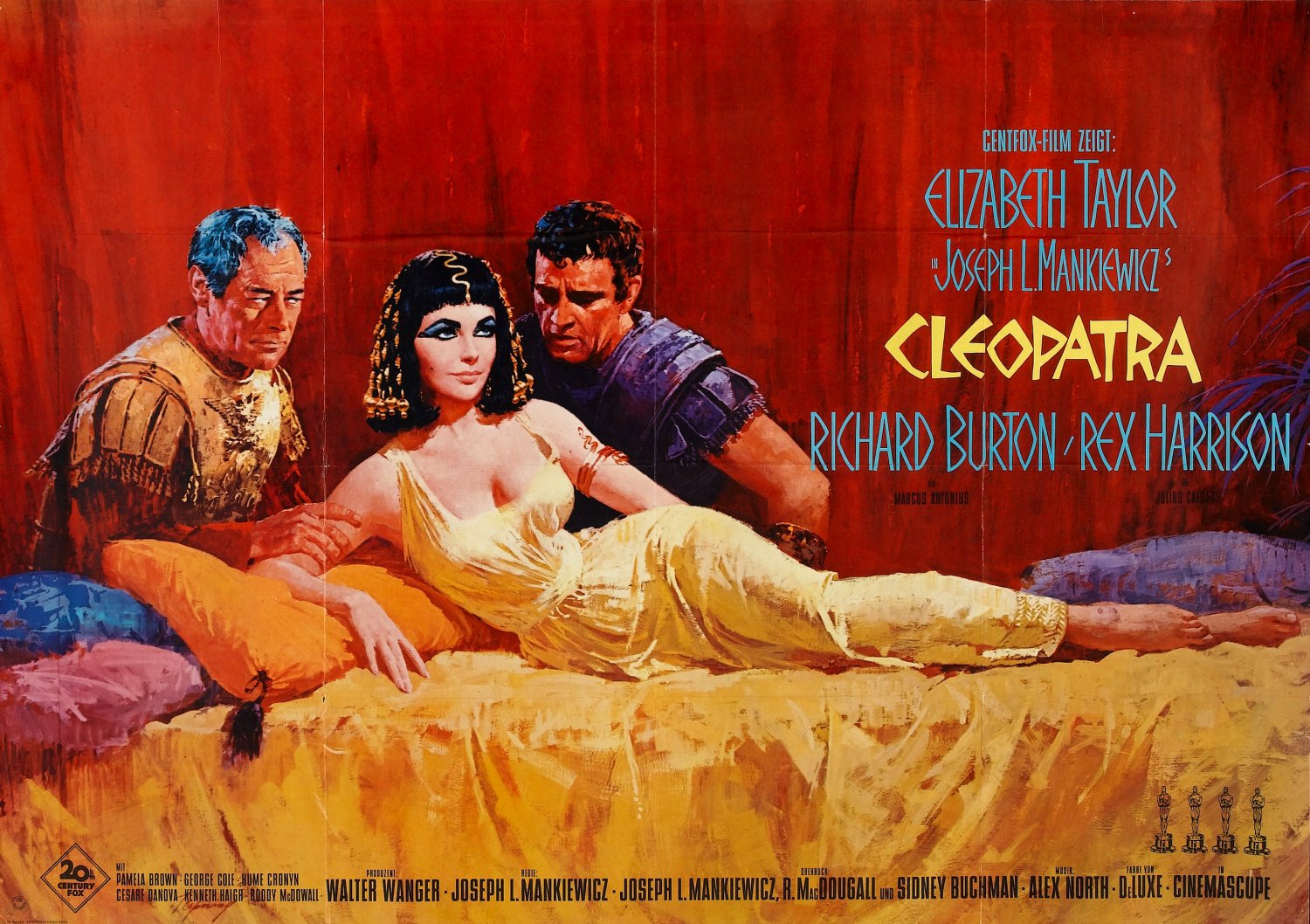
Row after row of plumed and armoured horsemen gallop into the Forum. Behind them, dozens of decorated chariots. Naked dancing girls whirling long streamers perform a decidedly risqué dance into the widening space. The crowds of bedazzled Roman citizens surge forward, entranced, and are forced back by the guards. Next come troupes of Sudanese warriors, and dancing Black Africans with great tufted head-dresses (of course, as according to the norms of 1963 Hollywood, these dancers look rather more like Black Californian dancers than the subject tribes of Lower Egypt). Feathered filmic fantasies on the theme of witch-doctors leap forward on giant stilts. A scantily dressed Nubian woman steals the scene for a moment, then disappears in clouds of coloured smoke. New rows of pharaonic guards march through the square bearing the great banners of Egyptian sovereignty. Showers of gold coin fall through the air. Suddenly the space is filled with beautiful girls with long, golden wings, pulling behind them a giant pyramid. Is it the queen? The show’s not over yet. The point of the pyramid opens and hundreds of doves fly up and away.
A military fanfare. The crowd is frantic. The new banners are made of dangling gold pieces and white plumes. Then come hundreds more Nubian slaves, pulling a great wooden harness. It’s not possible: a giant Sphinx of black onyx is slowly wheeled forward. At its mouth, gold steps lead up to a golden throne. Cleopatra, queen of Egypt, slowly descends to the feet of Julius Caesar. Her dress is a thousand golden feathers, with a crown and golden cloak to match. The Senate rises. The crowds cheer. Caesar nods. Will she? Yes, she will. She’s bending her beautiful head, bowing low before the entire power system of Rome. And as she rises, she closes one beautifully kohled eye at Caesar. First a submission, then a wink.
Byzantium is a vampire movie. Another one? I hear a collective sigh. After all, we have been inundated with movies of this genre lately, especially with Stephanie Meyer’s kind contribution to the cause ruining the genre for generations to come. Anyway, I feel I am straying off point here a little. In director Neil Jordan’s last vampire outing (Interview with the Vampire) we met Lestat and Louis, one a murderous, animalistic killer and the other a tormented soul. In Byzantium, based on the Moira Buffini play A Vampire Story, we meet Clara and Eleanor who bear a striking resemblance to their male counterparts. Byzantium focuses on the relationship between the mother and daughter vampire duo and their struggle for their very survival.
It had to happen eventually. Hollywood, or more accurately the half-dozen or so studios that make up the majority of its output, has seemingly realized that there might, just might, be more to life than turning every comic book that’s ever been doodled into a vacuous, overwrought blockbuster. The sixth installment of the Fast & Furious franchise is out this week. It will be a vacuous, overwrought blockbuster, too – but the right kind. And it could represent the rebirth of action cinema.
I say ‘could’, because it needs to make a giant pile of money first – and that’s why you need to go and watch it. Don’t go begrudgingly, though. If it’s anything like its predecessor, it promises to be an awesome, hair-raising mixture of preposterous car stunts, oiled muscly bodies and random bouts of artillery fire. And for some of us, that’s what cinema is all about.
Last week, we heard the news that Ray Harryhausen had died. In tribute to the stop-motion master, Mostly Film’s writers select their favourite moments from his illustrious career, and talk about what made his work so special. Did we miss your favorite? The comment box awaits you…




 MostlyFilm