The success of AMC’s The Walking Dead could be regarded as something of a mystery. At the end of its second season, it commands relatively stellar US ratings, is relentlessly zeitgeisty, and even has its own post-airing discussion show, Talking Dead – all the while featuring production flaws the size of shotgun-blasts to the torso.
And that’s being kind. This programme is shit. Shit on toast, shit on a water-biscuit, shit on grits, whatever grits might be. It is, by any measurable standard, a genuinely terrible programme. The premise is a genre cliché, the plotting is insane, the dialogue is like nails down a blackboard and the acting is truly laughable. I use that word with care – watch a few episodes and try not to emit long, deathless barks of empty faux-mirth on a regular and involuntary basis.
In this fourth and final part of MostlyFilm’s lookback at the 1983 BBC2 sci-fi season – of which you can read parts one, two and three by simply ‘clicking’ – we are left with what I was previously happy to call the dregs.
A harsh word, I know, but I’ll qualify that by saying that of the fifteen films on the list, they were the ones I wanted to revisit least. My reasoning was (as ever) decidedly shonky, but they seemed to be the pulpiest, the most familiar, the ones nearest to cultural touchstones. I know; boring, right? I’m supposed to be rooting out hidden gems here, not sitting down to bloody Invasion of the Body Snatchers for the zillionth time!
Of course, when I really thought about when I’d last watched all three of these films, rather than read about them, or talked about them, or referenced them – there was only one answer: the 1983 BBC2 sci-fi season. So preconceptions be damned, I reasoned, when sitting down with only an Xbox, a pile of dvd’s, a large bag of Jolly Ranchers and a look of steely determination. We’ve come this far together – last one to the finish-line’s a dirty, stinking communist.
Before its release in 1992, Twin Peaks: Fire Walk with Me was possibly David Lynch’s most eagerly-anticipated film yet. When it was released, it immediately became the most bitterly criticised work in his filmography. It has subsequently been re-evaluated by many, and now occupies a rather peculiar place in his body of work. A prequel to the TV series that Lynch co-created with Mark Frost, it was accepted at the time as forming part of the series’ narrative; but anyone thinking about watching the film for the first time in 2012 may never have seen a single episode of the TV show. If that includes you, please note that this article contains major spoilers. And also that the entire series is available on DVD.
The series was ostensibly about an FBI agent, Dale Cooper (Kyle MachLachlan) who is sent to the town of Twin Peaks to investigate the murder of a teenage girl, Laura Palmer; yet the whodunit element was only ever intended to act as a backdrop to the story of the town’s variously eccentric and/or sinister inhabitants. As the series went on, elements of outright fantasy were introduced, heralded by a much-spoofed dream sequence featuring a dancing, backwards-talking dwarf:
At first, the series was a phenomenon, but ratings took a nose-dive mid-way through the second season. Having revealed the identity of the killer, at the network’s insistence, the series floundered in a run of tedious episodes. The series found its feet again toward the end of the season, but too late to escape cancellation.
Like a lot of Twin Peaks fans, I was initially disappointed with the news that the film was to be a prequel rather than a continuation. We already knew what had happened to Laura Palmer; we wanted to find out what happened next, after the cliffhanger that closed the second and final season. But any new Peaks was better than no Peaks at all, so of course I went to see it.
With the announcement that the final Hercule Poirot stories will be filmed for ITV this year, confessed detective fiction bore and tedious cataloguer of ways in which the book was better than the film Laura Morgan wonders what we should expect.
Unbeknown to her, Agatha Christie had just come up with the plot for the pilot of Casualty
I have never been asked to appear on Desert Island Discs, but I have spent happy hours planning what to take with me, just in case Radio 4 should come knocking. My music choices change depending on my mood, but my book doesn’t: ever since I was nineteen, I have turned to Agatha Christie whenever I was ill, bored or miserable, and since banishment to a desert island is likely to involve all three, the Queen of Crime will be coming with me.
(I’m assuming that I will be allowed the complete works. If not, I’ll swap them for Shakespeare, the way you can swap the Bible for your preferred alternative.)
Christie’s stories have been adapted for screens both big and small almost since she started writing them, and while there have been a number of admirable Misses Marple, David Suchet’s 23-year tenure as ITV’s Poirot-in-residence has rendered everyone else’s efforts superfluous. Anorakish types like to tell a story of unclear origin about how Agatha Christie once saw a young Joan Hickson perform on stage and told her “I hope one day you will play my dear Miss Marple”. True or not, it’s pleasing to imagine that Christie could foresee how good Hickson would one day be as the gentle little old lady “with the mind of a sink”, but if Hickson’s Marple is a good likeness, Suchet’s Poirot is perfect: the character sprung from the pages of the books and brought to life. The fussy little walk, the enquiringly cocked head, even the accent, which ought to waver but never does: everything is spot-on.
So we should all be delighted by the news that ITV will be filming the remaining Poirot stories this year: five new episodes, from original stories of, to put it diplomatically, varying quality, which makes it all the more interesting to see what will be done with them.
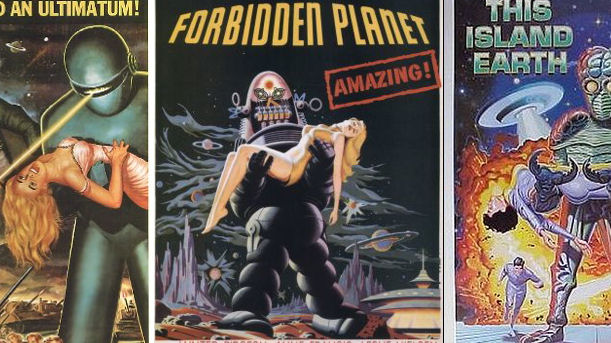
With seven films outstanding in our look-back at the 1983 BBC2 sci-fi season, should we perhaps turn from our never-ending vigilance against external dangers (such as wrenches and communists), and instead take some time to contemplate the monster that is Man himself? What lessons can we learn about our nature via these Technicolor messages from our own recent past? Well, if 1955’s Conquest Of Space is anything to go by, lesson #1 today is ‘religion is for unstable, murderous nutcases’, so thanks for all the pressing updates on that, Dawkins, you charmless little tit.
Produced and directed, respectively, by 50s sci-fi greats George Pal (who oversaw When Worlds Collide from Part 1) and Byron Haskin (who would go on to helm Robinson Crusoe on Mars, from Part 2), Conquest of Space might not be the oldest of the films we’ve rewatched, but it has a tone and feel of something made considerably earlier. Oh, and it’s loopier than a hipster’s earlobes, but have no fear – we’ll get to that.
It’s now almost twenty years since Sebastian Faulks’s novel Birdsong was first published and it comes as something of a surprise to realise that it has never yet been brought to the screen. It seems like a tale that’s ripe for adaptation, with its potent combination of passionate sex, the horror of the trenches, and book sales in the millions. Several versions have been proposed but none had come to fruition until so-hot-right-now writer Abi Morgan (who has two films, The Iron Lady and Shame, out this month in addition to Birdsong) and director Philip Martin adapted the book into two ninety-minute television episodes, beginning this Sunday, filling what is already described as the ‘Sherlock’ spot.
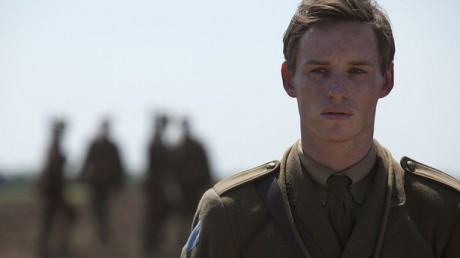
Stephen (played by Eddie Redmayne) is a young man visiting factory owner René Azaire to advise him on his textile mills in Amiens, northern France. He falls in love with Azaire’s wife Isabelle (a luminous Clémence Poésy) and they have an affair. Six years later, Stephen is a lieutenant in the trenches of the Western front in charge of a company of tunnelers responsible for mining underneath German trenches. The film flips back and forth between 1910 and 1916, contrasting the beauty and serenity of bourgeois Amiens with life in the trenches.
If this look-back at the 1983 BBC2 science-fiction season has a theme, it’s that if you’re a simple God-fearing man (or, to a lesser extent, woman), just trying to make his way in the world in the shadow of that first cracked atom, then whatever you do, for heaven’s sake give scientists a wide berth.
In nearly everything we’ve covered so far, men of science have either directly or indirectly been responsible for alien invasion, alien near-invasion, alien semi-invasion, or just alerting aliens to our existence so they can stage – yes! – an invasion. It’s almost as if American society in the 1950s went to bed at night afraid of sudden and total destruction from a massive yet amorphous enemy far away.
Not that such mattered to me, watching these films after my tea every Tuesday night for four months, a stripling of nine tender years. I’ve tried to revisit as many as I can, and I’ve found that it’s less the stories and the dialogue that have resonated over the ensuing three decades, but certain images, sound effects and colours.
It also sort-of explains why I blew up that government aerospace research lab that time, with everyone deliberately trapped inside. Goddamn good-for-nothing scientists.
Starting on 11th January 1983, and running over 15 weeks, BBC2 ran a branded season of sci-fi films on Tuesday evenings – crucially, for those who were 10 years old at the time, in that all-important between-tea-and-bedtime slot. Alerted to this by my father, who was always on the lookout for great films in front of which he could fall asleep, I sat on the floor and exposed my brain to far more strange and dangerous cosmic rays than could possibly have been good for me.
It was quite the grab-bag of movies, ranging from early-50’s schlock, late-50’s nuclear hand-wringing, psychedelic 60s romps, 70s paranoia and masses more besides. I watched them all. Little of their importance (or lack of) or legacy (ditto) meant anything to me at the time, but the joy contained in that long string of Tuesday nights still resonated in the back of my brain as an indistinct blur of space-ships, laser-beams and sudden stabs of orchestral menace. I’m not going to get all Nick Hornby on you here, but if I had to track down what kick-started my love for the genre, chances are I’d find it in a four-month excuse for a bunch of cheap repeats.
So when the subject came up in conversation recently, with similarly vague-yet-enthusiastic recollections, I felt it my duty to MostlyFilm – Europe’s Best Website – to revisit some of these half-remembered gems and bring them into sharp and unforgiving 1080p focus. And, I’ll warn you now, take the piss a bit.
Thomas Pratchett marks the, er, 48th anniversary of Doctor Who with some personal reflections.
On an October evening in 1987 I wandered into our small brown living room, in which our aged, four-channel, push-button TV was on. It was past six o’clock, so cartoons were long gone for the day, and I was seven, so whatever was actually on at that time usually never interested me. But what I saw on screen that night was different. A man was being chased by a white robot. What cool craziness was this on during the boring TV hours? I remember little else about it, but this was my first exposure to Doctor Who.
I love How I Met Your Mother. I love many TV shows, but this is something else, something serious. It’s not the best comedy on TV, but it might be my favourite. Yes, it’s a formulaic New-York set sitcom, about five friends, all attractive twenty/thirty-somethings. While it was marketed as, and, set-up like, a cheap knock-off of Friends, it’s a much better show.
For the record, I also love Friends, but How I Met Your Mother has pushed itself where the earlier show became lazy and bloated. The character development is consistent, and the comedy comes from the beautifully, intricately structured way in which we have got to know these people. There’s no equivalent to the ‘Rule of Tribbiani’ (in any given situation, Joey Tribbiani’s stupidity will expand to fill the available joke) and there’s a confidence and consistency to characterisation that has seen the show develop beyond any reasonable expectation that anyone might have initially had.
It’s not that there aren’t bad episodes of How I Met Your Mother: some 145 shows in, it would be incredible if there weren’t, but the worst episodes are a victim of their ambition. To explain that, I have to go back to the beginning, somewhat, which is kind of a Future Ted thing to do.




 MostlyFilm
