In the first of today’s two LFF updates, Ricky Young reflects on a handsome restoration of an ugly film
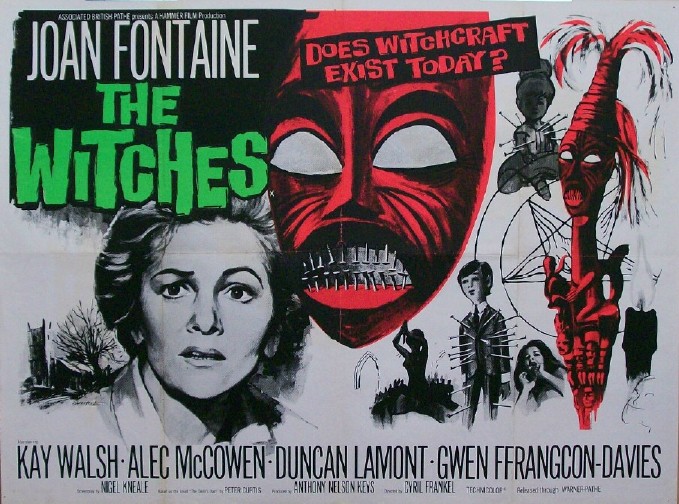
Today sees the LFF unveiling of the restored version of overlooked Hammer potboiler The Witches. Directed by Cyril Frankel and written by Nigel Kneale, it stars Hitchcock Oscar-winner Joan Fontaine in what would turn out to be her last cinematic role.
The Witches rarely gets much of a mention when discussing Hammer’s output – none of the big Hammer names or stars are involved – and despite the admittedly glorious-looking restoration, it’s not hard to see why. Even at their tackiest, the Hammer greats always had a spark of audience-pleasing oomph at their core. The Witches’ most exciting moment features six seconds of runaway livestock. Make of that what you will. Continue reading London Film Festival: The Witches→
The LFF opens to the public on Wednesday. Gareth Negus introduces a few films showing in the first week
The Strange Colour of Your Body’s Tears
Written and directed by Hélène Cattet and Bruno Forzani, this, like their debut Amer, is an art film that plays with the imagery of the giallo – the Italian horror sub-genre whose best known exponent is Dario Argento. If you’re unfamiliar with the form, this film may well be a bit baffling. If you are, then … it might still be a bit baffling.
The apparent plot centres on Dan Kristensen (Klaus Tange), who returns home to find his wife missing. His efforts to find her lead him to a room on the seventh floor, where a mysterious woman tells him this is not the first disappearance in the building. Things get progressively weirder, involving childhood flashbacks, and numerous murders.
The apartment building with hidden secrets recalls the sinister complexes of Argento’s Inferno; I also spotted visual and narrative references to The Bird with the Crystal Plumage, Deep Red and Tenebrae (those better versed in Italian horror can doubtless list many more). But while many Argento films have a loose grip on such trivia as logic and character motive, they do have actual plots behind their elaborate murders and lavish images; Strange Colour seems uninterested in such things. Cattet and Forzani frequently cut abruptly between scenes, often with a character waking up in a manner to suggest the preceding events could have been a dream. (Indeed, the film starts with the camera closing in on Kristensen’s closed eyes, as though to suggest the whole film may be taking place inside his head). As a lead character, he is frustratingly blank; it is impossible for the audience to feel much empathy, or even interest, in his bizarre plight.
Clearly, narrative is not the point in a film like this; it’s purely an art film, a visual and auditory experience that isn’t designed to be watched for the story. I don’t mind being baffled by a film, but by the halfway point I reluctantly concluded that I was also really quite bored. It is stunning to look at, beautifully designed and lit, and the directors come up with numerous images as impressively wince-inducing as anything in Argento’s back catalogue; but it feels like little more than a clever, elaborate tribute act.
Part of an occasional series in which Spank The Monkey travels to foreign countries, watches films in unfamiliar languages, and then complains about not understanding them
“I’m a man on the move,” says Sir Les Patterson at the start of his book The Traveller’s Tool: “I wouldn’t have had two shits in the same toilet.” I can’t say that I get about as much as the Australian Cultural Attache, but from the path I’ve taken in previous Monoglot Movie Club articles – the Netherlands, Brazil, UAE, Japan, Norway, Belgium, Sweden, Finland – you might have got the impression that I get to visit a country once and once only, before they chase me out of town and bar me from ever entering it again.
Happily, that’s not the case. To prove it, I went back to Sweden last month, in a return visit that had much warmer weather than my previous one in January (see illustration above). Back then, there was a sudden upsurge in interest in Swedish cinema, thanks to the Guldbagge film awards being announced: lots of local movies in theatres, many of them selling out. In the summer months, the Swedes appear to be watching all the same summer blockbusters as the rest of the world, but I still managed to catch a couple of bits of local product for your entertainment and my bewilderment. Continue reading Monoglot Movie Club: Stockholm Syndrome→
Richard Curtis has a new film out and it’s very good. Yes, it is.Ron Swansonreports.
“Time present and time past are both perhaps present in time future, and time future contained in time past.” Domhnall Gleeson and Bill Nighy wrap their heads around a chronological paradox. With hilarious results.
It’s nicely in keeping with Richard Curtis’ films’ apologetically stylised view of England that I’m tempted to start this positive review of his new movie, About Time, with an apology, or more accurately, a justification. It’s tempting to put my emotional reaction to his film down to the fact that I’m a sucker for this kind of thing, or that I was having a bad week, or that the idea of time travel has always made me want to cry. If I knew how to winsomely stutter in print, I would totally give it a go.
As it is, no justification is needed. It may seem like trifling praise indeed, to claim that About Time is Curtis’ best film, but I like Four Weddings, Notting Hill and Love, Actually quite a lot, and this absolutely soars past them. While it may benefit from the lowered expectations caused by the clusterfuck that was The Boat that Rocked and an insipid and oddly charmless trailer, this is a film that makes me hope there’s more to come from Curtis. Continue reading Clock This!→
Federico Fellini’s Satyricon gets a rare public screening in London next week.Niall Anderson welcomes it back.
Lights! Minotaur! Action!
Little dates faster than cinematic representations of the future; except perhaps cinematic representations of the past. Federico Fellini’s Satyricon (or, to use its pettifogging official title, Fellini-Satyricon) is ostensibly set in and around Nero’s Rome, but it couldn’t be more 1969 if it quoted Shelley while opening a big hamper of dying butterflies in Hyde Park.
A rarefied episodic adventure involving witches, cannibalism, mutilation and at least one character becoming a god, Satyricon is so committed to modish 60s estrangement techniques that the viewer is sometimes distracted from what’s really strange about it. Not the nudity, the gore, the jump-cuts, the spikily intrusive score, or the scenes that end mid-sentence; rather the bizarre calmness of the cinematography and a casual scenic beauty that constantly upstages the actual drama. Satyricon doesn’t play these aspects off against each other so much as it keeps piling them on, layer after layer. For all the deliberate dreamlike elaboration of its technique, Satyricon comes across as a very different dream to what Fellini may have intended. Continue reading A Science Fiction of the Past→
Mostly Film writers recall their fleeting experiences at the business end of filmmaking
Indy Datta
Tacita Dean’s ‘Film’ in a film. META.
So my mate Gavin was making a film, and he asked me if I wanted to be an extra in one scene. Obviously, when the call came I had been hoping to hear that his star, Kris Marshall, just wasn’t measuring up, and, he’d been thinking – and this was so crazy it just might work – but did I think I could possibly pretend to be in love with a beautiful French actress (Annelise Hesme) just for the duration of a wistful romantic comedy but, sadly, no. Still, as my drama teacher always said, possibly, there are no small parts, only small actors. Maybe this could be the start of something big.
Emma Street explains why Ben Wheatley’s new film is – and isn’t – like The Breakfast Club
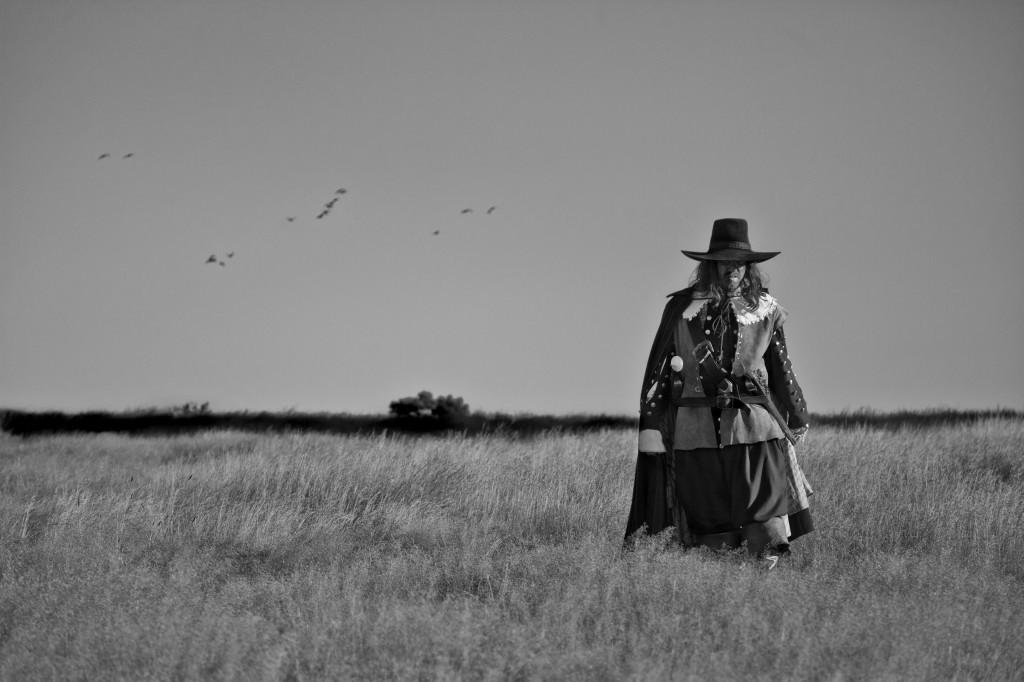
Michael Smiley in A Field In England
Ben Wheatley’s A Field in England was released last Friday across all platforms with the possible exception of kinetoscope. Viewers were offered the option of watching the film at the cinema, on DVD, via digital download or by tuning in to Film4 at 10:45 where the whole thing broadcast without ad breaks.
I dipped my toe in the multiple release formats experience by watching it first on television on Friday night and then seeing it on the big screen on Sunday at the ICA. This showing was followed by a question and answer session with director Ben Wheatley and actor Reece Sheersmith, who stars in the film and is better known as one of the League of Gentlemen. In this session Wheatley discussed how he chose to shoot the film chronologically in order to allow the actors the opportunity to grow with their characters. He also shared his thoughts on the cinematic advantages of shooting in black and white – how it prevents viewers becoming distracted by attractive scenery or costumes and focuses attention on character’s faces. Black and white footage, he says, also highlights dirt and grime.
In which case, he certainly achieved the look he was going for. The images that remain with you after watching A Field In England are the moods, reactions and suffering written on the protagonists’ faces and the grubby muddiness of their surroundings. Continue reading Smiley’s People→
Gareth Negus, Matthew Turner and Sam Osborn report from the 2013 Edinburgh International Film Festival.
Leviathan
Gareth Negus
The 2013 Edinburgh International Film Festival followed a successful first year for Artistic Director Chris Fujiwara.
Perhaps I ended up seeing the wrong films (with 100+ features and short programmes, it really wasn’t possible to see everything) but I felt the programme was a slight disappointment after last year. A lot of this was down to the underwhelming opening and closing films. It’s clearly not easy to select the perfect films for these slots: they need to balance commercial appeal with star quality for the red carpet press photographers, while maintaining a degree of artistic credibility. So Breathe In, the opener, probably seemed like a good bet: co-star Felicity Jones available for pictures, from the director of the well-reviewed Like Crazy, and an accessible subject matter. Unfortunately, though well photographed and nicely played by Jones and Guy Pearce, the story – middle aged musician and family man finds his mojo revitalised by a younger girl – was a very familiar one, and the film did nothing new or interesting with it.
Indy Datta takes a look at the new BluRays of Ghibli’s Grave of the Fireflies and Kiki’s Delivery Service.
After the recent theatrical run for the 1988 Ghibli double bill of Hayao Miyazaki’s My Neighbour Totoro and Isao Takahata’s Grave of the Fireflies, today sees the release of a slew of Studio Ghibli titles in DVD/Blu-ray dual format editions. I was lucky enough to score review copies of Fireflies and Miyazaki’s follow-up to Totoro – Kiki’s Delivery Service. Thoughts on the films and the discs after the jump.
Part of an occasional series in which Spank The Monkey travels to foreign countries, watches films in unfamiliar languages, and then complains about not understanding them
You’re so sadly neglected And often ignored A poor second to Belgium When going abroad Finland, Finland, Finland The country where I quite want to be
– Monty Python, Finland
Quick! Name a famous Finnish film director. I’ll give you bonus points for lateral thinking if you said Renny Harlin, but arthouse cinema fans will probably have plumped for Aki Kaurismäki. Sadly, I didn’t get to see any of his movies on my recent visit to Helsinki, but it’s hard to avoid the man’s presence, particularly if you’re the sort of person that eats food. The Belated Birthday Girl and I kept ending up in restaurants that were either patronised by the director (the menu at Kosmos includes ‘Pike perch with Lobster Sauce and Crayfish Tails au Gratin à la Aki Kaurismäki’), or owned by him. Of the latter, Zetor is probably the best one to go for, with its tractor-heavy décor and its patriotic blueberry pie served in a tin mug, as seen above.
Still, you have to assume that Finnish cinema doesn’t begin and end with Kaurismäki. So I made it my mission, as ever, to track down a couple of the latest domestic releases, and attempt to watch them without the benefit of English subtitles. Good news for all you lovers of schadenfreude: one of these turned out to be Monoglot Movie Club’s first complete failure. Continue reading Monoglot Movie Club: A Poor Second To Belgium→





 MostlyFilm