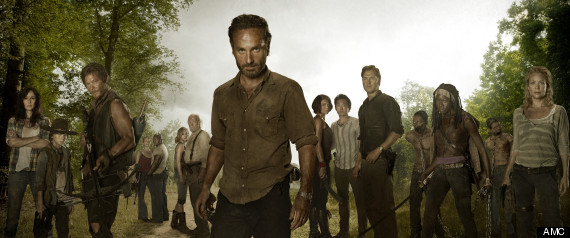
When we last talked about AMC’s The Walking Dead on MostlyFilm, we spent most of the article agog at how a programme so filled with desperate and throbbing flaws could continue to be such a mega-hit.
Make no mistake – and broadsheet media-section column inches be damned – this is by far AMC’s biggest show. Yes, they have Mad Men, of course, watched by Mark Lawson, Mark Lawson’s cat, Mark Lawson’s commissioning editor and absolutely nobody else. They had Breaking Bad, which managed a degree of cultural significance by repackaging the good bits of The Shield half-a-decade later, and whose ludicrously hype-drenched finale was watched by a supposedly epic 10.3 million viewers.
Want to know something? Thirteen out of The Walking Dead’s sixteen third-season episodes beat the ass off that. More people regularly tuned in to watch Egg out of This Life get chased by golems again than could be bothered finding out what ended up happening to Walter White. (Spoiler: He returned to his own planet.)
People sure do love the heck out of zombies, it seems. But, like a creeping, tenacious infection, spreading from a single starting point and extending its influence into multiple parts of the whole, this year The Walking Dead showed signs of an extremely worrying and unexpected new symptom.
In the first of today’s two LFF updates, Ricky Young reflects on a handsome restoration of an ugly film
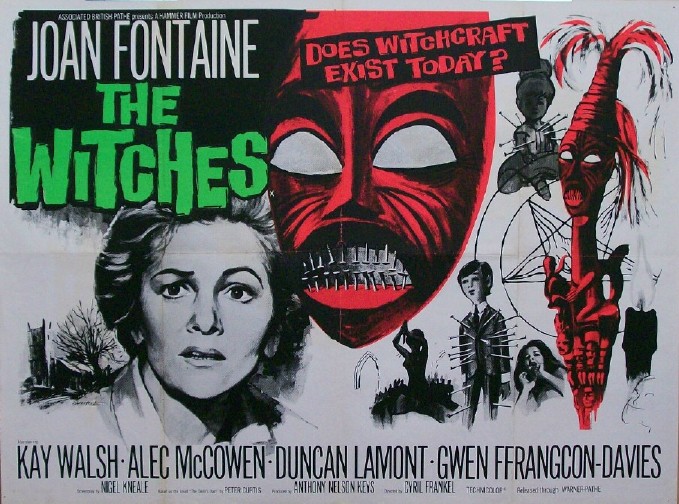
Today sees the LFF unveiling of the restored version of overlooked Hammer potboiler The Witches. Directed by Cyril Frankel and written by Nigel Kneale, it stars Hitchcock Oscar-winner Joan Fontaine in what would turn out to be her last cinematic role.
The Witches rarely gets much of a mention when discussing Hammer’s output – none of the big Hammer names or stars are involved – and despite the admittedly glorious-looking restoration, it’s not hard to see why. Even at their tackiest, the Hammer greats always had a spark of audience-pleasing oomph at their core. The Witches’ most exciting moment features six seconds of runaway livestock. Make of that what you will. Continue reading London Film Festival: The Witches→
Few things are certain in life, but one thing is for sure: Zoë Ball cannot start a sentence without preceding it with that weird teeth-sucking-then-“er” sound she makes. As a nation, we had forgotten quite how annoying it could be. But on Sunday night, for reasons likely to be forever lost to all of space and time, she was chosen to introduce the bizarre one-off special Doctor Who: Live – The Next Doctor, and we all got to be really quite irritated by it again, together, as one.
Yes, Peter Capaldi’s the next ‘Doctor Who’, lead character in the BBC’s television programme Doctor Who. It’s a bold move – brave, even. It’ll shake up a show in desperate need of being thrown into a completely different direction, and it might even raise the prospect of Capaldi using his Oscar to belt Steven Moffat across the face in an ‘I’m not saying this shit’ incident, which even if it never actually happens will forever exist in my head. In fact, I’m thinking about it right now. And again now. No, hang on…BAM! There it goes again!
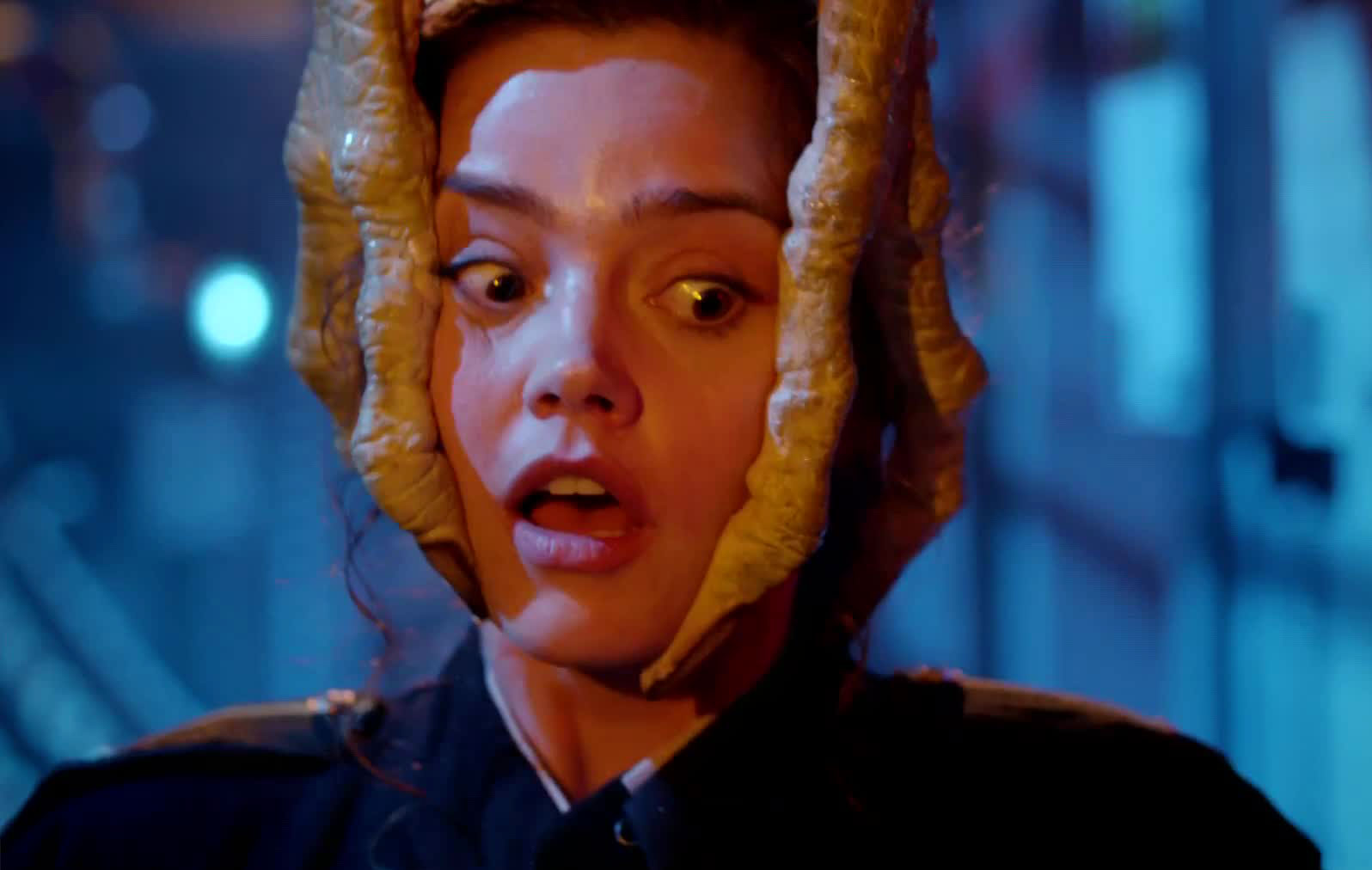
From the moment the 11th Doctor crashed into Amelia Pond’s garden while still wearing the 10th Doctor’s suit, Doctor Who has existed in a dream-world. The very first person he met was unhooked from reality, without origin or backstory, sitting on a crack in time and ready for her first chapter title; she wasn’t a real girl, she was The Girl Who Waited. From that point on, we’ve been shown a woozy and off-kilter version of reality, where things only made sense if they really, really had to, and exists a million miles away from the council estates, shopgirls and urgently-flickered news-broadcasts of the previous era. Doctor Who has certainly never been world you visit for unflinching docu-realism, of course, but the self-conscious focus on ‘stories’, meta-stories, and the consequences of myths and fairytales has led to an airless and looping feeling where nothing moves forward, nothing changes, nothing ends and nothing ever truly dies.
When MostlyFilm last talked aboutDoctor Who, immediately after the loud, deeply-unsatisfying semi-mystery that was the departure of the Ponds, we hoped that fans of loud, deeply-unsatisfying semi-mysteries would have had their fill by now, and that the audience, the actors, the production team and show-runner Steven Moffat could move on from loud, deeply-unsatisfying semi-mysteries into a new and exciting phase of The Programme That Can Be Anything. (After all, we’re not haters for the sake of it – we thought S5 was pretty damn good.)
What fools we were.
Season 7b existed as little more than another loud and deeply-unsatisfying semi-mystery, its final moments setting up yet another loud and probably deeply-unsatisfying semi-mystery as a 50th birthday present. Shh, though. MostlyFilm has angered the show-runner before, and an angry Steven Moffat isn’t anything we ever want to experience again.. Continue reading Trans-mundane Emanations→
As we join the start of another school year in suburbia, François Ozon opens his film Dans La Maison (In The House) with a clean and crisp montage of modern architectural lines, frosted glass, polished corridors, and crushing normality. In the first staff meeting, Germain (Fabrice Luchini – a shuffling, ill-dentured turtle of a man) learns that even with regards to the students’ dress, uniformity of thought is making a big comeback. A failed novelist and only-mildly-engaged literature teacher, we watch him deflate further than even he thought possible, then waddle off to his first class to set the traditional ‘What I Did This Summer’ paper and wait for the day to be over. His story ended some years ago, we imagine.
Marking his papers at home, however, he finds a surprisingly fruity submission from a new wrong-side-of-the-tracks pupil, Claude Garcia (Ernst Umhauer – like a fresher James McAvoy, but without that constant worry that his nose is about to drip), detailing his desire to get inside the house of a class-mate, for purposes as yet unknown. The essay ends with ‘To Be Continued’, leaving Germain and his art-dealer wife (Kristen Scott-Thomas – doing that suspicious ‘speaking-French’ thing again) hanging with a mixture of unease and prurience that threatens to spice up their comfortable yet boring existence. If, that is, they choose to let it.
On the first day of filming the new series of Lewis, Kevin Whately smiles for the camera.
SPOILER WARNING: If worried about Skyfall spoilers, then either go to the cinema and see Skyfall, or sit down and take a long, hard look at your priorities in life.
——
There’s a moment in Skyfall where the villain unhooks half his face. The remaining rotten bridgework peers out and half his cheek falls away, skin stretching in a cadaverous fashion. At that point I found myself thinking – this film needs to stop messing around and have him go full-zombie, right now.
He didn’t, of course, and therein lies much of the problem with the new James Bond film. Nobody does much of anything exciting, and what they do end up doing is so low-wattage and for such low stakes that by the time it becomes clear that we’re witnessing a half-arsed series reboot, two movies after the last half-arsed series reboot, it makes you wonder that if they can’t be bothered, why on earth should we?
Oh, it’s not a disaster, by any means. Skyfall is put together competently, hits the majority of the beats it aims for without boring your tits off, and nothing jumps out of the screen shrieking ‘GAZE NOT UPON THIS TURKEY!’ like, say, Avengers Assemble. However, it’s defiantly not the return to form that preview audiences breathlessly rushed to their computers to praise to the heavens.
But if you start thinking about that question of form, then you’re left reflecting that in a 50-year, 23-film series, there’s only actually ever been five good ones. So, was anyone really expecting otherwise? Or is the prospect of a genuinely copper-bottomed feel-good Bond success so seductive that people are willing to kid themselves that they just saw something brilliant, when it’s clear that they didn’t?
The first table-read of ‘The Angels Take Manhattan’ goes as well as expected.
The Ponds throw themselves off a building, and appear alive in a familiar graveyard. For some reason.
Amy Pond: “Why always here?”
The Doctor: “Does it matter?”
—
Alright, I’m through with playing nice.
Here at Europe’s Best Website, our journey talking about Doctor Who began at a fortuitous moment – the Russell T. Davies era had wheezed its last and every fanboi’s wish had somehow come true; Steven Flippin’ Moffat had taken over as Executive Producer! In a genre far more inured to disappointment and mediocrity, here was an aligning of planets that just didn’t seem real – the writer of some of NuWho’s best-regarded moments being handed the reins of the BBC’s flagship show, to bend to his considerable will.
We tracked the first two of Moffat’s series; celebrated the highs, tutted at the lows, and ended last year with the hope that, having got a few issues with self-importance out of his system, the newly low-key Doctor could return to being quirky and fun and serious and clever and scary and exciting i.e why we still love it, 49 years after it began.
But, no.
If you happened to see Moffat being presented with a Special Achievement Award at this year’s BAFTA’s (where it was abundantly clear that if he were in fact made out of delicious chocolate, the entire audience was going home hungry), or touched upon his now-infamous ‘The Tweeter’ presence (Sample tweet: “Thanks for saying nice things about me! If you said a bad thing about me, I’m calling the police!”), you could be forgiven for pondering quite how much of his not-inconsiderable talent is in thrall to his not-inconsiderable ego.
Three months after the announcement of Moffat taking over Doctor Who, it was announced that he would also be acting as Co-Executive Producer and sometime writer on the BBC’s new version of Sherlock, in which the classic Victorian detective would be reincarnated for our times as a boring, bug-eyed bell-end. Cleverly, each broadcast of the second series seemed to hit the airwaves with a new and rediffusable form of Holmes’ beloved cocaine, such was the rapture that greeted the three episodes of arch, incoherent filler – indeed, discussing on the internet how Sherlock survived his final plunge became one of this year’s most short-lived sensations, up there with ‘caring about sport’, and that Korean man who thinks he’s a horse.
Perhaps it’s unfair to suggest that Moffat could be spreading himself too thin – I do not, after all, know the man and the demands of his work-life in the slightest – but since the first five episodes of Series 7 represent the weakest gruel since the show came back in 2005, am I mad to ask for fewer damn ‘tease-words’ about next year’s Sherlock, and more of the juice that made Series 5 such a pleasure?
So, let the half-hearted, whey-faced griping begin!
If MostlyFilm was a giant robot, and the 1983 BBC2 Sci-Fi season was an unsuspecting Californian coastal town, then the former’s recent march through the latter may have left some wreckage behind.
‘Curse you, M05tlyF1lm!’ the surviving townspeople would shout at the departing metal colossus, fists aloft. ‘These were good ideas you’ve just trashed! Some of them were great ideas! Yes, not every production was a gem, granted, but how will we nourish our imaginations now?’
M05tlyF1lm would stop in his tracks, swivel his giant robot bonce around 180°, and bark out an order in a distressing grate:
###-REMAKE THEM-###
‘But there are surprisingly few straight remakes of the fifteen films on the list, M05tlyF1lm! Alright, Invasion of the Body Snatchers has been remade three times, and some argue that Innerspace could be regarded a technical remake of Fantastic Voyage, but we tried sitting through that recently and there’s no way it’s going on the list. It’s actually nothing like the original’
###-ALSO, SCHTICK OF MARTIN SHORT TOO TOXIC TO TOLERATE ON BIG SCREEN-###
‘Phew, ain’t that the truth. So, that’s the only way to rebuild our town, is it? By taking a discursive and flippant look at how three of our cherished sci-fi landmarks were later treated by other film-makers? Because, I have to say, this metaphor’s stretched enough as it is.’
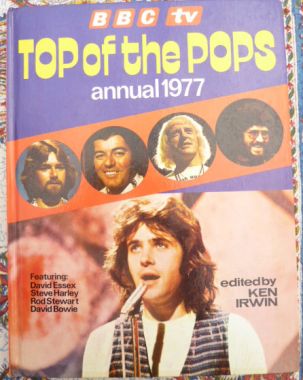
Europe’s Best Website plunges into the world of telly only rarely, (as goodness knows every single show that goes out over the ether gets recapped up the wazoo these days, for good or bad) but for this correspondent, the very best thing on the box in the last twelve months has been the weekly 35-years-ago Top of the Pops repeats on BBC4. Pre-’76, the archive was swiss-cheese at best, with dozens and dozens of shows lost to the ages, but when we joined what looks like a considerable on-going project , the gaps were narrowing down to insignificance.
The ‘Pops gets a hard time from the Nostalgia Police, thanks to the gruesome later incarnations and Steve Wright’s voiceovers on the generally-emetic TOTP2. But there was a time when it was always there, always grinding out the chart on a Thursday and heralding the weekend in the best fashion possible. Back when its broadcast rules (highest climber, highest new entry, number one, non-movers only after four weeks, no fallers unless they rose again and beat the previous position etc) emanated from the old-school Light Entertainment honcho who had no agenda other than reflecting the pop singles of the day. Unfettered pop!
The success of AMC’s The Walking Dead could be regarded as something of a mystery. At the end of its second season, it commands relatively stellar US ratings, is relentlessly zeitgeisty, and even has its own post-airing discussion show, Talking Dead – all the while featuring production flaws the size of shotgun-blasts to the torso.
And that’s being kind. This programme is shit. Shit on toast, shit on a water-biscuit, shit on grits, whatever grits might be. It is, by any measurable standard, a genuinely terrible programme. The premise is a genre cliché, the plotting is insane, the dialogue is like nails down a blackboard and the acting is truly laughable. I use that word with care – watch a few episodes and try not to emit long, deathless barks of empty faux-mirth on a regular and involuntary basis.




 MostlyFilm