Dene Kernohan asks: Is Ben Elton’s new sitcom the worst ever made?
I smell a hit.
“For me the sitcom is the holy grail of comedy writing, the toughest discipline but also the most rewarding” – Ben Elton, April 2013)
The Wright Way (BBC One, Tuesdays 10.35pm) is a new Ben Elton studio sitcom about Gerald Wright, the by-the-book head of a local council Health and Safety dept. (David Haig). Stylistically similar to The Thin Blue Line, Elton’s mid-90s ensemble series set in a police station and also featuring Haig, it aims to have some fun with today’s health and safety-conscious culture.
“What’s wrong with you, have you gone mad?!” – A good friend of mine when I told him that I was going to volunteer for Sundance London.
I’m an avid fan of Sundance Film Festival in Park City, Utah. To me, the line-up announcement is more exciting than Christmas and for ten days in January, the incoming film reviews become the equivalent of my morning newspaper. I read up on interesting new filmmakers and keep my eyes peeled for the titles that make it over to the UK.
So when Sundance announced an additional festival in London last year, I had to go. As expected, it fuelled my addiction and by the end, I didn’t want to leave. But what I didn’t expect was the army of volunteers on hand to guide me through it. I hadn’t given much thought as to how a festival of this size would operate and I was intrigued, so as soon as Sundance London 2013 was confirmed, I put my name forward to volunteer.
I got picked and this is what happened (more or less)…
The second Sundance London Festival took place in the 02 from 25-28 April. Mostly Film regulars Phil Concannon and Gareth Negus were there; here’s a taste of what they saw.
You’re asking for trouble, making claims like that.
It was inevitable that a remake of TheEvil Dead would open itself up to criticism and comparisons from fans of Sam Raimi’s cult 1981 original. Did we really need to be worried? As it turns out the answer is no. The feature debut of Fede Alavarez, who was chosen for the task by Sam Raimi, the new film is simply titled Evil Dead.
As in the original, the story focuses on five college-aged friends who travel to a secluded cabin in the woods. However in this new adaptation, the isolated location has been chosen to support Mia’s attempts to detox. The cabin is owned by the parents of siblings David and Mia and, although now dilapidated, contains lots of warm and comforting memories for Mia. Or so it seems… Fairly early on, after the discovery of something untoward in the basement along with a strange item, The Book of the Dead, it becomes apparent that things are not all that they seem – and that there is worse to come.
The Digital Intermediate process, known as DI, has been around in cinema for over a decade now. Basically, it is the transfer of filmed material to the digital realm, allowing for total control of the image in post production, especially with regards the colour palette. Traditionally it is an expensive process (10 years ago, around $200,000 for a feature film) and involved scanning the film in its entirety. But as film itself has become all but obsolete, this part of the process is unnecessary and digital grading has become more widespread. Continue reading Digital Grading: cinema and the blue rinse brigade→
I admit, I’ve moaned about Birds Eye View Film Festival in the past. Sometimes because I didn’t feel that the programming was very adventurous, but mainly because they kept offering me chocolate as an incentive to hand in my feedback form, (I like chocolate, but this is a film festival, why not something film-related?!).*
But this year, things are different. With a new Creative Director on board, (Kate Gerova, formally Head of Distribution at Soda Pictures), they have an edgy line-up of films that I really want to see, from a region undergoing massive change. I’m amazed that some of these films actually exist.
The Festival runs until 10th April at BFI Southbank, The Barbican, ICA and Hackney Picturehouse with a programme that includes 6 features, 9 documentaries, several short and silent films from countries across the region – Algeria, Egypt, Lebanon, Morocco, Palestine, Saudi Arabia and Syria. Some of these films may never screen in the UK again. I urge you to go and see them.
These are some of my favourites…
*I did complete a feedback form with exactly that feedback on it. I didn’t win the chocolate.
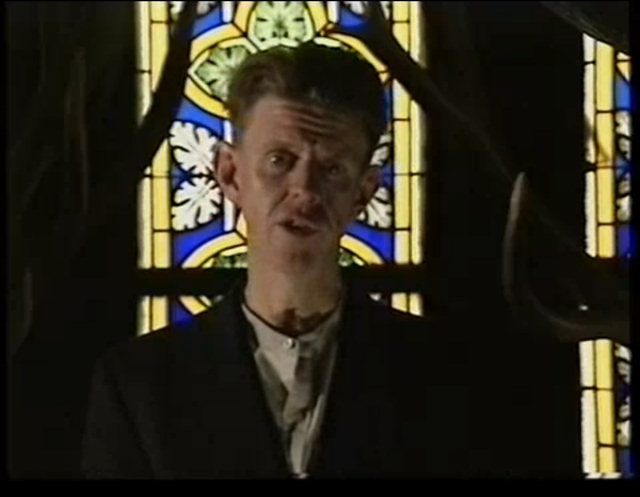
Alex Cox’s big loomy head – a late-night BBC 2 fixture
Moviedrome! You either remember it or you don’t, but if you do you’ll never forget it and if you never forget it, it will stay with you forever, which is how memory works. Late on BBC2, Alex Cox’s gnarled knuckle of a head would loom out at you and introduce a film so mind-blowingly obscure or spine-tinglingly brilliant it would impress itself into your unconscious brain and lodge there like a bit of popcorn in a tender gum. In later years it would be Mark Cousins on loomy head duty, but there’s little doubt that Cox is the classic loom-monger for most. It was fertile ground for our writers, and here we present some memories of both the films and their unique, treasurable presentation…
When you said ‘let’s cover Kate Bush’, this wasn’t what I had in mind…
Usually on Mostly Covers I fixate, sorry focus, on one great song and some of the more interesting interpretations of that song by artists; some great and some not so great. This time I am changing the format. This time I am looking at one artist and focusing on five of her better known songs. That artists is Kate Bush and those songs are; Wuthering Heights, Running Up That Hill, Cloudbusting, Babooshka and Hounds of Love.
Why, you may well ask, the change in format? Well in honest truth it is because I am greedy and yearn to share.I could, it is true, have focused solely on Wuthering Heights, which has generated the most cover versions (take a gander on YouTube if you like, there are hundreds and the majority are at best karaoke or, if you’re a little less kind, just plain old godawful), but I just couldn’t resist sharing a few other favourites that I felt were worthy of your attention. So here I am indulging myself, and I hope you, by providing you with a schmorgasboard of my favourites, with a couple of “special” curiosities as well – after all Mostly Covers wouldn’t be Mostly Covers without them.
When ABC’s Pan Am crossed the Atlantic in the fall of 2011, a Radio Times cover asked us if we were ready for the mile-high Mad Men and, in a move that her character Maggie would have frowned on, Christina Ricci invited us to fly her. On the face of it, there are some similarities with Mad Men: both shows are set in the 1960s with high production values and attention to period detail, but that is where the similarities end.
It’s International Women’s Day – yes there is, it’s on the 19th of November – and last year we celebrated with a look at some of the women who had defined cinema in front of the camera, decade by decade. This year, we thought we would go behind the scenes, paying no attention to the man behind the curtain, and look at those perhaps less celebrated women who have shaped film from the back rooms.




 MostlyFilm