Category Archives: Actors

Rearranging the Furniture

by Jen Corcoran

Lena Dunham in Tiny Furniture

Lena Dunham: if you don’t know her name already, you soon will. The 25 year-old Manhattan based film-maker is currently the focus of intense media attention from blogosphere to broadsheet as her Judd Apatow-sponsored TV series Girls debuts on HBO over in the US. Meanwhile, Dunham’s wildly acclaimed breakthrough feature Tiny Furniture (2010) finally gets a release in the UK this week, exporting her brand of naturalistic, female-led comedy across the Atlantic.

Lena Dunham’s accelerated rise through the Hollywood food chain has met with adulation and condemnation in equal measure. With a dozen YouTube shorts and one micro-budget feature, Creative Nonfiction, under her belt, Dunham was barely out of college when Tiny Furniture won the Best Narrative Feature prize at South by Southwest Festival. Starring the writer herself as Aura, a disillusioned graduate who returns to New York and moves back in with her mother and sister, the film is an unashamedly personal, self-parodying exploration of what it means to be young in the post-Millennial era.

Continue reading Rearranging the Furniture

Yesterday’s Men

by FIONA PLEASANCE

George Valentin - Georges Méliès
The gorgeous Georges.

I know what you’re thinking.  You’ve clicked on a link, and now there’s a sinking feeling in the pit of your stomach.  “Oh no,” you sigh, “not another bloody article about those retro-juggernauts, The Artist (2011) and Hugo (2011) and what it all means for Hollywood.  That’s so last month!”

Well, perhaps.  But as a teacher of film history, I hope that I can offer a slightly different perspective on the films as far as their historical accuracy and their contemporary significance are concerned.

Let’s start with The Artist which, having fictional characters at its heart, brings fewer concerns with it.  George Valentin, Peppy Miller and Kinograph Studios never existed, but the film takes place at one of the most interesting and extensively documented periods in cinema history.  The conversion process from silent to sound cinema made – and, yes, broke – a number of careers, so it encompasses many elements which Hollywood itself loves so much, particularly meteoric rises and dramatic falls from grace.

Continue reading Yesterday’s Men

Feminine Iconology, Part Two

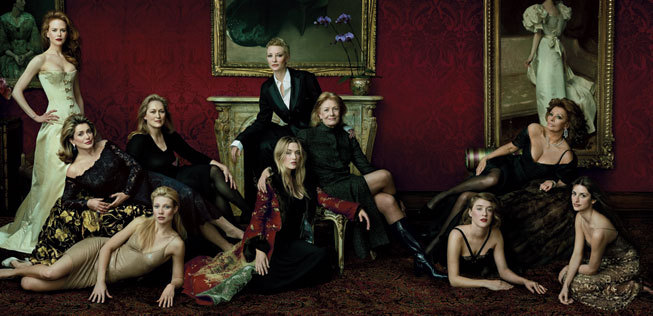
Image for Vanity Fair by Annie Leibovitz

Yesterday we brought you the icons of the silver screen from the Golden Age: one writer, one actress, one decade. You’ll have to imagine that a single person can represent an entire gender for an entire ten year span. Bear with us on that.

Today we move through Hollywood’s 1970s renaissance to the present day. How times have changed! Times have changed – right?

This post covers the 1970s, 1980s, 1990s, 2000s (and the 2000s – so fresh we did them twice!). If you haven’t read yesterday’s post, we covered the 1920s, 1930s, 1940s, 1950s and 1960s.

Continue reading Feminine Iconology, Part Two

Feminine Iconology, Part One.

Betty Grable, Lauren Bacall, Marilyn Monroe

It’s the 101st International Women’s Day! To mark this hugely important milestone, we have dedicated the next two days to some of the most iconic, glorious females in Hollywood. One writer, one actress, one decade. You’ll have to imagine that a single person can represent an entire gender for an entire ten year span. Bear with us on that.

Of course, the limitations of the brief mean that some big names have been missed. No Elizabeth Taylor, Louise Brooks, Jane Russell? Huge names, but that’s fine, it’s not a competition. There’s no thesis presented here, just personal choice. Each writer chose an actress they felt represented their decade, from the 1920s to the 2000s. You may draw your own conclusions of the evolution of the role and perception of women in the movies, of course.

We did not set out to create a definitive list – that would be absurdly arrogant – and no doubt you will have your own views on who best represents each decade. That’s why we have a comment box…

Come back tomorrow to see who we thought represented the spirit of the 1970s, 1980s, 1990s and 2000s (Twice), but today we cover the classics – Golden Era Hollywood. The 1920s, 1930s, 1940s, 1950s and 1960s start right after the jump.

Continue reading Feminine Iconology, Part One.

A Game of Two Halves

BY MARVMARSH

Ta ra pa pum pum

It occurred to me the other day that in just about every new film I have seen recently the male lead has popped off his top at the first available opportunity. Then I thought about it some more and was forced to admit that no, that isn’t quite true. After all, at no point in True Grit does Jeff Bridges pause in the middle of the Choctaw nation and break out his chest, right there in front of an aghast Matt Damon and Hailee Steinfeld. Still, in a lot of new films I’ve watched, an awful lot of men find reasons to get themselves shirtless. Ryan Gosling in Crazy, Stupid, Love, Eric Bana in The Time Traveller’s Wife, Jim Sturgess in One Day, Justin Timberlake in Friends with Benefits, Chris Hemsworth in Thor and so on. It seems to have become a regular event. Of course, the king of the shirtless is Matthew McConaughey, a man who has long considered a moment on camera with anything obscuring his chest, including a co-star, to be an affront to everything he stands for. Where he has led, plenty now follow.

The film that really made me think there has been a deliberate shift towards getting some naked man action on screen was Crazy, Stupid, Love. Ryan Gosling sits there, with his face which is actually an unhappy collaboration of two halves of faces, the facial equivalent of Bing Crosby and David Bowie singing ‘Little Drummer Boy’, with his top off because Emma Stone asked him to take it off, and she comments on how spectacular his body is (“Seriously? You look like you’ve been photoshopped”). What an odd scene. It really is just, hey, look at Ryan Gosling’s body! And he sits there looking all yeah, it’s pretty good I know, smiling with his wonky, half and half, ‘Little Drummer Boy’ face.
Continue reading A Game of Two Halves