Phil Concannon watches Matthew Barney’s Cremaster Cycle and River of Fundament. Read on if you dare.

Phil Concannon watches Matthew Barney’s Cremaster Cycle and River of Fundament. Read on if you dare.
Once again, Matthew Turner takes a detailed look at the work put in to translating comic books into comic book movies. Today’s subject is X-Men: Days of Future Past. Warning: This post contains spoilers for X-Men: Days of Future Past and is intended to be read after you have seen the film.

Continue reading Comics to Screen: X-Men Days of Future Past
Indy Datta on a literary account of a cinematic trainwreck – a book about the making of The Room.

Beware of spoilers, as Marvel-maniac Matthew Turner takes another dive into comic-book lore, this time inspired by Marc Webb’s arachno-rebootquel. Like, no , really beware of spoilers, we’re not even kidding.

The Innocents, Jack Clayton’s haunting take on The Turn of the Screw, is back in cinemas. Viv Wilby plucks up the courage to get spooked all over again.
 Continue reading Bly spirits: revisiting Jack Clayton’s The Innocents
Sarah Slade reviews the book in a box “S” – conceived by JJ Abrams and written by Douglas Dorst

Indy Datta is about as much of a Wes Anderson fan as it’s possible to be but finds Matt Zoller Seitz’s new book about the director charming, but too slight, and too polite.

Ahead of Tuesday’s announcement, MostlyFilm looks over the runners and riders for this year’s Man Booker prize
This year’s Booker list is one of the most readable, if not the most exciting, lists I can remember. There isn’t a book on the longlist (let alone the shortlist) which isn’t an accessible read. At points this can lead to a lack of ambition; Alison MacLeod’s Unexploded, of which even for MostlyFilm I’m not reading more than 100 pages, is a ghastly, conceited little book which welds barely-digested research to a hackneyed plot to no real effect. I’m sure MacLeod has spent a lot of time in the Mass Observation archive, but she never manages to rise above the most trite reflections on the 1940s. MacLeod aside, though, all the longlisted novels I’ve read are well worth a look; The Kills is mostly brilliant though drifts a little to close to a Roberto Bolano knock-off in the mid-section, The Spinning Heart and Five Star Billionaire are both beautifully constructed looks at the contemporary world, and The Marriage of Chani Kaufman is fantastically entertaining.
After the break, we look in more detail at the six books on the shortlist…
In the second part of Extremists Week, Niall Anderson looks at a curious biopic of the American right-wing’s favourite philosopher
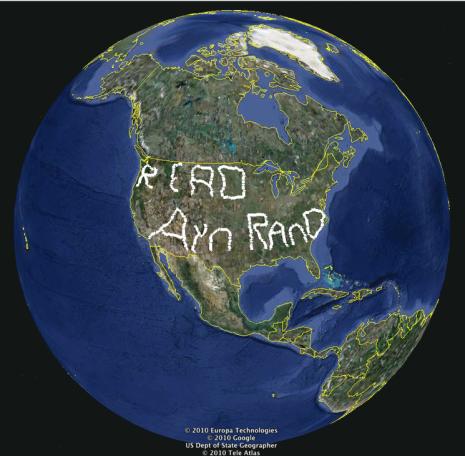
In August 2010, 22-year-old Nick Newcomen took a vacation, a car, a GPS device and ten days to ‘write’ the words READ AYN RAND across a Google Earth representation of the USA. In the process, he apparently logged 12,328 miles and thirty States. Speaking to Wired two days after completing his odyssey, Newcomen said: ‘In my opinion if more people would read [Rand’s] books and take her ideas seriously, the country and world would be a better place – freer, more prosperous and we would have a more optimistic view of the future.’
If Newcomen’s project sounds insane, it might be because Ayn Rand – libertarian philosopher and didactic novelist – tends to send her devotees insane. If it sounds like complete and utter bullshit (Nick Newcomen is weirdly untraceable for a man with such a pronounced interest in GPS), well, let’s just say that Rand and bullshit were close kin, if not inseparable.
But Rand’s own story is even odder than that. She is more popular and talked-about these days than at any time since her period as a Rightist anti-draft, anti-Nam firebrand in the sixties. Atlas Shrugged and The Fountainhead – her major novels, in heft at least – sell close to a million copies each every year in the US. In 1999, her face appeared on a 33-cent US stamp: an oddly equivocal gesture towards someone who was both a rabid stamp collector and opposed to any federal intervention in municipal life, up to and including the existence of the US Postal Service. Her fans include Brad Pitt, Wikipedia founder Jimmy Wales, Republican VP candidate Paul Ryan, and 30-year Federal Reserve chairman Alan Greenspan (once a personal friend). Having died in 1982, Ayn Rand is news in a way she never quite was in life.
Which is how I came to watch The Passion of Ayn Rand, a 1999 made-for-TV biopic in which England’s Own Helen Mirren dons an assymetric wig and a wigged-out Russic accent in order to impersonate the Great Lady of Voodoo Economics. We join Rand in the 1950s, in a moment of crisis. The high priestess of rational self-interest has fallen in love – with a married man, twenty-five years her junior. Continue reading Oh Randy, if they knew, I think they’d take me away
Indy Datta only saw the new Superman film last night, so this review will be small, and we can’t promise it will be perfectly formed.

Zack Snyder’s Man of Steel is, in almost every way, the epitome of the contemporary fantasy comic-book blockbuster, assembled with enormous skill and craft – but also witless, repetitive, thoughtlessly cacophonous, artlessly pretentious. There’s an hour of throat clearing exposition before anything of any interest happens. The plot, on pretty much every conceivable level, makes no sense. Film and director seem needlessly cowed by the source material (the crazy Snyder grandiosity of 300 and Sucker Punch is entirely absent, and yeah, I miss it), yet also simultaneously Nolanishly embarrassed by its inherent silliness (the one time a character says the word “Superman”, it’s an inadvertently delivered punchline). Henry Cavill, in the lead, is given little scope to be anything more than a sixpack on a stick.
Not unusually for superhero movies, it’s down to the villain to save the day.
 MostlyFilm