Category Archives: Classic Films

MostlyChristmas: favourite Christmas movies, part 1

Mostly Film has come over a touch festive this week, and will be bringing you a Christmas-themed post every day. Today and tomorrow, some of our  contributors recommend their favourite movies for the festive season. Today, adopting the Santa Claus classification, the nice ones. Tomorrow, the naughty. Sort of. Don’t hold me to that.

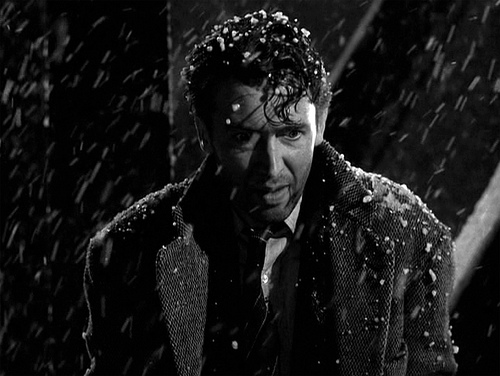
It’s a Wonderful Life

By Ron Swanson
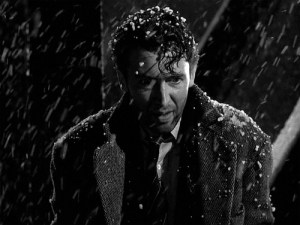
It’s fair to say that choosing It’s a Wonderful Life as a great Christmas movie isn’t a hugely original, or controversial stance. Sometimes it’s important to try and raise people’s awareness of a forgotten or neglected piece of art that could provide some hitherto unimagined joy. Equally, though, the pleasure in re-experiencing a masterpiece should not be discounted.

It’s a Wonderful Life is, for me, a perfect cinematic experience. It lionises kindness, solidarity, justice and hope, while also accepting that even the best of us can plumb the depths of frustrated ambitions, depression and self-pity.

It hangs around a marvellous performance from Jimmy Stewart, who never did more to disabuse audiences of the notion that he was a one-trick pony than he does here. George Bailey is a fully rounded human being: charming, decent, but with a quick temper and the potential for cruelty.

We see Bailey sacrificing his dreams of travelling the world to protect the future of his friends and neighbours by taking over his father’s business – a building and loan company, which is the only barrier to the predatory, pitiless Mr Potter (Lionel Barrymore) from controlling the town of Bedford Falls.

When people talk about It’s a Wonderful Life, they often use words like syrupy and schmaltzy, but there is real darkness to Frank Capra’s movie. George is on the brink of suicide, facing ruin and resenting all of the sacrifices he’s made, he laments his poor luck and vents his anger – claiming the world would have been better if he’d never been born.

As he realises the worth of his life (thanks to an unlikely angel), and goes on a voyage of self-discovery, one honest plea from his wife (the lovely Donna Reed) exercises all of the town to rush to his aid, providing him with the money he needs to save himself (and, therefore, themselves) from Potter’s clutches.

Although the film ends on Christmas Eve, the film manages to evoke festive feelings despite not being ‘about’ Christmas. Instead, it’s a film about loving your family, feeling grateful for what you have, and letting go of what you don’t. That’s what Christmas should be about, and for the 130 minute running time, that’s how it feels. I’m not sure you could ask for more than that. Continue reading MostlyChristmas: favourite Christmas movies, part 1

MostlyFilm’s Best of 2011 – the year in Rep

by Philip Concannon

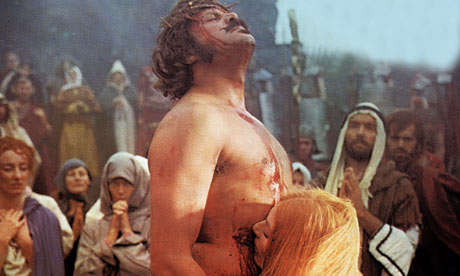
The Devils

The most exciting action sequence I saw on the big screen in 2011 didn’t occur in a summer blockbuster. It wasn’t directed by Steven Spielberg, James Cameron, Paul Greengrass, or any other contemporary master of cinematic thrills, and it has nothing to do with those myriad French films in which a frantic man in a suit runs around Paris for some reason. The sequence I’m referring to is the climax of Storm Over Asia, when the protagonist – a direct descendant of Genghis Khan – picks up his sword and leads the charge against his British captors. Breathlessly paced and set to a rousing score of Mongolian throat singing, the sequence practically lifted me out of my seat in a way that very few recent films have managed to do. Storm Over Asia was directed by Vsevolod Pudovkin, and it was made in 1928.

Continue reading MostlyFilm’s Best of 2011 – the year in Rep

If My Calculations Are Correct, Part Two

by Ricky Young

If this look-back at the 1983 BBC2 science-fiction season has a theme, it’s that if you’re a simple God-fearing man (or, to a lesser extent, woman), just trying to make his way in the world in the shadow of that first cracked atom, then whatever you do, for heaven’s sake give scientists a wide berth.

In nearly everything we’ve covered so far, men of science have either directly or indirectly been responsible for alien invasion, alien near-invasion, alien semi-invasion, or just alerting aliens to our existence so they can stage – yes! – an invasion. It’s almost as if American society in the 1950s went to bed at night afraid of sudden and total destruction from a massive yet amorphous enemy far away.

Not that such mattered to me, watching these films after my tea every Tuesday night for four months, a stripling of nine tender years. I’ve tried to revisit as many as I can, and I’ve found that it’s less the stories and the dialogue that have resonated over the ensuing three decades, but certain images, sound effects and colours.

It also sort-of explains why I blew up that government aerospace research lab that time, with everyone deliberately trapped inside. Goddamn good-for-nothing scientists.

Continue reading If My Calculations Are Correct, Part Two

Life is but a dream: Les Enfants du Paradis

By Josephine Grahl

I dreamed of impossible things… ‘but how could they be impossible, since I was dreaming them?’ asks the mime Baptiste. It’s a line which captures the essence of Les Enfants du Paradis, a film which circles around the opposition between dreaming and life, illusion and reality.

The idea of making the film may have originally seemed an impossible dream: a film involving a cast of thousands of extras, a mile-long set representing nineteenth century Paris, with various cast and crew members who were Jewish or fighting in the Résistance, to be made in German-occupied France in 1943. Film stock was rationed, and shooting was repeatedly delayed – Carné later claimed this was so that the film would not be released until after France had been liberated. The deceptions, self-deceptions and betrayals of life under occupation are reflected in the uncertainties and shifting loyalties of the characters in the film.

The film begins with an extended shot of a closed theatre curtain, over which the credits play; finally the curtain rises, but it is a deception: a velvet curtain painted on to a canvas. It rises to reveal not a stage, but the Boulevard du Temple,  itself a space for performance: acrobats, jugglers and performing monkeys vie for trade along the street packed with theatres and sideshows and filled with bustling, vigorous, raucous crowds.

Continue reading Life is but a dream: Les Enfants du Paradis

French Exchange – An American in Paris

By Viv Wilby

A charmless lunk

Before I get going, a disclaimer: I’m a Gene Kelly sceptic. I’ve always been baffled by Singin’ In The Rain’s unassailable position as the greatest musical (and one of the greatest films) ever made. I’m not going to rehearse all those arguments again here, but one of the biggest stumbling blocks I have is Kelly himself. I just find him utterly charmless. I can see that he could dance, that he introduced a muscular modernism to screen dance that had hitherto been dominated by the top hat and white tie of Astaire. But his grinning, his trying-too-hard hoofing and husky voice, I just can’t get on with at all.

But there’s a season of MGM musicals on at the NFT, and it’s showcasing his magnum opus – An American In Paris – so I thought I’d give it a go. Continue reading French Exchange – An American in Paris

A Wax Museum With a Pulse

Indy Datta revisits Pulp Fiction

1.

In a clever postmodern/wanky touch, this post will be presented out of chronological order.

2.

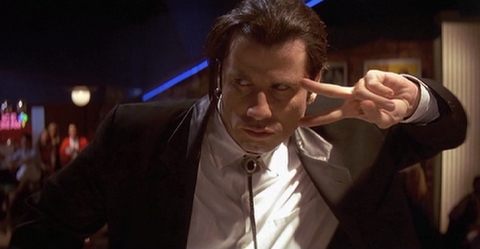
Recently, I attended a screening of Quentin Tarantino’s 1994 breakthrough movie at the Soho Square offices of the British Board of Film Classification. Before the film, Craig Lapper, senior examiner at the board, told us a little bit about the classification history of the film at the BBFC. In 1994, with the murder of James Bulger a recent memory, that old BBFC standby, “imitable behaviour” was a contentious issue in film censorship in Britain, due in large part to fabricated tabloid reports that Bulger’s killers had had their minds murderously warped by repeat viewings of Child’s Play 3 (as quaint and faintly hilarious as that sounds now). Although the film had been passed uncut for theatrical exhibition, when it came to home video, one particular shot particularly disturbed James Ferman, who was then the board’s director: the shot of a hypodermic needle piercing the skin of John Travolta’s smackhead hitman Vincent Vega. Ferman’s belief was that there were certain trigger images that had a quasi-hypnotic effect on drug users, causing them to lose control to their addiction, and that this was one of them. Accordingly, the shot was optically reframed so that home video viewers couldn’t see needle break skin.

Continue reading A Wax Museum With a Pulse

Perfect 10

Philip Concannon revisits Krzysztof Kieslowski’s Dekalog

Thou shalt not break the fourth wall

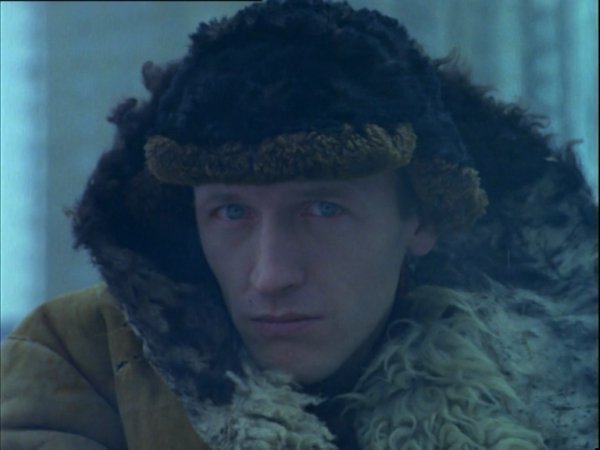
The camera moves slowly across the surface of a frozen lake. On its bank, hunched in the snow, we find a young man warming himself against a fire. The man raises his head and then slowly turns to look directly at us, wearing an expression that is hard to read; it could be a look of curiosity, perhaps, or one of reproach. The camera then cuts to another location, where a woman cries as she watches silent footage of a smiling child on television, before it brings us back to the young man who appears to be wiping a tear from his eye.

This is the opening scene from Krzysztof Kieslowski’s Dekalog, a ten-part miniseries the director made in Poland in 1988. The young man, played by Artur Barciś, appears in eight of the ten episodes, always in a slightly different guise and always observing the drama as it plays out but never intervening, like an omnipotent angel of fate. As Dekalog progresses, we might expect some clarification on this character’s true identity, but Kieslowski was not a man who liked to provide answers.
Continue reading Perfect 10

Glamour of the Gods

The current National Portrait Gallery exhibition, Glamour of The Gods, sets out to ‘demonstrate photography’s decisive role in creating and marketing the stars central to the Hollywood mystique.’

The Tramp thinks the execution falls far short of the goal.

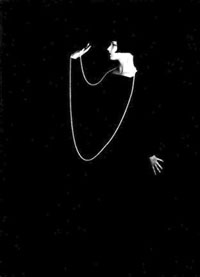
Louise Brooks by Eugene Robert Richee

In my mind, Hollywood’s Golden Age runs anywhere between 1915 and 1950. I’ve had pictures of film stills and film stars from this era on my walls since I was old enough to dictate what pictures I could have on my walls. They are almost fairytale images: glimpses of impossibly glamorous women in the most beautiful clothes. So it was nice to see one of my favourite images from childhood here: Louise Brooks, her jet-black hair in its iconic fringed bob, her lithe dancer’s body clad all in black, her porcelain white face and hands and a long string of pearls all you can see – this is glamour and art. I didn’t want to be a princess when I was little, but I did want to be Louise Brooks. Continue reading Glamour of the Gods

2011: A Film Odyssey

Philip Concannon previews More4’s history of film and cinematic innovation

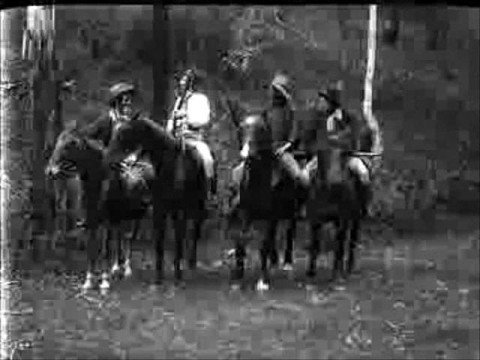
The Story of the Kelly Gang – the first feature-length film ever made

“At the end of the 1800s, a new art form flickered in to life. It looked like our dreams.”

The Story of Film is a story told through moments; images thematically linked to tell us how this art form, created by inventors and visionaries in the 19th century, exploded to become the industry that we know it as today. Mark Cousins has already told this story in his book of the same title, but this 15-part documentary series still feels like a significant film event. At a time when the art of cinema seems secondary to the business of moviemaking, and when public interest and awareness in films beyond the mainstream appears to be at an all-time low, The Story of Film is a valuable attempt to reconnect us with the essential magic at the heart of cinema. “Movies are multi-billion dollar global entertainment industry now,” Cousins admits at the start of episode one, “but what drives them isn’t box-office or showbiz. It’s passion, innovation.” Continue reading 2011: A Film Odyssey