Category Archives: Cult Movies

Undiscovered Country: the Films of Edward Yang

by Philip Concannon

A Brighter Summer Day

When Edward Yang died in 2007, I didn’t feel the sense of loss that I often feel when a notable filmmaker passes. At the time, I had only seen Yang’s last film Yi Yi, and as much as I adored that picture, I had no idea that it was merely the tip of the iceberg. I had no idea that we were losing in Edward Yang one of the most remarkable directors of his generation, and I wasn’t the only one unaware of the richness of Yang’s oeuvre either, because aside from his internationally acclaimed Yi Yi, the director’s films are largely unavailable for viewers in Europe and America. Prints and DVDs remain intractably bound up in complex rights issues, with the funding of some Taiwanese films by the country’s gangsters complicating the matter further. Few would quibble with Yang’s status as a great filmmaker, if only they were given the opportunity to see his body of work in its entirety.

Continue reading Undiscovered Country: the Films of Edward Yang

Stumbling On

Mr Moth on why modern zombies are rubbish.

'Rarr brains etc and all that'
'Right. Better go chase down the living to feast on their guts'

‘And you wonder why
When your heart has died
That your feet go stumbling on’
– Lal Waterson & Oliver Knight, ‘Stumbling On’

I think we’re all fairly au fait with the rules of a zombie outbreak, aren’t we? I’ll rehearse them, just in case. First of all – you get bit, you’re gone. Might not be a fatal bite, but it’ll kill you anyway. Something in the saliva, maybe? It’s never specified, but whatever. The first rule of Bite Club is: you do not talk about Bite Club. If you’re in a group and a zombie took a nibble, don’t say anything. It’ll make the surprise of your transformation all the more exciting. They’d just kill you if they knew, anyway, ‘for your sake’. And how would they kill you? Rule two: remove the head or destroy the brain. I don’t know any zombie that wouldn’t work on. It’s quite effective on non-zombies, too, so be careful. Rule three: zombies will be quite easy to eliminate mano-a-zombo, but in greater numbers will take you down, no survivors. Oh, yeah, zombie movies are pretty fucking bleak, my friend. If you do live, you’ll do so knowing that you’re just delaying the inevitable; which brings me to the fourth and final rule: zombies are easy to outpace, so just run away and you’ll be cool. For a while. Continue reading Stumbling On

A Wax Museum With a Pulse

Indy Datta revisits Pulp Fiction

1.

In a clever postmodern/wanky touch, this post will be presented out of chronological order.

2.

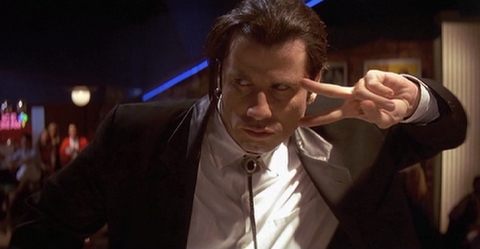
Recently, I attended a screening of Quentin Tarantino’s 1994 breakthrough movie at the Soho Square offices of the British Board of Film Classification. Before the film, Craig Lapper, senior examiner at the board, told us a little bit about the classification history of the film at the BBFC. In 1994, with the murder of James Bulger a recent memory, that old BBFC standby, “imitable behaviour” was a contentious issue in film censorship in Britain, due in large part to fabricated tabloid reports that Bulger’s killers had had their minds murderously warped by repeat viewings of Child’s Play 3 (as quaint and faintly hilarious as that sounds now). Although the film had been passed uncut for theatrical exhibition, when it came to home video, one particular shot particularly disturbed James Ferman, who was then the board’s director: the shot of a hypodermic needle piercing the skin of John Travolta’s smackhead hitman Vincent Vega. Ferman’s belief was that there were certain trigger images that had a quasi-hypnotic effect on drug users, causing them to lose control to their addiction, and that this was one of them. Accordingly, the shot was optically reframed so that home video viewers couldn’t see needle break skin.

Continue reading A Wax Museum With a Pulse

The Only Way is Essex?

Philip Concannon looks at three linked Brit gangster films. Can nothing stop the Geezer Appeal bandwagon?

The Range Rover in which Patrick Tate, Anthony Tucker and Craig Rolfe were found dead in 1995

On December 7th 1995, three dead bodies were found in a Range Rover on a remote farmland in Rettendon, Essex. The three men – Patrick Tate, Tony Tucker and Craig Rolfe – were notorious criminals who appeared to have fallen victim to an ambush in a drug deal gone awry, and two men were later convicted of the triple murders. Michael Steele and Jack Whomes are currently serving life sentences despite continually protesting their innocence, and various other individuals involved in the incident have either disappeared into the witness protection programme or made money from books tangentially connected to the three dead men.

That’s about all there is to the case of the Rettendon Range Rover murders, and yet between the years 2000 and 2010 no less than three films inspired by these events were released into UK cinemas (in the same period of time Terence Davies, one of our greatest filmmakers, struggled to get two pictures made). In a world teeming with amazing stories just begging to be told, why has this grubby tale about nasty people proved such an irresistible lure to filmmakers in this country? In truth, it’s not hard to see why – whatever angle you choose to attack this tale from, it offers up drugs, sex, betrayal and lashings of violence. For tawdry thrills that will appeal to an undemanding DVD audience, this incident appears to be a sure thing. If you’re after anything more than that – if you yearn for such cinematic luxuries as complex characters, witty dialogue and nimble plotting – you’d be advised to look away as I delve into the murky world of Essex Boys, Rise of the Footsoldier and Bonded by Blood. Continue reading The Only Way is Essex?

Plus ça change …

Emma Street marvels at the sanity of the characters in bodyswap comedies.

The Magic Fountain of Plot Contrivance: Ryan Reynolds and Jason Bateman in The Change-Up

Hollywood loves a body swap. Whether it’s an older person swapping bodies with a younger one (Freaky Friday, 18 Again) or a man swapping bodies with a woman (It’s A Boy Girl Thing, The Hot Chick) or a person becoming a different version of themselves (Big, 13 Going On 30). Well, in The Change-Up, a thirty-something man wakes up in the body of a thirty-something man! A different one, obviously. It would just be normal life, otherwise.

Jason Bateman and Ryan Reynolds are lifelong friends. Bateman is a successful lawyer with an impossibly hot wife, three adorable children, tons of money and a very busy schedule. Reynolds is an unsuccessful actor with a sword fixation and a lot of free time. On a drunken night out together, they tell one another – insincerely – that they wish they had the other one’s life. Unfortunately they do so whilst pissing into a magic fountain of plot contrivance. Next morning sees the inevitable:  hangovers, regrets and waking up in someone else’s body. Continue reading Plus ça change …

Citizen Clunge

Indy Datta puts The Inbetweeners Movie in context

Simon Bird remembers he has points on this movie

At the time of writing this piece, just before another Orange Wednesday evening swells the coffers further, The Inbetweeners Movie has taken about 28 million pounds at the box office in its first two weeks on release, making it the most successful launch ever for a live-action comedy in the UK. This also puts it on course to outgross films, such as Transformers 3, that probably cost a hundred times as much to produce. Rigorous statistical analysis proves that these figures show that every teenager in the country has seen it twice, and that it probably stopped the August riots. Newspaper journalists can’t see something unusual without pronouncing it a new trend, so we’ve seen a breathless rush of speculation that the British film industry will “learn the wrong lessons” from the success of Inbetweeners and unleash upon us a baleful tide of unwanted adaptations of sitcoms and teen telly shows. This would at least mean that they could take next summer off from whining about the preponderance of sequels and comic book adaptations to instead complain that the multiplexes were being monopolized by the likes of My Family: the Movie, Misfits: the Movie and/or Roger & Val Have Just Got In: the Movie.

But how much of an outlier, really, is the success of Inbetweeners, viewed in the context of British comedy film?

Continue reading Citizen Clunge

Cult Australian Cinema

Fred Schepisi’s forthcoming The Eye of The Storm

September sees the release of The Eye of the Storm, directed by Fred Schepisi and based on the novel by Patrick White. It’s Schepisi’s first film in eight years (not including the award-winning HBO mini-series Empire Falls), and his first film made in Australia since A Cry in the Dark in 1988. MarvMarsh takes a look back at one of his best films, while other MostlyFilm contributors choose some of their own favourite Australian films. Sadly, The Crocodile Hunter: Collision Course didn’t make the cut. Continue reading Cult Australian Cinema

Shake Your Money Maker

MarvMarsh looks at the history of big finance on screen

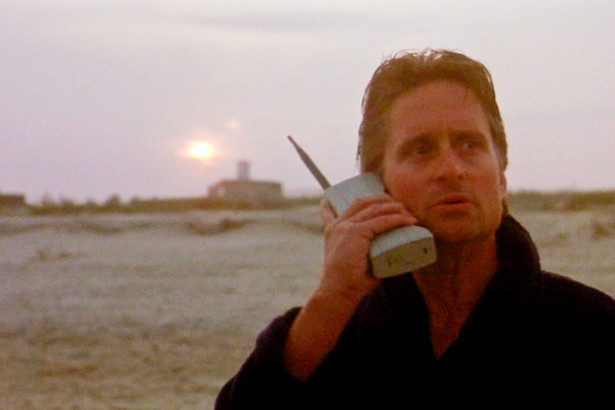
Gordon was very happy with his 'free calls on the beach at sunset' plan

Gordon Gekko; Larry the Liquidator; the Duke brothers. They may sound like professional wrestlers but what they actually are is nothing like as honest and noble. They are cinema’s money men. The people at the top of the writhing pile of maggots that is the financial industry. It is not an industry that Hollywood understands, or if it does then that does not translate into a willingness to portray it accurately. A few broad strokes give us a man on the edge, betting the firm in a desperate attempt to save his drink-soaked skin; a few more give us his boss, who spends his days in his gigantic office or the back of his limousine, drinking whiskey and handing out lessons on what life is really like. A final few more gives us the young Turk who realises something is badly wrong and saves his soul by bringing down the firm and walking away. And that, pretty much, is the financial industry on film.

Given that we now live in a post-apocalyptic landscape after our dreams were all laid to waste by the feckless actions of some greedy banker scum, or so the story goes, perhaps that is all the financial industry really deserves. Films have a difficult relationship with work as it is, so to accurately and interestingly cover the work of people it is going to be hard to portray as human, let alone sympathetic, is a big ask. Also, is there really an audience for a film about an individual diligently carving out a good reputation for himself in the Compliance department of an international bank? Perhaps, but I wouldn’t want to be the one pitching it. Actually, of course I would because what if it sold? I’d be a millionaire! But it wouldn’t. I can’t even get that to fly in my dreams.

Here’s an idea for an exciting scene in a film, Producer Guy. Continue reading Shake Your Money Maker

The Passion of the Kinski

Philip Concannon

Just good friends: Werner Herzog and Klaus Kinski

The title of Klaus Kinski’s memoir is Kinski Uncut, but that’s not strictly accurate. When the actor first attempted to publish his autobiography in 1988, under the title All I Need is Love, a lawsuit from Marlene Dietrich (who had taken offence to his depiction of her as a lesbian) ensured the book was withdrawn from circulation until after her death. Since then, each subsequent edition of the book has carefully removed the names of anyone still living who may be feeling similarly litigious, so what we have here is not exactly the complete recollections of Klaus Kinski as the author intended. Nevertheless, it still feels like a pure, concentrated dose of Kinski; as if the actor’s brain spilled out onto the page and he left it there without making any attempt to organise his thoughts or check his darker impulses. Perhaps Kinski Unfiltered or Kinski Unhinged would have been more appropriate titles.

But is it Kinski Untrue? I don’t doubt that many of the events in the book took place in Kinski’s life, but the author’s hyperbolic description of them often gives us reason to doubt the veracity of what we’re reading. Everything in Kinski Uncut is extreme – his suffering is more intense than most ordinary souls could bear, his acting performances are received with either angry derision or tears and standing ovations, his sexual encounters (of which there were many) are all epic and orgasmic. When he talks about his childhood, he describes a period of Dickensian squalor, where he suffered permanently from starvation and frostbite and learned to steal in order to survive. Everything in the book seems designed to reinforce the idea that Kinski’s life was more dramatic, outrageous and depraved than that of any mere mortal who might be reading his story; that he is a tortured genius who has suffered nobly among the “idiots” and “riffraff” who make up the rest of the population. This is Klaus Kinski’s world, and the rest of us are just living in it. Continue reading The Passion of the Kinski