Part of an occasional series in which Spank The Monkey travels to foreign countries, watches films in unfamiliar languages, and then complains about not understanding them

Continue reading Monoglot Movie Club: The World, Under Construction
Part of an occasional series in which Spank The Monkey travels to foreign countries, watches films in unfamiliar languages, and then complains about not understanding them
Continue reading Monoglot Movie Club: The World, Under Construction
Ron Swanson
This year’s London Film Festival put together the best programme of films I can remember in my ten or so years of attendance. It delivered some brilliant films with huge reputations from festivals earlier in the year, but also a fair few new discoveries for me, and a handful of well-crafted crowd-pleasing films, which are the lifeblood of any festival. Continue reading London Film Festival: Festival Wrap-Up
Want to make a film about a cult musician-turned-bank-robber who’d like to make one last record before he dies of lung cancer? Paul Duane tells you how.
When this all started I was in limbo. A documentary called Barbaric Genius that I’d given three years and a great deal of my own money to was on the verge of collapsing, leaving me in real doubt as to whether I’d be able to continue. I was able to finish that film in 2011, but at the time previously committed co-producers were melting into thin air on all sides as the going got tough, and I had taken to drinking whiskey in the office where I spent most days alone, looking out the window at the hotel opposite, feeling like some hopeless case out of an Edward Hopper painting.
I’d spoken to Jerry on the phone a few times. He’d found his way into my life via some blog posts I’d put up a few years earlier, when I was desperately trying to fund a film about the extraordinary Memphis musician and producer Jim Dickinson, one of the very few people I’ve ever met who absolutely deserved to have a film made about him.
Jerry had eluded me at that time – he was in jail in Florida, it later turned out – but now he’d resurfaced and I was the first ‘media’ person he contacted, and only because he wanted to get back in touch with Jim Dickinson, who was at this point (mid-2009) in hospital and seriously ill.
Then Jim died – a black day in the memories of all who knew him, though his self-penned epitaph – “I’m just dead, I’m not gone” – has proved true. And my contact with Jerry lapsed. I had many things to work on. Until, one day, I had nothing to work on, everything except the whiskey and the view out the office window had fallen away, and that was the day I heard from Joyce (Jerry’s saviour, fianceé and the love of his life, it seems). Continue reading Very Extremely Dangerous
The Sacrament (Ti West, 2013)

Ti West, the man the festival brochures like to call the king of slow-burn horror, has been promoted (possibly not the right word) from FrightFest to full London Film Festival status for his latest film. A non-supernatural cult horror largely inspired by, though not specifically based on, the Jonestown massacre, it’s a found footage film, which may have you moaning already.
The found footage is presented in the manner of The Last Exorcism rather than The Blair Witch Project, in that it’s been edited – sometimes in such a way as to suggest there were more cameramen available than the script leads us to believe – and given a suitably doomy score.
The film follows two reporters from Vice ,which I was surprised to learn is actually a real thing, into a remote hippy-ish cult, which the sister (Amy Seimetz of Upstream Color) of a friend has joined. Initially, all seems like peace and love, despite the armed guards at the gate. But things take a sinister turn once the reporters start asking questions of the cult leader, Father (Gene Jones).
I greatly enjoyed West’s last two films, The House of the Devil and The Innkeepers; unfortunately, The Sacrament didn’t work so well for me. Part of that was down to my expectations – I had anticipated that Eden Parish would hold a supernatural secret, and was disappointed that the threat turned out to be more prosaic. That, of course, is my problem rather than the film’s. The real flaw is that, having arrived at the camp, the leads’ subsequent actions have basically no effect on what transpires. They run around filming, and do quite a bit of shouting, but fail to exert any influence on who lives and who dies. They can only observe, and hope not to get killed.
Perhaps that was West’s intended point, and what he saw as the true horror of the situation. It’s good to see him trying new subject matter and expand his range, but while The Sacrament includes individual moments that shock, it failed to move me as drama. Gareth Negus
The Sacrament is showing at the London Film Festival on Wednesday 16 October. Continue reading London Film Festival: Day Eight Update
In the first of today’s two LFF updates, Ricky Young reflects on a handsome restoration of an ugly film
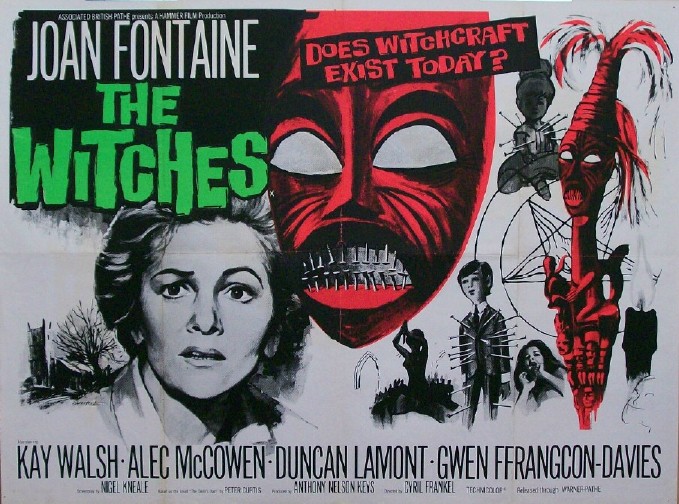
Today sees the LFF unveiling of the restored version of overlooked Hammer potboiler The Witches. Directed by Cyril Frankel and written by Nigel Kneale, it stars Hitchcock Oscar-winner Joan Fontaine in what would turn out to be her last cinematic role.
The Witches rarely gets much of a mention when discussing Hammer’s output – none of the big Hammer names or stars are involved – and despite the admittedly glorious-looking restoration, it’s not hard to see why. Even at their tackiest, the Hammer greats always had a spark of audience-pleasing oomph at their core. The Witches’ most exciting moment features six seconds of runaway livestock. Make of that what you will. Continue reading London Film Festival: The Witches
Caulorlime watches out for smokies with a can on his back. Come on!

“I don’t know where to start with this” is a terrible cliché. It’s used by lazy writers to suggest bewilderment at the oddness of a concept that usually turns out, after a little unpacking, to be utterly mundane. It’s apt here, though, because trying to write about Convoy, the 1978 Sam Peckinpah movie about lorry drivers that was based on a novelty song, left me with, literally, too many choices about where to start.
I’m a smart-arse. That should really go without saying. Being a smart-arse is sort of my thing*. It didn’t serve me well here. Every time I started writing about this film I ended up ridiculing a different aspect of the weirdness, and that didn’t work. You can’t just pick this thing apart and mock its constituent pieces. You need to try and mock it as a whole. Convoy isn’t really a product of the paranoid seventies**, or a product of right-wing America***, or of an occasionally great director phoning it in****. It isn’t even a cautionary tale about attempting to construct a coherent narrative out of a three minute pop song sung/rapped in a baffling slang*****. I mean, it’s all of those things, but it’s also much, much less. Continue reading “Ain’t she a beautiful sight?”
Need a solid, British character who can display authority with a hint of vulnerability in a changing post-war landscape? Viv Wilby recommends Trevor Howard.
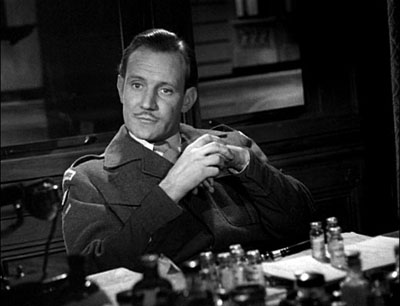
Were he still alive, Trevor Howard would have turned 100 yesterday. One of the striking things about the DVD boxset released to mark his centenary is the extent to which it confirms his own observation that he spent most of his career playing ‘number two’.
Five films are collected here, and only in two does he really have anything like a clear claim to the leading role. Supporting actor, co-star on occasion, but rarely is he asked to carry a film. Even where he arguably gets the main part — The Heart of the Matter and Outcast of the Islands in this collection — there’s a meaty supporting cast buoying him up and it’s still no guarantee of top billing. Yes, Brief Encounter is here, of course, but Brief Encounter is really all about Celia Johnson. She is where the emotional heft of the film resides. Trevor’s just there to look good and give her someone to play off. He’s a consort, a co-lead.
Woody Allen takes on the financial crisis? Niall Anderson withdraws his savings.
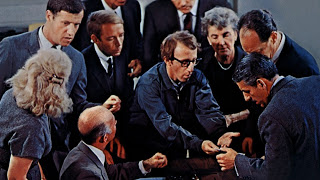
An idea for Woody Allen’s next film. An experienced and somewhat notorious director turns up at a film festival to tout his new film. The festival could be Cannes, it could be Venice, but this being a Woody Allen film, let’s make it Tribeca. The director’s new film centres on the step-by-step destruction of a central female character, with her destruction acting at least partly as a metaphor for some wider apocalypse. During the course of a press conference before the film’s premiere, the director muses out loud on his motivations and aesthetic. ‘I used to think I was a Jew,’ he says. ‘But now I realise I’m a Nazi.’ He says it again. ‘I’m a Nazi.’ There are gasps and nervous giggles, and the press conference putters on politely for the next ten minutes, but everyone in the room knows that a storm is coming.
I offer this plot to Woody because, in Blue Jasmine, he has made his first Lars von Trier film. It has everything: English dialogue that is somehow not quite English; insultingly whimsical plotting; the odd fancy-schmancy poetic interlude (just because); and above all a central female character who is insulted and toyed with by fate, before being utterly destroyed because – it turns out – she’s a total fucking bitch.
Cleaving still closer to the Von Trier template, the way in which she’s a bitch is supposed to say something about the failures of our common humanity. But where Von Trier would contrast the neurotic frailty of his protagonist with visions of profligate nature (talking foxes, haunted horses, blood-spunking penises), Woody has to find his own metaphor for the horrors of life. And find it he does: poor people. Continue reading Nebbish Say Nebbish Again
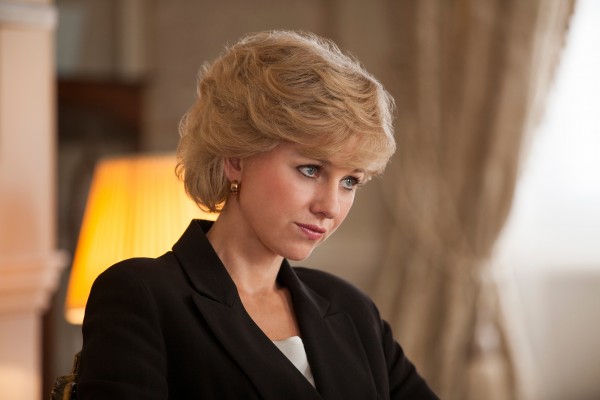
EMMA STREET relives the heady days of 1997 with Naomi Watts. We didn’t get an interview, but she walked out of this review as well.
I am going to assume that all the events depicted in Oliver Hirschbiegal’s Diana are shown exactly as they occurred in real life. That’s how biopics usually work, right? Particularly Royal ones. How else would Peter Morgan have got Her Majesty’s words so spot on in The Queen that they matched Tony Blair’s account of it years later?
The internet is ruining us, discovers Niall Anderson. Also, Jonathan Franzen.
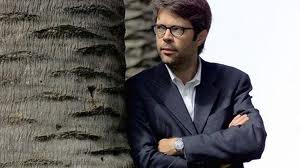
Last Saturday, The Guardian published a lengthy essay by Jonathan Franzen, which it inaccurately decided to headline ‘What’s Wrong With The Modern World’. The headline was inaccurate in two regards: first, because Franzen was trying to introduce the work of German satirist Karl Kraus to a new audience, and therefore merely suggesting parallels between Kraus’s time (the interwar period) and ours. Second, because the essay told you glancingly little about the modern world, but a great deal about the anxieties of Jonathan Franzen. In particular, Franzen seems to have a bug up his bum about the internet. To wit: ‘I confess to feeling some … disappointment when a novelist who I believe ought to have known better, Salman Rushdie, succumbs to Twitter.’
Succumbs, eh? Leaving aside the principal metaphorical dubiousness (does one ever deliberately succumb to anything?), the language of disease is always surprisingly close at hand whenever contrarians and conservatives decide to take a look at the apparent social effects of the internet. Franzen’s specific complaints – that the internet distracts people from really important issues; that it induces a kind of phenomenological panic about needing to have an opinion on every subject; that it effectively closes off real communication, even as it claims to open it up – are fairly standard. Indeed, so standard that Saul Bellow was able to write a very similar essay (‘There Is Simply Too Much To Think About’) in 1991, without ever having heard of the internet. Imagine.
To be fair to Franzen, there’s little in his essay that hasn’t occurred to even the most web-savvy and web-friendly individual. Slouched in front of an iridescent screen, pursuing a pointlessly vindictive web-spat with somebody you’ll never meet, who among us has not thought we might be wasting our lives? But there’s a difference between this feeling and the attitude of outright rejection that Franzen seems to be suggesting. And there’s a massive difference between momentary anxieties about online behaviour and a panoptic fear about what it might be doing to us as a species. (Maybe this is why we still have novelists: to worry about the global effects of every email sent in haste.)
In any case, Franzen is not alone. A new documentary released this week by Beeban Kidron, InRealLife, is Franzen’s thesis made flesh. Comprising extensive interviews with six teenagers along with fly-on-the-wall footage of their lives outside the internet, InRealLife is serious, well-intentioned and occasionally genuinely shocking. It also goes beyond mere human interest into genuine ethical quandaries of how the internet turns us all into consumers at a younger and younger age. But for all that, it is wrongheaded, hasty, shortsighted and more than a little bit sensationalist – all phenomena that Jonathan Franzen would like to blame the internet for. Well, Jonathan, I hate to tell you …
 MostlyFilm