All posts by Niall Anderson

Mostly Shorts

An occasional series in which Mostly Film looks at the best short films being distributed on the web

A scene from the 2013 Best Short Film Oscar-winner 'Inocente'
A scene from the 2013 Best Short Film Oscar-winner ‘Inocente’

MostlyFilm likes big. MostlyFilm likes small. And given that we’re rather small ourselves, we like to see the things we champion get big: whether that be an individual film or a niche film festival. This feature is basically a one-stop window for the best – or at least the prettiest – of what’s going on in the world of short films and web series: a new artistic world that’s grown extraordinarily fast in the last ten years.

If you’ve made a short film yourself, or have just seen one you particularly like, please email editor@mostlyfilm.com, point us to it, and we’ll see what we can put together. If we get enough responses, we may put on an event in a central London cinema for outstanding respondents. So if you’re struggling to finish that short film, now might be the time to push it over the line.

What follows after the jump isn’t at all indicative of what we’re looking for; it’s just what’s turned up in our trawls over the past few weeks. The emphasis is on animated work, which doesn’t necessarily suggest a bias on our part: it’s just a reflection of how expensive live-action stuff is in comparison. You needn’t feel inhibited about nominating something different. In fact, we’d encourage you to do so. Continue reading Mostly Shorts
Out of my cold, dead hands

In the last part of Extremists Week, our fearless correspondent Kiwizoidberg looks at the favourite films of the gun lobby

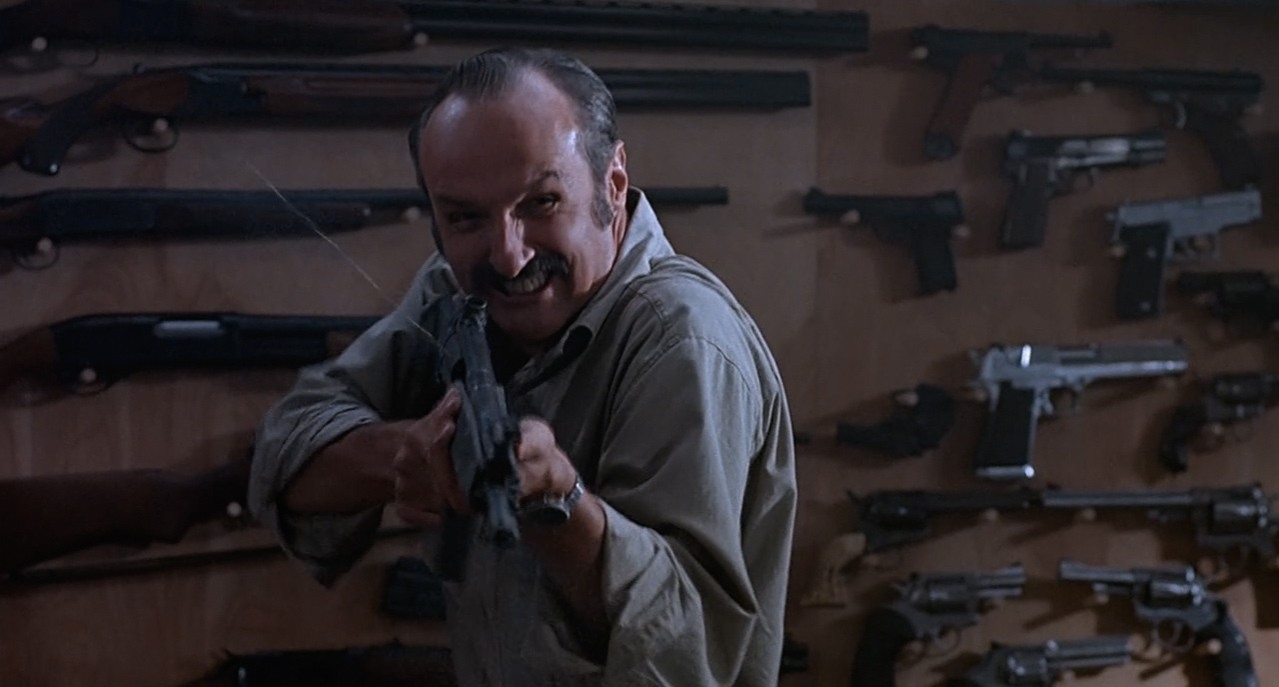
“I am COMPLETELY out of ammo. That's never happened to me before.” Michael Gross in Tremors
“I am COMPLETELY out of ammo. That’s never happened to me before.” Michael Gross in Tremors

Amat victoria curam: victory favours the prepared. When SHTF and it’s TEOTWAWKI, will you be ready? Will you grab your bug-out bag and head for the hills, or retreat to your fortified bunker? And how are you going to defend yourself from everyone else who ignored your warnings and thought you were crazy?

Welcome to the world of the Doomsday preppers. This group of people is made up of individuals, families or even communities who are preparing for the end of the world as we know it (TEOTWAWKI). They may be crazy, but their paranoia has driven them to take action. They have stocked up on water and tinned food and developed skills that they believe will help them survive whatever the world may throw at them when the shit hits the fan (SHTF). How they think the end comes about varies, but preppers are planning to survive and are willing to defend themselves by any means necessary. When this includes firearms, we have the makings of a gun-nut. The term can be interpreted as pejorative or affectionate, depending on your point of view.

When I see or hear the term ‘gun nut’, I imagine someone like Burt Gummer in Tremors (1990). Burt and his wife have a respectable arsenal in their cellar which comes in handy when the graboids invade their town. Back when the film was released, Burt seemed a likeable enough kind of crazy. Nowadays, you are unlikely to find any charming gun-nuts in film. Instead, you get characters like Harlan Ogilvy (Tim Robbins) in the basement scene from the War of the Worlds (2005), someone out of touch with reality; unstable and highly dangerous.

What is this fear that drives the preppers, and what role has film or TV played?Disaster movies are almost as old as cinema. When the genre hit its absolute peak in the 40s and 50s, it did so when WWII was a fresh memory, and when fear of nuclear weapons and Soviet infiltration were at their height. The Roswell Incident of 1947 led to sightings of UFOs everywhere – not least on celluloid. Pretty soon the latent paranoia of Hollywood B-movies was reflected on TV through shows like The Twilight Zone. Prepper lists of favourite films tend to include ‘Panic in the Year Zero’ from 1962, which tells you something about the longevity of this particular cultural crisis, and maybe why we’ve seen so many disaster movies recently. Continue reading Out of my cold, dead hands

Oh Randy, if they knew, I think they’d take me away

In the second part of Extremists Week, Niall Anderson looks at a curious biopic of the American right-wing’s favourite philosopher

Not pictured: an equivalent image of China with the words 'No, fuck off' on it
Not pictured: an equivalent image of China with the words ‘No, fuck off’ on it

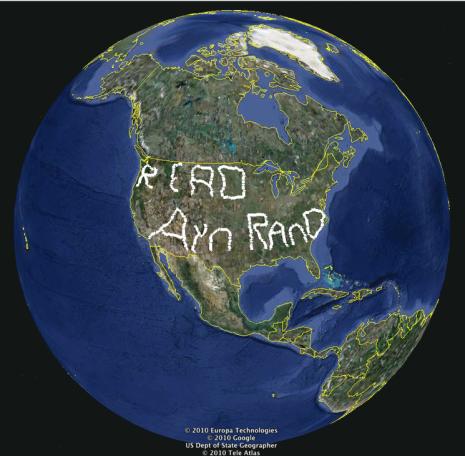
In August 2010, 22-year-old Nick Newcomen took a vacation, a car, a GPS device and ten days to ‘write’ the words READ AYN RAND across a Google Earth representation of the USA. In the process, he apparently logged 12,328 miles and thirty States. Speaking to Wired two days after completing his odyssey, Newcomen said: ‘In my opinion if more people would read [Rand’s] books and take her ideas seriously, the country and world would be a better place – freer, more prosperous and we would have a more optimistic view of the future.’

If Newcomen’s project sounds insane, it might be because Ayn Rand – libertarian philosopher and didactic novelist – tends to send her devotees insane. If it sounds like complete and utter bullshit (Nick Newcomen is weirdly untraceable for a man with such a pronounced interest in GPS), well, let’s just say that Rand and bullshit were close kin, if not inseparable.

But Rand’s own story is even odder than that. She is more popular and talked-about these days than at any time since her period as a Rightist anti-draft, anti-Nam firebrand in the sixties. Atlas Shrugged and The Fountainhead – her major novels, in heft at least – sell close to a million copies each every year in the US. In 1999, her face appeared on a 33-cent US stamp: an oddly equivocal gesture towards someone who was both a rabid stamp collector and opposed to any federal intervention in municipal life, up to and including the existence of the US Postal Service. Her fans include Brad Pitt, Wikipedia founder Jimmy Wales, Republican VP candidate Paul Ryan, and 30-year Federal Reserve chairman Alan Greenspan (once a personal friend). Having died in 1982, Ayn Rand is news in a way she never quite was in life.

Which is how I came to watch The Passion of Ayn Rand, a 1999 made-for-TV biopic in which England’s Own Helen Mirren dons an assymetric wig and a wigged-out Russic accent in order to impersonate the Great Lady of Voodoo Economics. We join Rand in the 1950s, in a moment of crisis. The high priestess of rational self-interest has fallen in love – with a married man, twenty-five years her junior. Continue reading Oh Randy, if they knew, I think they’d take me away

Come See The Paradise

Niall Anderson looks at smaller festivals and special screenings coming up this summer

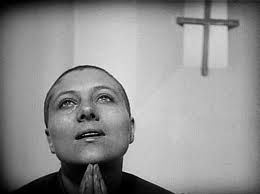
'Is that the Lord in your eyes or are you just happy to see me?' Maria Falconetti in Dreyer's The Passion Of Joan Of Arc
‘It’s been seven hours and fifteen days since my last confession.’ Maria Falconetti in Dreyer’s The Passion Of Joan Of Arc

Film festival season begins every year in January with Sundance, proceeds to Berlin for February, and advances to Cannes in early May. Somewhere in the middle the Oscars happen, and then the heavy-hitters take a breather till August and Venice. In the meantime there are countless smaller festivals, special one-off screenings, and various blink-and-you’ll-miss-em appearances of directors and films you might like to see if only you knew they were happening. So welcome to the Mostly Film Blink-And-You’ll-Miss-Em round up for summer 2013.

First up, because it’s genuinely first up, is a special showing in London’s Union Chapel of Carl Dreyer’s 1928 silent masterpiece The Passion Of Joan Of Arc. A critical classic almost since it first appeared, and renowned for the savagely self-exposing turn of its star, Maria Falconetti, The Passion has inspired countless musical interpretations and post hoc soundtracks. The one you’ll hear at the Union Chapel is by Irish composer Irene Butler, scored for soprano, organ and electronics. Part of the Union Chapel’s Organ Project season, the piece will be performed on July 17th only. If you’d like free tickets, there will be a competition on MostlyFilm’s twitter account – starting NOW. Continue reading Come See The Paradise

Pull The Utah One, It’s Got Bells On

Niall Anderson watches the West End transfer of The Book Of Mormon

Joseph Smith, founder of the Church of Latter Saints, pops in on a little Colorado town
Joseph Smith, founder of the Church of Latter Day Saints, pops in on a little Colorado town

It goes without saying that Americans on the whole have a different view of religion than Europeans, and a lot of this has to do with how the two civilisations conceive of the rights of their individual citizens. To vulgarise slightly, in Europe rights are conceived of in negative: they’re the things that nobody can legally stop you from doing. In America, the connotation is largely positive when not outright libertarian. The expression of your individual rights as a citizen is precisely what marks you out as American; a tendency that in turn reinforces the notion of America itself as the great unindividuated home of personal freedom.

There are ironies galore here, but one thing there isn’t is actual irony. The sober Baptist in his New England chapel, the snakehandler in his revivalist’s tent, the dollar-mad televangelist in his sweaty megachurch: all are equally protected by the same Bill of Rights. This is a legalistic definition of equality, to be sure, but in a nation effectively founded by lawyers it has become something close to the cultural definition too. To suggest in the public realm that some manifestations of the religious impulse are kookier than others is held to be impolite; to suggest that religion as a whole might be a crock has the ring of sedition about it. When you mock the faithful, are you not also attacking their fundamental rights as citizens?

All of which perhaps explains the especial nervousness – and the especial atmosphere of heretical glee – that greeted the first Broadway run of The Book Of Mormon in 2011. A satirical musical about America’s foremost native religion, written and co-directed by America’s foremost native satirists (South Park honchos Trey Parker and Matt Stone), the advance word was so hectically positive that you almost thought they’d found a cure for religion through the medium of dancing and low sarcasm. In a probably unconscious echo of the missionary zeal the musical elsewhere mocks, The Book Of Mormon has evangelised itself into a number of touring productions, one which turned up in London last week. Far from home in an alien culture, how would Mormon get on in the godless hinterlands of Soho and Piccadilly? Continue reading Pull The Utah One, It’s Got Bells On

Ready to take your order

Niall Anderson watches two very different cinematic confidence tricks

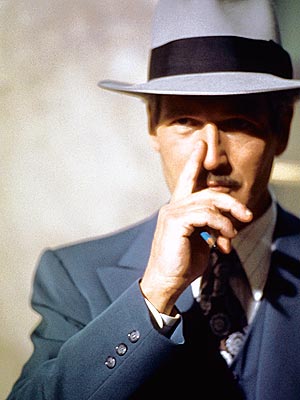
The Sting
Paul Newman knows more than you know

As the old joke has it: on the internet nobody knows you’re a dog. But what kind of dog are you? Are you housetrained? Do you like children? Do you have any infectious diseases? Are you even, actually, a dog?

Hoaxes and confidence tricks have always been fertile ground for drama, but certain crops have withered in recent years. The clever confidence caper (epitomised by The Sting) doesn’t seem to flourish as it used to. If it hasn’t quite died out, it’s been genetically modified into something almost unrecognisable. The films of Christopher Nolan, for instance, are all confidence capers at root, but you wouldn’t know it to look at the overbearing foliage.

Besides, there’s a new harvest. Films about, for want of a better term, being a dog. Where once the cinematic conman played a short game, hoping to trick himself into money or out of danger, he now does what he does indefinitely and for no immediately intelligible reason. His first hope is that you’ll accept him as a dog. His highest hope is that you’ll accept him as a dog for a really long time. The usual pleasures of the cinematic con trick – whether and how he’ll get away with it – are replaced by the mopier issue of why he wants to be a dog in the first place.

Catfish (2010) remains the exemplar of this new tricky cinema. A transparent and risibly faked “documentary” about how social media allows people to disguise their real identities, Catfish takes callow New York brothers the Schulmans into the American heartland to discover that the hot twentysomething pixie one of them fancies is actually a dowdy middle-aged woman with no friends and a lot of Facebook accounts. There is shock, followed by hugging and learning. The Schulman brothers learned so much, in fact, that they felt compelled to franchise their wisdom into Catfish: The TV Show – an MTV production in which Nev Schulman spies on internet daters and exposes them if they’re not telling the truth.

This seems to me to be a fairly crippled notion of the truth. It is also a fairly obvious bit of reactionary posturing about the rise of online communication. But the note of paranoia – the idea that you can’t trust anybody till you see them in the flesh – feels authentic in both its fear and naivety. Everything will be all right once all the masks are dropped. Two films coincidentally released this week take on this idea in very different ways. Continue reading Ready to take your order

A Long Way From There To Here

Niall Anderson looks at a new documentary about migrant experience in London

The Road runs 260 miles, from Holyhead in Wales to Marble Arch in London. We call it the A5, but the Saxons called it Watling Street and the Romans called it Iter II. It’s still the main westward approach to London, which gave filmmaker Mark Isaacs an idea: “Just to go along the road and meet people who’ve set up homes in this stretch that’s more associated with constant travel.”

Originally conceived as a series for the BBC, The Road was going to traverse the entire length of the A5, but that was, says Isaacs, “a difficult pitch”. It was the advent of the 2012 Olympics that eventually gave the film its final 76-minute shape: “The idea of all these different nationalities converging for a few weeks on London, set against London as a migrant city from day to day: the persistence of migration in London’s history.”
Continue reading A Long Way From There To Here

Pig’s Ear

Niall Anderson has listened to to all of the Now That’s What I Call Music Albums so you don’t have to

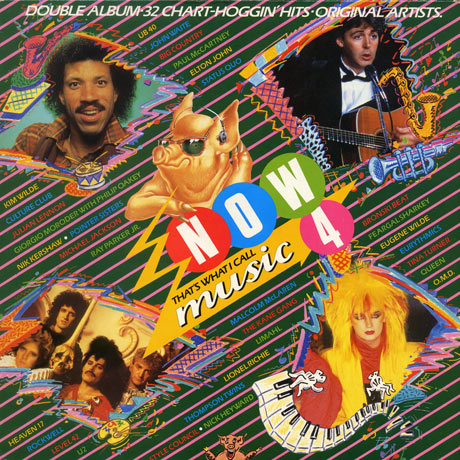
now-4-cover-001
The Now! pig, imaginatively named ‘The Pig’

The saddest and most interesting place I’ve ever been in London is the Old Vinyl Factory in Hayes. In its 1950s salad days, when it was owned by HMV, it employed 10,000 people, producing and packaging the label’s roster of recording artists. When I visited the site in 2008, it was owned by EMI and employed just four people: two of them part-time. A 17-acre site occupied by a maximum of two people daily, all there to manage the EMI archive. With its empty concrete offices and effusively strewn barbed wire, it was like visiting a post-apocalyptic prison camp.

I asked one of the archivists what he spent his time doing. ‘We’re only really busy around Christmas when the compilation albums get made,’ he said, and with that took me around the archives. Master reels of Beatles albums, signed gold and platinum discs by The Beach Boys, Scott Walker’s hesitant signature on a two-album contract in 1981 (only one album appeared: 1982’s Climate Of Hunter). Gold-dust for the archivist and pop aficionado. I happen to be both.

So as a tribute to the discouraged archivists, I decided I’d listen to EMI’s own historical effort at canonising pop: the Now That’s What I Call Music series. All of it. Currently running to 83 volumes (or 10 days of continuous listening), it has valid claims to being the biggest selling compilation series of all time. The Top Of The Pops albums aren’t pop enough! The Motown Chartbusters comps didn’t bust enough charts! Even unimpeachable pop blockbusters like Thriller and ABBA Gold haven’t sold in the quantities that the Now! series has. We’re talking about a collection of songs popular enough and deep enough to be worth an extended trawl. Ladies and gentlemen, this is it. This is pop.
Continue reading Pig’s Ear

We Shall Not Be Moved

Niall Anderson’s tears aren’t the only things being jerked by The Sessions

Image
Peel slowly and see: Helen Hunt and John Hawkes in The Sessions

In what might have been a particularly discouraging life, Mark O’Brien accomplished a great deal. Born in Boston in 1950, he contracted poliomyelitis when he was six and ended up more or less immobile from the neck down. On good days he could move his right foot, and in later years he used this foot to power a motorised trolley to carry him around Berkeley, California, where he worked and studied. He graduated from the University of California (after a prolonged struggle to even be allowed to enrol) and later sued the state to be considered legally independent rather than a ward of his parents. Thereafter, he lived on his own – with help from carers – and supported himself through journalism.

He has also been the subject of a previous film, Breathing Lessons, which won an Oscar for Best Short Documentary in 1997. The opening sequence of Breathing Lessons gives you some idea of what O’Brien was up against: in particular, it gives you the brutal noise and pounding indifference of the iron lung where he was forced to spend most of his time. He could survive for an hour or two outside it, but his lungs were so weak it actively hurt him to breathe.

The opening sequence of The Sessions – a fictionalised account of a period from O’Brien’s life in the 1980s – is practically identical to that of Breathing Lessons. O’Brien, ventriloquized with spooky accuracy by John Hawkes, recites the same poem, and both sequences end with a steady pan along the iron lung until we see O’Brien’s face. But the lung, in The Sessions, is silent. Hawkes speaks the words fluently, with no trace of the forced respiration you hear from O’Brien himself. A good deal of the difficulty of O’Brien’s life is wiped away at a stroke. Indeed, wherever The Sessions finds an unexpected wrinkle in O’Brien’s biography, it quickly and efficiently smooths it over. The frictionless result is not just different from Mark O’Brien’s actual life, but from any life ever lived.
Continue reading We Shall Not Be Moved

I Know You Are But What Am I?

A comic thriller about psychopaths leaves Niall Anderson fearing for his mental balance

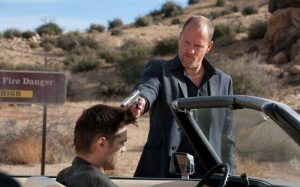
Woody Harrelson cures Colin Farrell's hangover in Seven Psychopaths
Woody Harrelson cures Colin Farrell’s hangover in Seven Psychopaths

Let’s talk about getting shot in the head. Right square in the head so that there’s a sudden arc of blood out the other side, and you fall, not forward, but straight down fast like a puppeteer has just cut your wires. You are now dead, but maybe twitching a bit. An obliging camera will start to pan back from your prone, blood-haloed body until the scene encompasses the hulking figure who’s just done you in. The soundtrack will go quiet for a second or two, because this is what necessarily happens after a murder. But then a strangely soothing pop song will start up from somewhere – say ‘Take It Easy’ by The Eagles – and we see your murderer amble into the next scene with a carefree look on his face. You, on the other hand, are dead.

We have all seen this a hundred times in a hundred movies. The pattern is so exact that even minor variations can change the mood. If the camera lingers on the body rather than pulling away, then we know that this is a particularly significant kill. If, on the other hand, we don’t see a body at all, we know that the killer is a busy man with a lot more killing to do. However the individual scene plays out, the basic scenario is so firmly encoded in the DNA of mainstream film that it takes real talent to find something new to do with it.

Martin McDonagh’s Seven Psychopaths is at least partly concerned with this sort of coding, with the way the morals and aesthetics of cinema become part of the way we see the real world – and real-world violence in particular. It is not scolding or baleful in the Haneke style. Nor does it have Tarantino’s self-conscious aestheticism, where knowledge of cinematic convention is the sole essential justification for novel forms of violence. Put very simply, Seven Psychopaths doesn’t know what it is. The directorial finger is occasionally wagged at the failure of imagination that violence represents. The same finger then closes around a trigger and commits merry mayhem. Lots of people get shot in the head. Continue reading I Know You Are But What Am I?