Niall Andersonlooks at a new documentary about migrant experience in London
The Road runs 260 miles, from Holyhead in Wales to Marble Arch in London. We call it the A5, but the Saxons called it Watling Street and the Romans called it Iter II. It’s still the main westward approach to London, which gave filmmaker Mark Isaacs an idea: “Just to go along the road and meet people who’ve set up homes in this stretch that’s more associated with constant travel.”
Originally conceived as a series for the BBC, The Road was going to traverse the entire length of the A5, but that was, says Isaacs, “a difficult pitch”. It was the advent of the 2012 Olympics that eventually gave the film its final 76-minute shape: “The idea of all these different nationalities converging for a few weeks on London, set against London as a migrant city from day to day: the persistence of migration in London’s history.” Continue reading A Long Way From There To Here→
Fashion and the movies have a mutually rewarding relationship. Historical movies, however authentically costumed, almost always have a little something of the period in which they are made – think of the poofy, quintessentially sixties hair in Doctor Zhivago, or the 1935 version of Anna Karenina, starring Greta Garbo as Anna, in which the female characters attend balls in sequinned strapless vamp dresses more suited to 1930s Hollywood than to late nineteenth century Petersburg. But it goes the other way too – Dr Zhivago sparked a brief craze for fur hats and long Russian coats, and Gone with the Wind inspired a short-lived fashion for romantic full-skirted evening dresses before the fabric restrictions of the Second World War put an end to such frivolous wastefulness.
Evidence for this symbiosis is sprinkled throughout the V&A’s new exhibition of Hollywood costume, five years in preparation, which assembles some of the most memorable and iconic costumes from the last century of Hollywood film. Witness the costume in which Claudette Colbert played Cleopatra in 1934, which to modern eyes looks like nothing so much as a particularly elegant 1930s evening gown. Next to it, one of Elizabeth Taylor’s outfits for her portrayal of the Egyptian queen is a reminder of the fashion for gilded embellishment and weighty jewellery which followed the success of the 1963 film. Since the exhibition is at the V&A, it’s an interesting exercise to visit the fashion galleries down the corridor and compare the authentic period clothing with the versions produced for film – how far do cinema versions stray from the authentic? How are the shapes and silhouettes exaggerated or minimised? When a costume is made to be filmed, what effect does that have on the detailing or on the colours used?
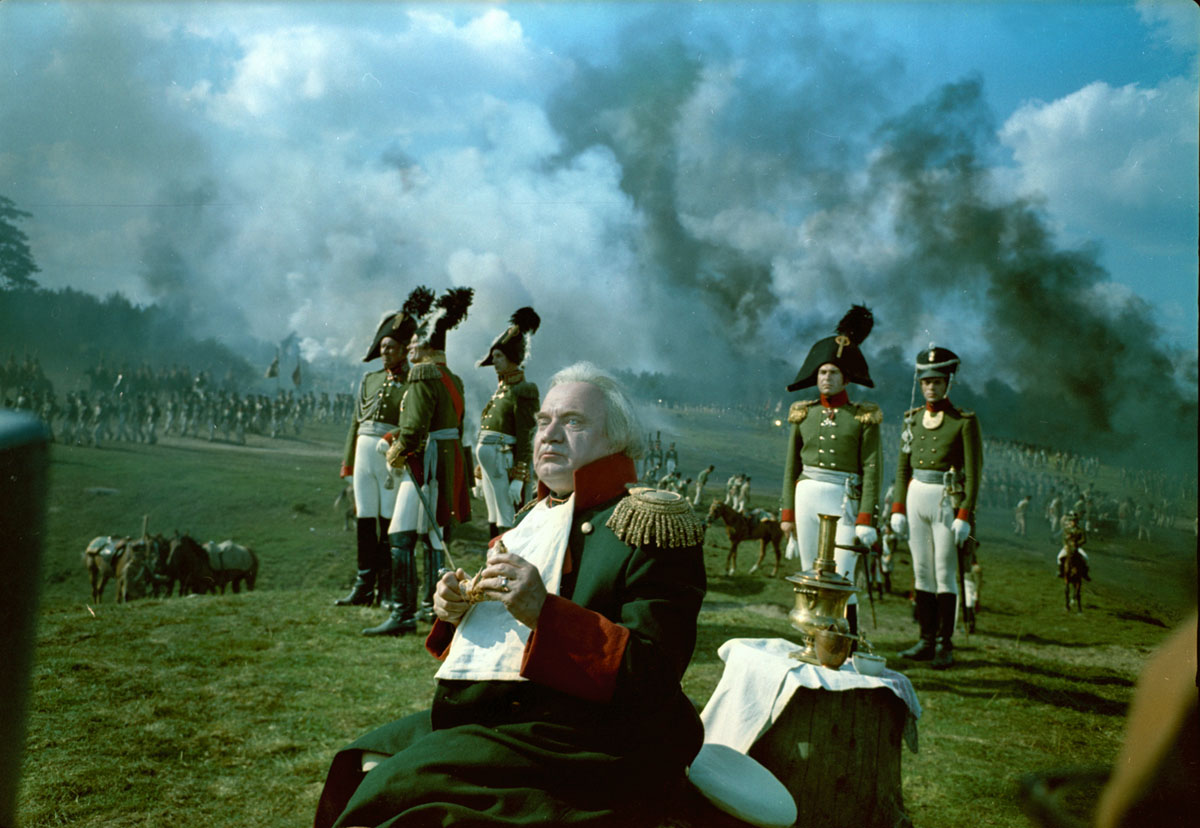
Niall Andersonlooks at Sergei Bondarchuk’s epic 1967 recreation of War and Peace, which is showing at London’s Renoir cinema on 7 October at 10am.
War!
Like the novel it adapts, the single most extraordinary thing about Sergei Bondarchuk’s War and Peace is that anybody had the nerve, skill and patience to bring it off. Granted, Bondarchuk had a technically unlimited budget and the full coercive weight of the Soviet Ministry of Culture behind him (he could, and did, call in 15,000 mounted cavalry to restage the Battle of Borodino), but the politics of the film’s production don’t get close to explaining the surreal attention to detail of the resulting film – nor the fervour with which it tries to animate even the smallest of Tolstoy’s fancies.
Take, for instance, the bear. Readers of the novel will recall that one strand of the plot begins with a policeman being strapped to the back of a bear and thrown into the Neva River as part of a bohemian jape. It would have been easy for the film to just refer to this incident in passing, or to do away with the bear altogether (surely a drenched copper proves the point, whatever he’s strapped to). This is not Bondarchuk’s way. Tolstoy wrote that there was a bear, so there must be a bear. And indeed there he is, unremarked at a dining table during a loud party: one extra among a hundred.
A scene like this could easily be dismissed as a stunt, or – maybe worse – as evidence of a slightly crazed literalism. But there are too many such stunts across the film’s seven-and-a-half hours for that word to carry the necessary weight, and the literalism comes to seem like a shrewd recognition that an epic is really just the magnification of the intimate. So it was in Tolstoy’s hands, anyway, and Bondarchuk seems to have realised that to compromise on the small details would have been to compromise the whole Tolstoyan vision – and his own. Continue reading Time and Patience→
A famous technical innovator, Stanley Kubrick was defiantly behind the curve in one regard. He always mixed the sound of his films in mono. His reasoning was simple: you can’t predict the sound environment of a movie theatre. You can’t predict the size of the room, the output or placement of the speakers, the number of channels in a theatre’s mixer or the competence of the projectionist. A complicated stereo mix would leave too much to chance. So just make sure the dialogue is audible, mix the whole shebang in mono, and get the film out there. It will sound pretty much as good in a suburban fleapit as it did on the sound stage.
This may seem like a mere technical consideration, but it has artistic consequences, the major one being that with only one audio track to play with, you have to think carefully about your approach to volume. Working in mono, you can’t have a sudden violent explosion in a viewer’s right ear while the rest of the soundtrack potters on at its usual level. Big surges in volume have to be carefully planned or the entire sound mix will be destabilised. The result being that the loud parts of Stanley Kubrick’s films are rarely objectively loud (in terms of decibels); they’re just loud in relation to the other bits. Mono means that you have to pay equal attention to the quiet stuff.
Of course, it’s entirely possible to achieve this kind of careful audio balance in stereo. Indeed, given the advances in sound recording and mixing afforded by digital technology, it should be easier now than ever. Digital sound recordings have a much wider frequency spectrum than analogue recordings, which means, first, that a larger range of sounds can be captured and reproduced, and, relatedly, that there is now less need to rely on sheer volume to distinguish between – for example – an explosion and dialogue. In addition, the technology gap between what a sound designer hears on the sound stage and what the moviegoer can expect to hear in the theatre has drastically narrowed since Kubrick’s heyday. Even the worst suburban fleapit now has Dolby Digital stereo sound, and even the most careless or high-handed sound designer will have this minimum standard in mind when mixing and mastering the sound for a film. For all these reasons, we should be living through a golden age of sound: crisper, cleaner and more dynamic than before. So why are people leaving IMAX screenings of The Dark Knight Rises, for instance, complaining both that the whole thing is too loud and that the dialogue is inaudible? Surely a purpose-built IMAX theatre is the perfect environment to see it? More generally: why hasn’t the golden age come to pass? Continue reading Betting On Red→
I spent four years making Barbaric Genius, my first feature documentary. I’ve been a director for about twenty-five years, but I learned more about every aspect of filmmaking – and more about life – in those four years than in the first twenty put together.
The film is finally getting a cinema release this week, a year after its festival debut, and it felt like it might be a good time to try to figure out how to pass on some of the things I’ve learned, for what they’re worth.
I saw a woman on the train with an iPod cover imitating a cassette. This is, I think, poor form. Like the chief of some ancient tribe wearing the head of a defeated tribe’s chief as a hat, it seems unnecessarily boastful of one’s victory. The mp3 player is, of course, smaller, more convenient, with better sound quality than the traditional Walkman. The boxy, (literally) clunky beast was limited to one album at a time, too, and if you wanted variety you needed to carry round a small satchel full of tapes. Or listen to a mixtape.
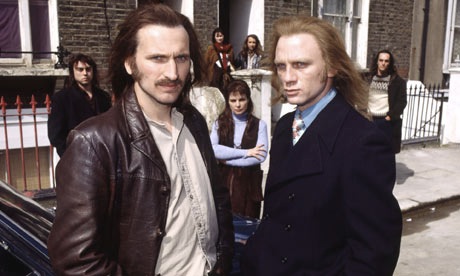
Christopher Eccleston and Daniel Craig, Our Friends in the North, 1996
Do you remember the acclaimed nineties BBC drama that brought actors Christopher Eccleston and Daniel Craig to popular attention? I recall it fondly as ‘Our Wigs in the North’. You see, friends, I have a problem with hair and make-up. The anachronistic mullet, the dreadful syrup, the misplaced pout; I cannot rest when it doesn’t work in a TV or film drama. Immune to the frustrated protestations of my viewing companions, I just can’t ignore it and be another brick in the fourth wall. The distraction of an obvious scratchy looking wig or time travelling bonce infuriates me deeply, often forcing me to shout obscenities about fringes at the telly.
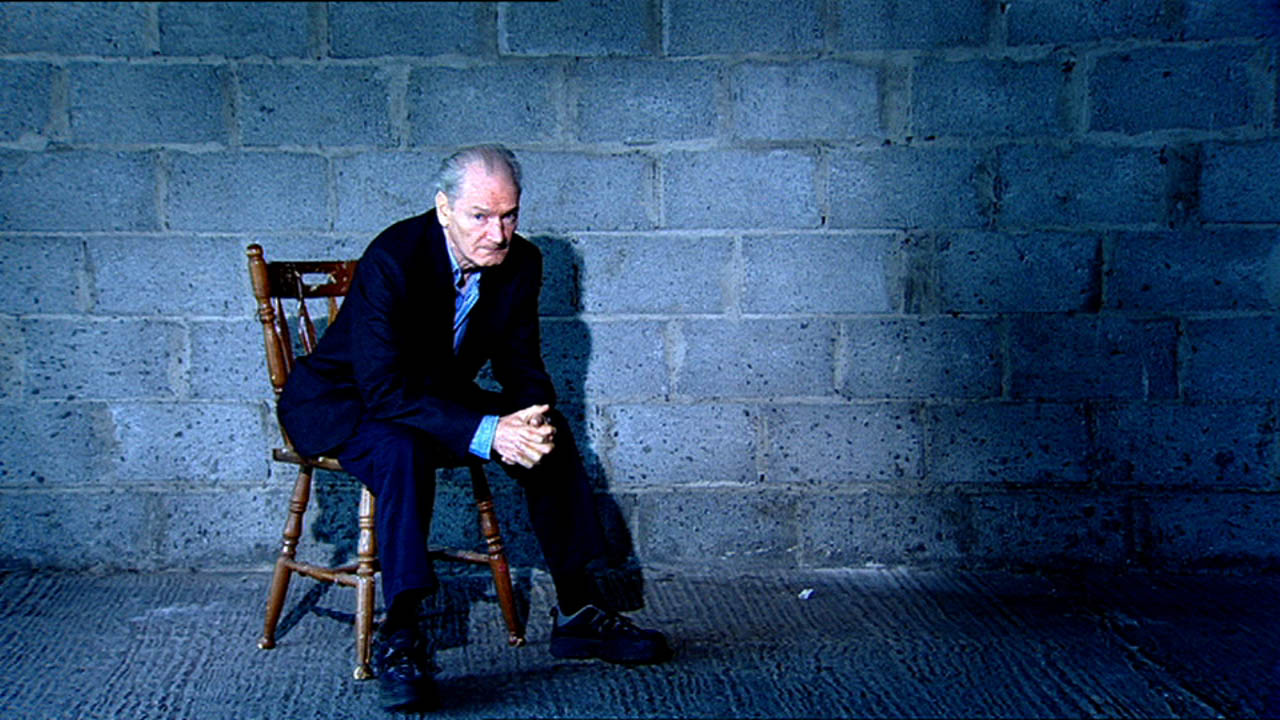
Kenneth Lonergan, a big, disorganised-looking, mop-haired, slightly put-upon-looking man, sits at the front of the auditorium. He’s looking at the audience, they’re looking at him, and nobody speaks. The guy who’s doing this Q&A with Lonergan, director Damien O’Donnell, is nowhere to be seen – it transpires he’s looking for a small bell that he’s brought as a prop, for some reason that never really becomes clear. There’s a long, uncomfortable pause as the audience and Kenneth Lonergan try to figure out the etiquette to deal with this mild bit of social discomfort.
It’s a very ‘Kenneth Lonergan’ type of moment, right out of Margaret, Lonergan’s second film in his two-film career as a writer/director.
Margaret’s a baggy, shapeless, engrossing story that can’t really be described except to say that you need to see it in order to talk about it. If you do see it you’ll definitely want to talk about it, the way you talk about people you know and the odd, compulsive decisions they make, and why the fuck did they do this and not that? It’s that kind of film.
Lonergan was visiting the Jameson Dublin International Film Festival to talk about screenwriting. Here’s some of the things he had to say on the subject.
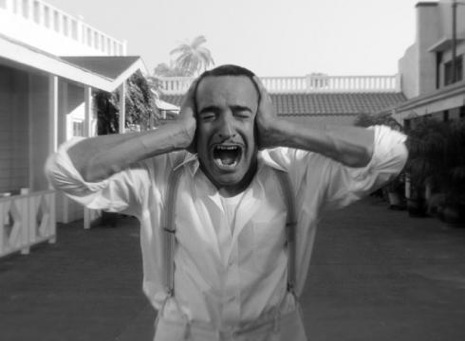
I know what you’re thinking. You’ve clicked on a link, and now there’s a sinking feeling in the pit of your stomach. “Oh no,” you sigh, “not another bloody article about those retro-juggernauts, The Artist (2011) and Hugo (2011) and what it all means for Hollywood. That’s so last month!”
Well, perhaps. But as a teacher of film history, I hope that I can offer a slightly different perspective on the films as far as their historical accuracy and their contemporary significance are concerned.
Let’s start with The Artist which, having fictional characters at its heart, brings fewer concerns with it. George Valentin, Peppy Miller and Kinograph Studios never existed, but the film takes place at one of the most interesting and extensively documented periods in cinema history. The conversion process from silent to sound cinema made – and, yes, broke – a number of careers, so it encompasses many elements which Hollywood itself loves so much, particularly meteoric rises and dramatic falls from grace.
“In the brief span of six years, between directing his first one-reeler in 1908 and The Birth of a Nation in 1914, Griffith established the narrative language of cinema as we know it today.” – David A. Cook, a History of Narrative Film (2004)
“DW Griffith, when you come right down to it, invented motion pictures. As Lionel Barrymore says, there ought to be a statue to him at Hollywood and Vine, and it ought to be fifty feet high, solid gold, and floodlighted every night.” – Mack Sennett
If you believe some of the things that have been said about him, there was no cinema before DW Griffith. Sure, there were other innovators in the medium’s nascent years, but Griffith was the man who broke new ground and unified these techniques into a narrative that played out on a scale unprecedented in American cinema. The Birth of a Nation was the first film blockbuster, it is unquestionably one of the most influential pictures ever made, and it immediately launched the man behind it into the pantheon of great directors. Whether or not he should remain there is another matter entirely, however, as we consider the thorny question that faces everyone who sits down to watch The Birth of a Nation – should this epic be considered as one of American cinema’s greatest achievements, or its greatest shame?



 MostlyFilm