Richard Curtis has a new film out and it’s very good. Yes, it is.Ron Swansonreports.
“Time present and time past are both perhaps present in time future, and time future contained in time past.” Domhnall Gleeson and Bill Nighy wrap their heads around a chronological paradox. With hilarious results.
It’s nicely in keeping with Richard Curtis’ films’ apologetically stylised view of England that I’m tempted to start this positive review of his new movie, About Time, with an apology, or more accurately, a justification. It’s tempting to put my emotional reaction to his film down to the fact that I’m a sucker for this kind of thing, or that I was having a bad week, or that the idea of time travel has always made me want to cry. If I knew how to winsomely stutter in print, I would totally give it a go.
As it is, no justification is needed. It may seem like trifling praise indeed, to claim that About Time is Curtis’ best film, but I like Four Weddings, Notting Hill and Love, Actually quite a lot, and this absolutely soars past them. While it may benefit from the lowered expectations caused by the clusterfuck that was The Boat that Rocked and an insipid and oddly charmless trailer, this is a film that makes me hope there’s more to come from Curtis. Continue reading Clock This!→
Federico Fellini’s Satyricon gets a rare public screening in London next week.Niall Anderson welcomes it back.
Lights! Minotaur! Action!
Little dates faster than cinematic representations of the future; except perhaps cinematic representations of the past. Federico Fellini’s Satyricon (or, to use its pettifogging official title, Fellini-Satyricon) is ostensibly set in and around Nero’s Rome, but it couldn’t be more 1969 if it quoted Shelley while opening a big hamper of dying butterflies in Hyde Park.
A rarefied episodic adventure involving witches, cannibalism, mutilation and at least one character becoming a god, Satyricon is so committed to modish 60s estrangement techniques that the viewer is sometimes distracted from what’s really strange about it. Not the nudity, the gore, the jump-cuts, the spikily intrusive score, or the scenes that end mid-sentence; rather the bizarre calmness of the cinematography and a casual scenic beauty that constantly upstages the actual drama. Satyricon doesn’t play these aspects off against each other so much as it keeps piling them on, layer after layer. For all the deliberate dreamlike elaboration of its technique, Satyricon comes across as a very different dream to what Fellini may have intended. Continue reading A Science Fiction of the Past→
Spank The Monkey hails a film festival with a twist.
Remember cinemas? They used to be good, didn’t they? And now they’re not. Many people have offered their solutions to the problem, but the only thing we can agree on is that we should ignore anyone who uses the phrase ‘second screen experience’ without an accompanying ‘wanker’ hand gesture. So what can be done?
Maybe we should look at the example of one of the best cinemas. Between 1981 and 1993, the Scala was a London cinema club with a wildly eclectic approach to programming. Its twelve-year mission to introduce audiences to the most extraordinary films on the planet was celebrated in a 2011 festival called Scala Forever, which I reported on at the time. It was a great way to commemorate a long-gone icon, but it wasn’t quite a permanent monument. An upcoming festival called Scalarama, on the other hand, has much larger ambitions. Continue reading Scalarama→
James Deen! Lindsay Lohan! Bret Easton Ellis! Paul Schrader! Yes, it’s The Canyons. What, wonders Niall Anderson, could possibly go wrong?
The Canyons begins with scenes of boarded-up cinemas in Hollywood. The historic home of movies is now inhospitable to them. A little later, a friend asks Lindsay Lohan’s Tara why she’s cooled off on a particular film project. ‘When was the last time you saw a movie that really meant something to you?’ she replies. The answer is a dodge for all sorts of reasons particular to Tara, but it nicely incarnates both the epic self-indulgence of The Canyons and its ambivalent sadness about the end of Hollywood as dream factory.
Most of the pre-release notices of The Canyons have focussed on its sensational behind-the-scenes aspects: the stunt casting (porn star James Deen; teen-starlet-turned-trainwreck Lindsay Lohan), the Kickstarter campaign to fund it (which didn’t actually kickstart anything), and the unholy alliance between nihilist author Bret Easton Ellis and moralist director Paul Schrader. The most sensational thing about the film turns out to be how exactly it maps to your expectations: The Canyons is, in several respects, a film you don’t need to see. Continue reading Dismay of the Locust→
The Lone Rangerwas a megaflop almost before it hit the screen, butGareth Negusstill lives in hope it might actually be good.
‘Why the long face?’
You can see how it must have looked like a good idea. Resurrect a semi-superheroic duo – The Lone Ranger and Tonto – familiar to a couple of generations. Get the team behind Pirates of the Caribbean to make it. Throw a ton of money at the screen.
But Disney’s reinvention of The Lone Ranger opened to disappointing ticket sales in North America, becoming almost as big a flop for the studio as John Carter last year. It’s perhaps the highest profile would-be tentpoles that have underperformed domestically this year, joining After Earth, White House Down, Pacific Rim and The Wolverine. It’s not unusual for one of the year’s megabudget productions to disappoint the studio accountants, but it’s less common for a whole string of them to meet with audience indifference, while more frugal productions like The Conjuring enjoy a healthy return. Some of these films may yet be saved by their international take, but until that happens there’s a temptation to think that audiences are finally tiring of formula filmmaking. It’s more likely, however, that there are just too many of these things being released in a short space of time . It’s hard to look like an event movie when you’re offering the same pleasures as three or four other things playing in the same multiplex.
The omens were there: westerns aren’t exactly big box office these days (but then, neither were pirates before Pirates). The Lone Ranger is a famous character, but does anyone much under 40 really know or care who he is? (A problem that also affected John Carter). And the idea of Johnny Depp playing Tonto did feel slightly odd, even if Depp is part Native American, sort of, possibly (in the film’s production notes, he hedges “I was told at a very young age that we have some Indian blood in our family… who knows how much — maybe very little, I don’t know.”). There was also a level of weariness at the prospect of another mannered, deliberately eccentric Depp performance, the freshness of his first appearance as Jack Sparrow having lost its shine after three dull sequels and the flop of Dark Shadows. But is The Lone Ranger just suffering from the competition, or is it actually a bad movie? Continue reading The Loneliness of the Long-Distance Ranger→
The Tramp looks at the apocalyptic conclusion of Edgar Wright and Simon Pegg’s ‘Cornetto Trilogy’.
Why stop at one Cornetto?
In the USA everything is bigger. The landscape, the buildings, the food portions… I think the sheer size of everything in the USA creeps into the conception of Hollywood films. (Well, that and the deep pockets of the studios.) When zombies invade, they invade a shopping mall the size of a small town, or a lone house surrounded by cornfields so vast that they reach to both ends of the horizon. The police are always pitted against villains with more hardware than the army, while not being short of a rocket launcher or two themselves. When aliens land, they choose to dramatically level large national landmarks carved into mountain ranges or hide below ground in those vast cornfields I mentioned earlier, insidiously taking over townsfolk and rolling out their secret invasion via trucks large enough to make a Routemaster look tiny.
This sense of vastness somehow manages to cover up the inherent silliness of an awful lot of Hollywood movies. Or if not cover up precisely, at least provide some form of legitimacy to them. In scrunched-up old Blighty, however, big themes are more difficult to pull off – hence the risky tendency to come at these themes (and Hollywood plots in general) by means of send-up and leg-pull. But it’s in precisely this risky area that Simon Pegg, Nick Frost and director Edgar Wright have succeeded. It started in 2004 with Shaun of the Dead, in which a zombie apocalypse is experienced from Crouch End’s best pub. It was followed in 2007 by Hot Fuzz, in which a Big City cop blows shit up in a small sleepy village. Now, to complete the trilogy, comes The World’s End, in which aliens infiltrate the cultural wasteland of an English New Town. Continue reading Offer me solutions, offer me alternatives and I decline.→
When I last wrote about the Festival back in 2011, I focussed entirely on the performance events, and that’s going to be the case again this year. I tried to get to one gallery event this time round: do it 20 13, the latest incarnation of a long-running conceptual art show that concentrates more on the description of the concepts than on the finished pieces. The random arrangement of the exhibition throughout the regular displays at Manchester Art Gallery does it no favours, because you end up spending more time with those regular displays instead. (In my case, a lovely retrospective of local philanthropist Thomas Horsfall, documenting his efforts to educate the working classes by founding the original Manchester Art Museum.)
Emma Street explains why Ben Wheatley’s new film is – and isn’t – like The Breakfast Club
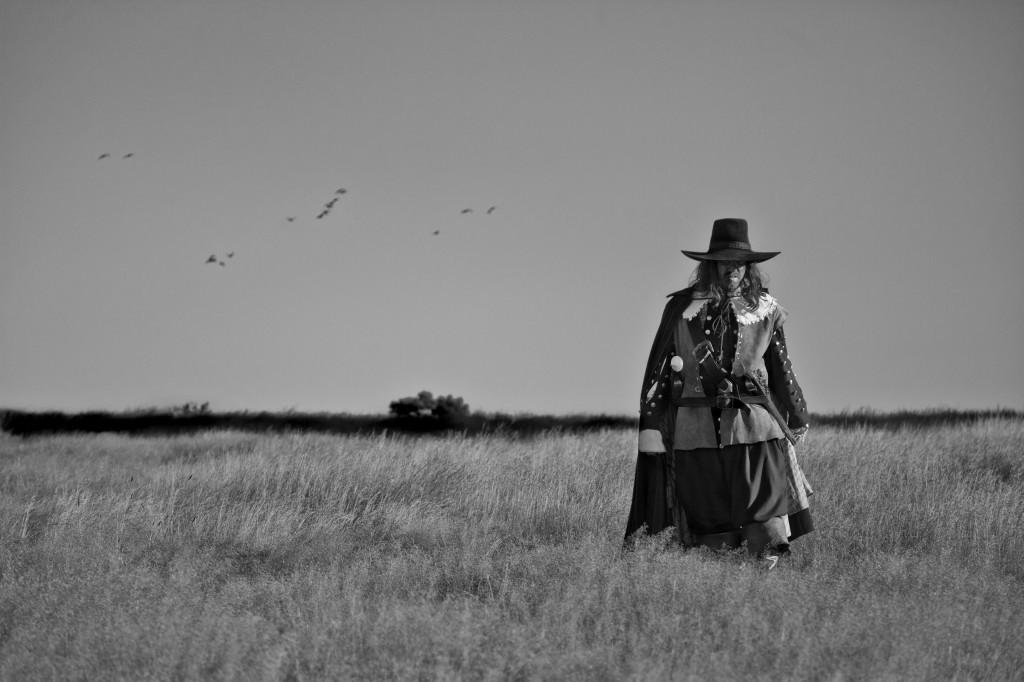
Michael Smiley in A Field In England
Ben Wheatley’s A Field in England was released last Friday across all platforms with the possible exception of kinetoscope. Viewers were offered the option of watching the film at the cinema, on DVD, via digital download or by tuning in to Film4 at 10:45 where the whole thing broadcast without ad breaks.
I dipped my toe in the multiple release formats experience by watching it first on television on Friday night and then seeing it on the big screen on Sunday at the ICA. This showing was followed by a question and answer session with director Ben Wheatley and actor Reece Sheersmith, who stars in the film and is better known as one of the League of Gentlemen. In this session Wheatley discussed how he chose to shoot the film chronologically in order to allow the actors the opportunity to grow with their characters. He also shared his thoughts on the cinematic advantages of shooting in black and white – how it prevents viewers becoming distracted by attractive scenery or costumes and focuses attention on character’s faces. Black and white footage, he says, also highlights dirt and grime.
In which case, he certainly achieved the look he was going for. The images that remain with you after watching A Field In England are the moods, reactions and suffering written on the protagonists’ faces and the grubby muddiness of their surroundings. Continue reading Smiley’s People→
Indy Datta takes a look at the new BluRays of Ghibli’s Grave of the Fireflies and Kiki’s Delivery Service.
After the recent theatrical run for the 1988 Ghibli double bill of Hayao Miyazaki’s My Neighbour Totoro and Isao Takahata’s Grave of the Fireflies, today sees the release of a slew of Studio Ghibli titles in DVD/Blu-ray dual format editions. I was lucky enough to score review copies of Fireflies and Miyazaki’s follow-up to Totoro – Kiki’s Delivery Service. Thoughts on the films and the discs after the jump.
Part of an occasional series in which Spank The Monkey travels to foreign countries, watches films in unfamiliar languages, and then complains about not understanding them
You’re so sadly neglected And often ignored A poor second to Belgium When going abroad Finland, Finland, Finland The country where I quite want to be
– Monty Python, Finland
Quick! Name a famous Finnish film director. I’ll give you bonus points for lateral thinking if you said Renny Harlin, but arthouse cinema fans will probably have plumped for Aki Kaurismäki. Sadly, I didn’t get to see any of his movies on my recent visit to Helsinki, but it’s hard to avoid the man’s presence, particularly if you’re the sort of person that eats food. The Belated Birthday Girl and I kept ending up in restaurants that were either patronised by the director (the menu at Kosmos includes ‘Pike perch with Lobster Sauce and Crayfish Tails au Gratin à la Aki Kaurismäki’), or owned by him. Of the latter, Zetor is probably the best one to go for, with its tractor-heavy décor and its patriotic blueberry pie served in a tin mug, as seen above.
Still, you have to assume that Finnish cinema doesn’t begin and end with Kaurismäki. So I made it my mission, as ever, to track down a couple of the latest domestic releases, and attempt to watch them without the benefit of English subtitles. Good news for all you lovers of schadenfreude: one of these turned out to be Monoglot Movie Club’s first complete failure. Continue reading Monoglot Movie Club: A Poor Second To Belgium→






 MostlyFilm