Category Archives: Home Video

Side by Side

by Sarah Slade

side_by_side_keanu_reeves

One of the interviewees in this thoughtful account of the rise of digital moviemaking called the film production process “sculpting with light”, and they have a point. Film-making captures light and shade, and creates something solid, permanent: a thing that can be carried between places, handled, edited and projected. Whether digital or celluloid, the end result is the same, isn’t it?

Continue reading Side by Side

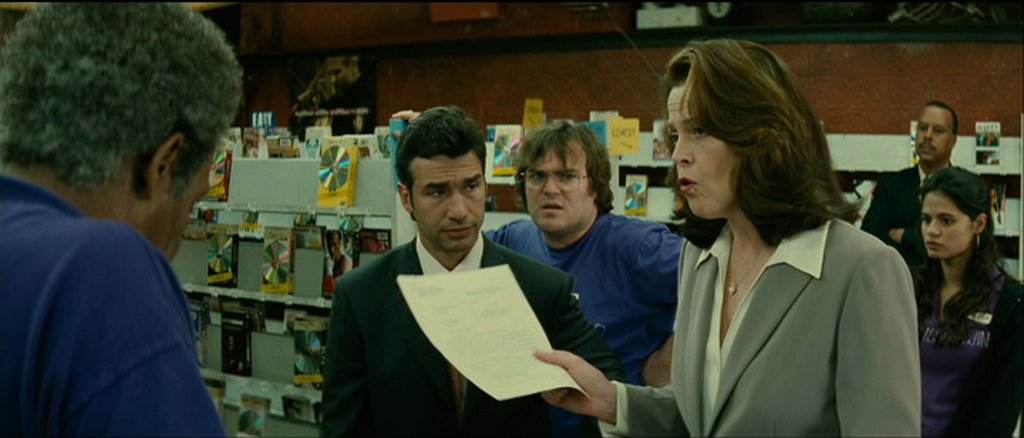
Netflix Roulette

Will video-on-demand recommendations give The Tramp the random joy she used to get from video stores?

‘What do you mean you don’t have Under Siege 3?’ The Tramp in her video rental days.

I like films, a lot. I have liked films a lot for a goodly number of years. Back in the glory days of video rental, I’d easily watch three or four films over a weekend, choosing them with an eye to variety. So if I rented a blockbuster new release I also had to get something obscure or subtitled, or if I rented an action film I’d get a rom-com to go with it.

Random rentals were the bedrock of my taste for years, the source of my guilty pleasures and my not so guilty ones: French cinema, anime, and martial arts movies – particularly when they star Steven Segal and a random rapper. But with the decline
of the video rental store, so the joy of the random video discovery has gone. Which is why I was excited by Netflix and its ‘picked for you’ recommendations service.

Continue reading Netflix Roulette

Enraptured by the details: a Billy Wilder double-bill

by Blake Backlash

It can be difficult to know how to begin. The attempt to come up with a first line for his novel about alcoholism sends Don Birnham, the protagonist of The Lost Weekend, into a bout of sweaty self-doubt. The fear of the blank page is enough make him abandon the manuscript of The Bottle to go searching for an actual bottle.

If Billy Wilder ever experienced such creative uneasiness himself, it doesn’t show in the films. The openings of The Lost Weekend and Double Indemnity are both memorable because of the strikingly assured way they immerse us quickly into their narratives. We watch Fred MacMurray stagger into an office in the wee-small hours and start to dictate a memo, in which he confesses to murder. And we watch Ray Milland through a window, as he packs a suitcase and casts nervous glances towards the bottle of whisky we can see dangling on a rope that hangs out of that window. The endings of both these films will, in different ways, return us to these opening images – this is a pattern that Wilder used most famously in Sunset Blvd, which opens with William Holden’s corpse floating in a swimming pool, as William Holden starts to tell us how he came to be floating there.

Continue reading Enraptured by the details: a Billy Wilder double-bill

Surviving Švankmajer

by Spank The Monkey

Type the name of Jan Švankmajer into YouTube during a dull afternoon at work, and you’ll be rewarded with hours of visually inventive, intellectually playful entertainment. But you’ll probably be rewarded with a P45 as well: the world of Švankmajer is – let’s emphasise this up front – quite definitively Not Safe For Work. Unless you work in a mental institution. Or an abattoir.

Czech surrealist/animator Švankmajer has been making films for close on five decades now, but for the most part they’ve been shorts: in those fifty years, he’s directed only six full-length features. Three of them have just been released on DVD by New Wave Films, and between them they provide a convenient snapshot of his strengths and weaknesses.

Continue reading Surviving Švankmajer

Il Boom

By Blake Backlash

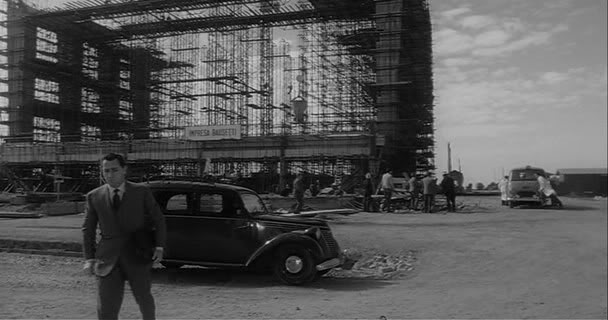
There is a scene in Vittorio De Sica’s Il Boom where a number of well-to-do Italians dance to a band who are performing the tackier sort of early 60s pop song. The lyrics are sung in English. That same quality of a cheap import is imbued in the title of the film. Whereas most European countries created a label in their own language to denote their rapid, post-war economic growth (it is hard to think of a word less German than Wirtschaftswunder), the Italian media co-opted their term from English. ‘Il Boom’ has connotations of something messy and uncontrollable, while at the same time seeming voguish and silly, perhaps even meaningless. Such associations suit De Sica’s satire – which is interested in showing us the empty spaces that might be concealed by the ostentatious sixties prosperity.

Continue reading Il Boom

La Grande Illusion

By Indy Datta

La Grande Illusion – which tells the story of a motley band of French POWs in captivity and on the run during the First World War – was Jean Renoir’s first major commercial success. In the early years of his career (after a short-lived flirtation with the idea of becoming a ceramicist) he had partially financed the string of loss-making silent films he made by selling paintings left to him by his father, the impressionist painter Pierre-Auguste Renoir. Although the advent of cinema sound had suited Renoir’s film-making almost from the start, with successes such as La Chienne and Boudu Sauvé des Eaux, La Grande Illusion – with its more expansive scope and scale and its cast of movie stars, including French man of the moment Jean Gabin – was a hit of a different order, and the first non English-language film to be nominated for the Oscar for Best Picture. Its success (along with the success of his next film, an adaptation of Zola’s La Bête Humaine) gave Renoir the kind of status as a film maker that couples freedom to money. He used that capital to make La Règle du Jeu, a scandalous failure that, the legend has it, drove Renoir out of the French film industry and into the arms of Hollywood. Continue reading La Grande Illusion

If My Calculations Are Correct, Part Four

by Ricky Young.

In this fourth and final part of MostlyFilm’s lookback at the 1983 BBC2 sci-fi season – of which you can read parts one, two and three by simply ‘clicking’ – we are left with what I was previously happy to call the dregs.

A harsh word, I know, but I’ll qualify that by saying that of the fifteen films on the list, they were the ones I wanted to revisit least. My reasoning was (as ever) decidedly shonky, but they seemed to be the pulpiest, the most familiar, the ones nearest to cultural touchstones. I know; boring, right? I’m supposed to be rooting out hidden gems here, not sitting down to bloody Invasion of the Body Snatchers for the zillionth time!

Of course, when I really thought about when I’d last watched all three of these films, rather than read about them, or talked about them, or referenced them – there was only one answer: the 1983 BBC2 sci-fi season. So preconceptions be damned, I reasoned, when sitting down with only an Xbox, a pile of dvd’s, a large bag of Jolly Ranchers and a look of steely determination. We’ve come this far together – last one to the finish-line’s a dirty, stinking communist.

Continue reading If My Calculations Are Correct, Part Four

If My Calculations Are Correct

Part one of a four-part piece, by Ricky Young

Big Expectations

Starting on 11th January 1983, and running over 15 weeks, BBC2 ran a branded season of sci-fi films on Tuesday evenings – crucially, for those who were 10 years old at the time, in that all-important between-tea-and-bedtime slot. Alerted to this by my father, who was always on the lookout for great films in front of which he could fall asleep, I sat on the floor and exposed my brain to far more strange and dangerous cosmic rays than could possibly have been good for me.

It was quite the grab-bag of movies, ranging from early-50’s schlock, late-50’s nuclear hand-wringing, psychedelic 60s romps, 70s paranoia and masses more besides. I watched them all. Little of their importance (or lack of) or legacy (ditto) meant anything to me at the time, but the joy contained in that long string of Tuesday nights still resonated in the back of my brain as an indistinct blur of space-ships, laser-beams and sudden stabs of orchestral menace. I’m not going to get all Nick Hornby on you here, but if I had to track down what kick-started my love for the genre, chances are I’d find it in a four-month excuse for a bunch of cheap repeats.

So when the subject came up in conversation recently, with similarly vague-yet-enthusiastic recollections, I felt it my duty to MostlyFilm – Europe’s Best Website – to revisit some of these half-remembered gems and bring them into sharp and unforgiving 1080p focus. And, I’ll warn you now, take the piss a bit.

Continue reading If My Calculations Are Correct

A Wax Museum With a Pulse

Indy Datta revisits Pulp Fiction

1.

In a clever postmodern/wanky touch, this post will be presented out of chronological order.

2.

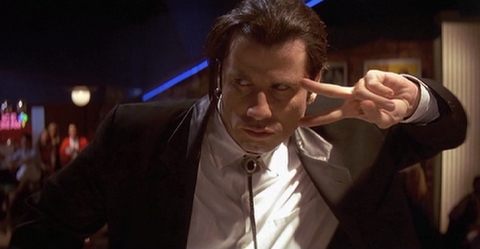
Recently, I attended a screening of Quentin Tarantino’s 1994 breakthrough movie at the Soho Square offices of the British Board of Film Classification. Before the film, Craig Lapper, senior examiner at the board, told us a little bit about the classification history of the film at the BBFC. In 1994, with the murder of James Bulger a recent memory, that old BBFC standby, “imitable behaviour” was a contentious issue in film censorship in Britain, due in large part to fabricated tabloid reports that Bulger’s killers had had their minds murderously warped by repeat viewings of Child’s Play 3 (as quaint and faintly hilarious as that sounds now). Although the film had been passed uncut for theatrical exhibition, when it came to home video, one particular shot particularly disturbed James Ferman, who was then the board’s director: the shot of a hypodermic needle piercing the skin of John Travolta’s smackhead hitman Vincent Vega. Ferman’s belief was that there were certain trigger images that had a quasi-hypnotic effect on drug users, causing them to lose control to their addiction, and that this was one of them. Accordingly, the shot was optically reframed so that home video viewers couldn’t see needle break skin.

Continue reading A Wax Museum With a Pulse