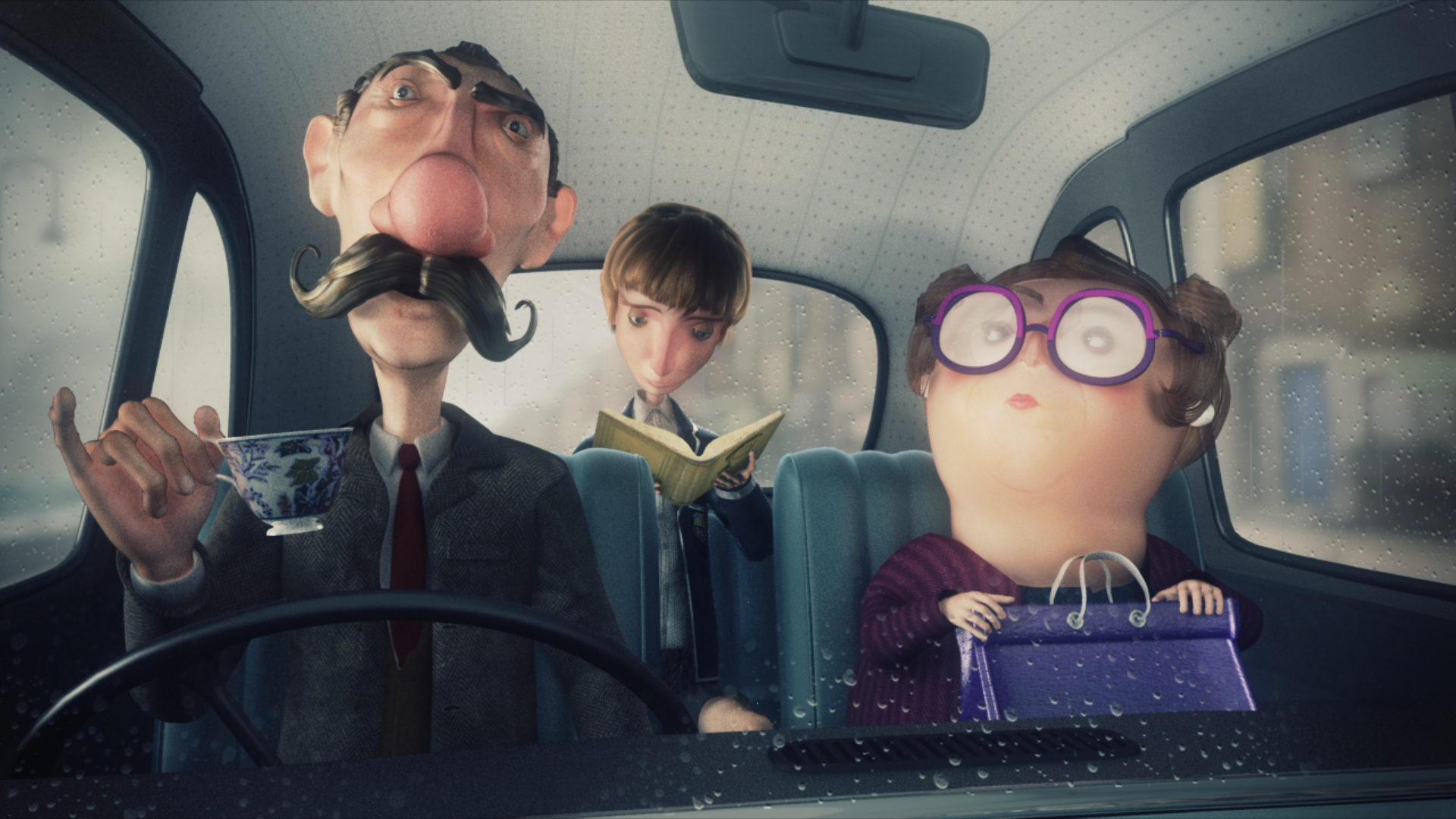
A Liar’s Autobiography: The Untrue Story of Monty Python’s Graham Chapman is based on Graham Chapman’s fictionalised autobiography which was first published in 1981. Chapman recorded an audio version of his book and this voice recording is used as the soundtrack to the film along with new voice recordings from John Cleese, Michael Palin, Terry Jones and Terry Gilliam. Eric Idle is the only no-show from the Monty Python team.
Fourteen different animation studios worked on the project, animating separate chunks of the film. “Creatively, the different styles reflect the stages in Graham’s life.” said one of the directors, Jeff Simpson, in an interview “Also, it saves us a lot of time.”
Chapman died at the age of 48 from throat cancer. The other members of Monty Python’s Flying Circus have forged successful careers as directors, Hollywood A-list actors and the like while Chapman never had much chance to establish a career post-Python. What with being dead and all.
It’s difficult to know what to say about Jennifer Lynch’s Chained, beyond I didn’t like it. I really, really didn’t like it. I don’t like graphic violence, I don’t like the serial killer genre, I don’t like kidnapping stories: the odds were stacked against Chained but I understood that it was trying to say something different about serial killers, so I thought that it deserved to be seen through to the end.
This year’s Japan Foundation film season – entitled Once Upon A Time In Japan, and touring the UK’s arthouse cinemas from today – has a historical flavour to it. All of the films are period pieces of one type or another, showing how Japanese filmmakers use stories of the past to say things about the present day.
Much of the programme hasn’t been seen in the UK before, unlike last year, so I can’t give you quite as comprehensive a preview as I did in 2012. We can’t discuss Hula Girls, the latest example of the Japanese genre in which young people bond during unfashionable physical activity. (See also: Waterboys, Swing Girls, Tits Volleyball.) We have to pass over Kaidan Horror Classics, a portmanteau film featuring big name directors like Hirokazu Kore-eda and Shinya Tsukamoto. Most regrettably, screeners were not available for Bubble Fiction: Boom Or Bust, in which Hiroshi Abe tries to solve Japan’s economic crisis with a time-travelling washing machine. How can the other seven films in the programme stand up against a synopsis like that? Well, let’s find out.
This month on Mostly Pop – old people! Well, some of them are merely getting on a bit in pop terms (ie they are now in their 30s), but some are proper old. Like David Bowie! Remember David Bowie? Ask your granddad etc. Anyway, as Jim touched on in his Music For Old People column last week, Bowie’s back after ten years of, I dunno, playing Call of Duty and wanking. This is his first single since some single literally no-one gave a toss about, and it’s my duty to review it because people apparently give a toss now, plus January is just the worst month for singles releases and I need material. Sorry, Jim, I do know he’s your turf.
Niall Anderson’stears aren’t the only things being jerked byThe Sessions
Peel slowly and see: Helen Hunt and John Hawkes in The Sessions
In what might have been a particularly discouraging life, Mark O’Brien accomplished a great deal. Born in Boston in 1950, he contracted poliomyelitis when he was six and ended up more or less immobile from the neck down. On good days he could move his right foot, and in later years he used this foot to power a motorised trolley to carry him around Berkeley, California, where he worked and studied. He graduated from the University of California (after a prolonged struggle to even be allowed to enrol) and later sued the state to be considered legally independent rather than a ward of his parents. Thereafter, he lived on his own – with help from carers – and supported himself through journalism.
He has also been the subject of a previous film, Breathing Lessons, which won an Oscar for Best Short Documentary in 1997. The opening sequence of Breathing Lessons gives you some idea of what O’Brien was up against: in particular, it gives you the brutal noise and pounding indifference of the iron lung where he was forced to spend most of his time. He could survive for an hour or two outside it, but his lungs were so weak it actively hurt him to breathe.
The opening sequence of The Sessions – a fictionalised account of a period from O’Brien’s life in the 1980s – is practically identical to that of Breathing Lessons. O’Brien, ventriloquized with spooky accuracy by John Hawkes, recites the same poem, and both sequences end with a steady pan along the iron lung until we see O’Brien’s face. But the lung, in The Sessions, is silent. Hawkes speaks the words fluently, with no trace of the forced respiration you hear from O’Brien himself. A good deal of the difficulty of O’Brien’s life is wiped away at a stroke. Indeed, wherever The Sessions finds an unexpected wrinkle in O’Brien’s biography, it quickly and efficiently smooths it over. The frictionless result is not just different from Mark O’Brien’s actual life, but from any life ever lived. Continue reading We Shall Not Be Moved→
You may remember Indy Datta’s review of Samsara back in August (please do check out the images and the stunning trailer embedded in that review, it’s pretty amazing) which concluded with the opinion that ‘Samsara’s images themselves are consistently glorious’ and that the Blu-Ray ‘is destined to become a preferred demo disc of home cinema nerds everywhere.’
Well, nerds, I have good news! The dual-play Blu-Ray will be out on Monday and we have a copy to give away. Give away! Like some kind of competition! Sweet.
All you have to do to win this eye-meltingly beautiful film is email me* with the answer to this question by midnight on Sunday 13th of January:
What is the name of the seminal 1982 ‘visual documentary essay’ Samsara director Ron Fricke worked on as cinematographer?
I will accept slightly misspelled answers. Usual exclusions apply to MostlyFilm contributors, their families and indentured undead servants.
Part of an occasional series in which Spank The Monkey travels to foreign countries, watches films in unfamiliar languages, and then complains about not understanding them
What could be more Christmassy than Brussels? I’m talking about the European city, of course, not the green bollocky things that take up space on the dinner plate which could be more usefully occupied by turkey. The markets, the gluhwein, the 25 metre high installation in the Grand Place that was referred to in some circles as Tree 2.0: a evening stroll through the streets in December will soon leave you with a warm festive glow. (Though that’s probably mainly the gluhwein.)
But inevitably, when The Belated Birthday Girl and I spent Christmas 2012 running round the key cities of northern Belgium, we took occasional breaks from the festivities to catch some of the local movies: two in Brussels, and one in Bruges (though not In Bruges). The locations are important – Monoglot Movie Club is all about celebrating the language problems you encounter with other nations’ domestic cinema, and we ended up with three entirely different sets of problems this time.
Based on a short story by Danish author Karen Blixen (who also wrote as Isak Dinesen), Babette’s Feast (1987) tells the story of two sisters, Martine (played by Birgitte Federspiel) and Philippa (Bodil Kjer) who live in a remote fishing village on the western coast of Denmark. Daughters of a Christian pastor who leads his own sect based on self-denial and austerity, after his death they preside over his dwindling flock, doing good works and living a simple, austere life. Continue reading Master Chef – Babette’s Feast→
Partners in Crime (Associés Contre le Crime... ) (2012) is Pascal Thomas’ third adaptation featuring Agatha Christie’s detective duo Tommy, renamed Bélisaire for a French audience, and Tuppence, going by her full name of Prudence. Christie’s introduced the couple in 1922 in the Secret Adversary. They were a frothy, cheerful couple, who reappeared in Partners in Crime in 1929, a collection of short stories, and a further three novels, the couple ageing with the time passed between the books.
A comic thriller about psychopaths leavesNiall Andersonfearing for his mental balance
Woody Harrelson cures Colin Farrell’s hangover in Seven Psychopaths
Let’s talk about getting shot in the head. Right square in the head so that there’s a sudden arc of blood out the other side, and you fall, not forward, but straight down fast like a puppeteer has just cut your wires. You are now dead, but maybe twitching a bit. An obliging camera will start to pan back from your prone, blood-haloed body until the scene encompasses the hulking figure who’s just done you in. The soundtrack will go quiet for a second or two, because this is what necessarily happens after a murder. But then a strangely soothing pop song will start up from somewhere – say ‘Take It Easy’ by The Eagles – and we see your murderer amble into the next scene with a carefree look on his face. You, on the other hand, are dead.
We have all seen this a hundred times in a hundred movies. The pattern is so exact that even minor variations can change the mood. If the camera lingers on the body rather than pulling away, then we know that this is a particularly significant kill. If, on the other hand, we don’t see a body at all, we know that the killer is a busy man with a lot more killing to do. However the individual scene plays out, the basic scenario is so firmly encoded in the DNA of mainstream film that it takes real talent to find something new to do with it.
Martin McDonagh’s Seven Psychopaths is at least partly concerned with this sort of coding, with the way the morals and aesthetics of cinema become part of the way we see the real world – and real-world violence in particular. It is not scolding or baleful in the Haneke style. Nor does it have Tarantino’s self-conscious aestheticism, where knowledge of cinematic convention is the sole essential justification for novel forms of violence. Put very simply, Seven Psychopaths doesn’t know what it is. The directorial finger is occasionally wagged at the failure of imagination that violence represents. The same finger then closes around a trigger and commits merry mayhem. Lots of people get shot in the head. Continue reading I Know You Are But What Am I?→





 MostlyFilm