All posts by Niall Anderson

Time and Patience

Niall Anderson looks at Sergei Bondarchuk’s epic 1967 recreation of War and Peace, which is showing at London’s Renoir cinema on 7 October at 10am.
War!

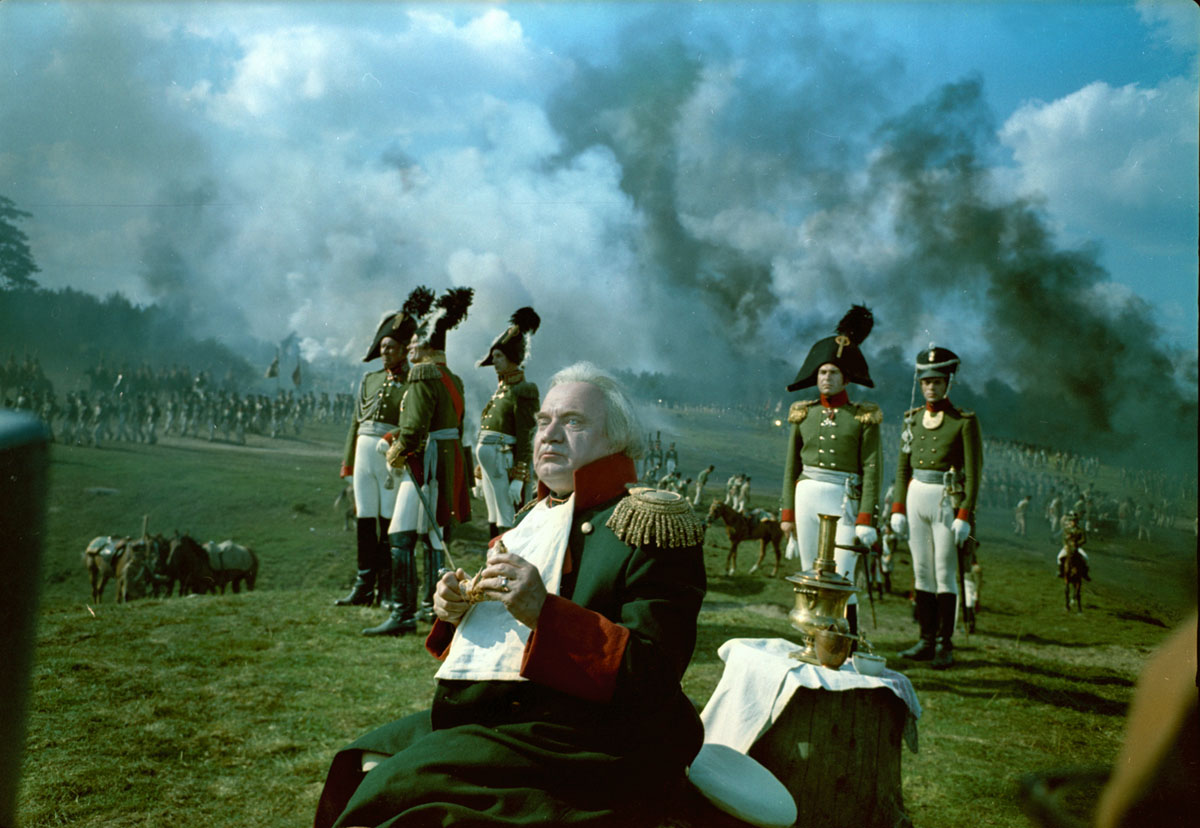
Like the novel it adapts, the single most extraordinary thing about Sergei Bondarchuk’s War and Peace is that anybody had the nerve, skill and patience to bring it off. Granted, Bondarchuk had a technically unlimited budget and the full coercive weight of the Soviet Ministry of Culture behind him (he could, and did, call in 15,000 mounted cavalry to restage the Battle of Borodino), but the politics of the film’s production don’t get close to explaining the surreal attention to detail of the resulting film – nor the fervour with which it tries to animate even the smallest of Tolstoy’s fancies.

Take, for instance, the bear. Readers of the novel will recall that one strand of the plot begins with a policeman being strapped to the back of a bear and thrown into the Neva River as part of a bohemian jape. It would have been easy for the film to just refer to this incident in passing, or to do away with the bear altogether (surely a drenched copper proves the point, whatever he’s strapped to). This is not Bondarchuk’s way. Tolstoy wrote that there was a bear, so there must be a bear. And indeed there he is, unremarked at a dining table during a loud party: one extra among a hundred.

A scene like this could easily be dismissed as a stunt, or – maybe worse – as evidence of a slightly crazed literalism. But there are too many such stunts across the film’s seven-and-a-half hours for that word to carry the necessary weight, and the literalism comes to seem like a shrewd recognition that an epic is really just the magnification of the intimate. So it was in Tolstoy’s hands, anyway, and Bondarchuk seems to have realised that to compromise on the small details would have been to compromise the whole Tolstoyan vision – and his own. Continue reading Time and Patience

You’ll never guess what happened next

Niall Anderson pleads for people to lighten up about spoilers

Kirk responds badly to being spoiled for Friday Night Lights

The first recorded use of the term SPOILER ALERT is from 8 June 1982. It occurred in a Usenet film group (net.movies) and related to Star Trek II: The Wrath of Khan, which had been released the previous Friday. A group member called Hamilton from the University of Chicago employs the term as a warning to other users before speculating [SPOILER ALERT!] on whether Spock is genuinely dead or if he could be brought back for the sequel.

It feels strange to see a meme so fully formed a good twenty years before it hits the mainstream. But it’s all basically here, including the tendency of spoiler etiquette to skew towards cultish material. Look further in the Usenet archives and you’ll see the term being adopted as a simple matter of course and courtesy. A spoiler hierarchy also develops. Minor plot points are preceded by a throat-clearing SPOILER ALERT, while complex or major plot points tend to be translated into a substitution cypher like ROT13 (which replaces a letter with the one thirteen places after it in the alphabet). This way, you couldn’t be spoiled inadvertently.

It’s all nice and civilised, in other words, and it seems to have developed within Usenet without friction: that is to say from a commonsense recognition that not everybody who’s reading will have seen the film that you’ve seen, and would just like to know whether you thought it was good or not. The Usenet archive isn’t exhaustive or particularly easy to navigate, but of the 300 uses of the word “spoiler” I was able to find from the 1980s, none was preceded by a complaint, a tantrum, or a threat of excommunication from the community for apparently saying something too revealing. The anger and the aggression surrounding spoiler etiquette in the Net age simply aren’t there. I don’t often wish I was living in the past, but for this one topic I do.

Open a TV or film discussion thread on just about any online forum these days and the following things will happen. Someone will cry firsties, someone will call foul on the firstie, someone will propose an alternative firstie that makes an oblique jokey reference to something that happened in the thing under review. At which point someone else will appear threatening to kill you and your children if you even think of spoiling the plot. A dozen similar messages will appear at intervals until your scrollwheel goes elastic from the effort and your eyebrows knot themselves into a permanent V at the sheer bad-tempered entitledness of these people. The unintended consequence being that I now read more complaints about spoilers than I do actual spoilers. Continue reading You’ll never guess what happened next

Betting On Red

Niall Anderson looks at the loudness war in cinema

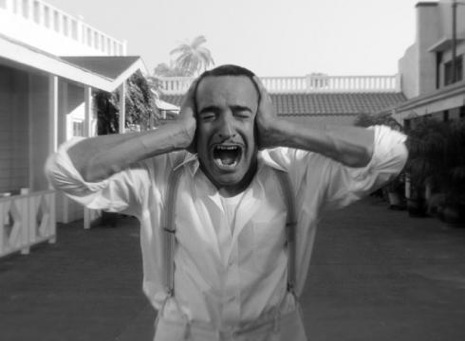
Noise annoys: Jean Dujardin has a terrible dream

A famous technical innovator, Stanley Kubrick was defiantly behind the curve in one regard. He always mixed the sound of his films in mono. His reasoning was simple: you can’t predict the sound environment of a movie theatre. You can’t predict the size of the room, the output or placement of the speakers, the number of channels in a theatre’s mixer or the competence of the projectionist. A complicated stereo mix would leave too much to chance. So just make sure the dialogue is audible, mix the whole shebang in mono, and get the film out there. It will sound pretty much as good in a suburban fleapit as it did on the sound stage.

This may seem like a mere technical consideration, but it has artistic consequences, the major one being that with only one audio track to play with, you have to think carefully about your approach to volume. Working in mono, you can’t have a sudden violent explosion in a viewer’s right ear while the rest of the soundtrack potters on at its usual level. Big surges in volume have to be carefully planned or the entire sound mix will be destabilised. The result being that the loud parts of Stanley Kubrick’s films are rarely objectively loud (in terms of decibels); they’re just loud in relation to the other bits. Mono means that you have to pay equal attention to the quiet stuff.

Of course, it’s entirely possible to achieve this kind of careful audio balance in stereo. Indeed, given the advances in sound recording and mixing afforded by digital technology, it should be easier now than ever. Digital sound recordings have a much wider frequency spectrum than analogue recordings, which means, first, that a larger range of sounds can be captured and reproduced, and, relatedly, that there is now less need to rely on sheer volume to distinguish between – for example – an explosion and dialogue. In addition, the technology gap between what a sound designer hears on the sound stage and what the moviegoer can expect to hear in the theatre has drastically narrowed since Kubrick’s heyday. Even the worst suburban fleapit now has Dolby Digital stereo sound, and even the most careless or high-handed sound designer will have this minimum standard in mind when mixing and mastering the sound for a film. For all these reasons, we should be living through a golden age of sound: crisper, cleaner and more dynamic than before. So why are people leaving IMAX screenings of The Dark Knight Rises, for instance, complaining both that the whole thing is too loud and that the dialogue is inaudible? Surely a purpose-built IMAX theatre is the perfect environment to see it? More generally: why hasn’t the golden age come to pass? Continue reading Betting On Red

A Home at The End of The World

Niall Anderson looks at a new book about Andrei Tarkovsky’s most mysterious film


Stalker doesn’t ask much of the viewer. It tells a clear, simple story. It’s not tricksy, obscure or up itself. Every scene seems perfectly calculated to either raise an interesting question or provide a more interesting answer. Its ending is a real ending (one of the most memorable in all cinema, in fact). So yes: Stalker is easy. All it asks is that you give it your complete and sincere attention for nearly three hours, preferably without blinking.

Continue reading A Home at The End of The World

Actor! Actor!

Niall Anderson looks at the history of actors writing fiction

Would you buy a used Western from this man?

You can’t imagine Popeye Doyle writing a novel. Buck Barrow barely lived long enough to read one. Royal Tenenbaum wouldn’t write a novel, but he might pass off someone else’s as his own. Harry Caul, on the other hand, looks to have the necessary focus, but he’d need to put down that saxophone and stop going insane for a while.

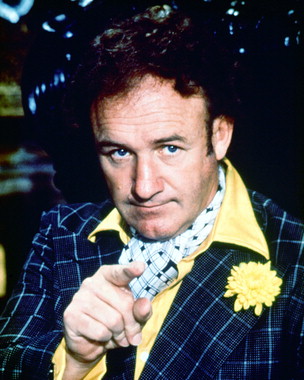
Gene Hackman, the man who played all these parts, hasn’t made a movie in almost a decade, but he has used his relative leisure to write four novels. Gaunt, sparely told and resolutely unmodern, the first three are blown off-course every few chapters by excitable procedural interludes – long disquisitions on how to cast an anchor in a storm, for example, or dredge up a sunken chest from the bottom of the ocean. It doesn’t seem unreasonable to lay these passages at the door of Hackman’s co-author, Dan Lenihan, a retired marine archaeologist once charged with salvaging the debris from Pearl Harbor.

For his fourth novel, a western called Payback at Morning Creek, Hackman has done what all great gunslingers and novelists must do: he’s struck out alone. Gaunt, sparely told and unmodern like never before, Payback at Morning Creek does away with Lenihan’s antic boyishness and substitutes for it an epic manliness that is all Hackman’s own. Thus remasculated, Hackman turns his attention to the real business: that of rewriting Shane from memory. Continue reading Actor! Actor!

Mostly Links – 3 February 2012

by Mostly Film

Meeting people is easy: Mostly Links on his monthly outing

Contrary to what you might expect, Mostly Film has a life outside blogging. Disguised as a perfectly normal human being (only a bit squintier), Mostly Film sometimes even leaves the house to meet other people, and has tea with them, or dinner, or a drink. You may even have sat next to Mostly Film on a bus and not realised it.

Mostly Film also has opinions about things that aren’t film or telly. They aren’t always grown-up or fully formed opinions – they tend to involve the words ‘aspect ratio’, whatever the topic – but they’re definitely opinions. Just ask, next time you’re sitting on a bus next to a perfectly normal human being (only squintier).

For instance, yesterday Mostly Film heard US Republican presidential hopeful Mitt Romney say that this year’s election run-in is going to be “the most vitriolic, spiteful campaign in American history.” Now, is that a threat, a promise, or a plea for mercy? Might it even be a request for advice? Mostly Film has chosen to believe it’s the last option, so this week’s Mostly Links is all about the dirtiest elections in screen history. Continue reading Mostly Links – 3 February 2012

I Don’t Like Loose Ends: Steven Soderbergh’s Haywire

"Unready for my close-up": the elusive Steven Soderbergh

By Niall Anderson

The first problem with auteur theory is that it made everyone want to be an auteur. The second is that auteurism made versatility a matter of special regard, rather than an essential part of a director’s make-up. As auteurism took hold in the 70s, the salaried DIY wizards of Hollywood’s middle years must have wondered what was suddenly so impressive about people directing and writing their own movies. Not long before, writing and reworking scripts had once been an essential facet of the director’s job: you just didn’t get a credit for it. And yet here was someone like Robert Altman doing the same thing, and being called a genius. Continue reading I Don’t Like Loose Ends: Steven Soderbergh’s Haywire

Mostly Links – 30 September 2011

By Niall Anderson

If we only really see the big Oscar contenders in December and January, then this is the period in which we begin to see the outliers and the chancers: the films that need a strong headwind and decent box office in the Anglosphere to compete.

This is particularly true of non-English language films and films where the star wattage comes from a single obvious source. We saw this last week with Drive, where the appeal of a stellar cast (including the prettily robotic Ryan Gosling) is balanced against the rather less obvious draw of director Nicolas Winding Refn, previously known only to suburban misanthropes with violent dreams. Continue reading Mostly Links – 30 September 2011

Kill BBC4

By Niall Anderson

Do you remember the furore when BBC Knowledge was axed? Were you part of the protest?

Here was a channel dedicated to the purest Reithian ideal. It had science documentaries, serious arts coverage, challenging first-run drama and comedy. It ran twenty-four hours a day. It had recognisable anchors and presenters. Now its budget and personnel were going to be slashed by two-thirds.

Its replacement would be a mere eight hours of programming every night. Most of that would be repeats and imports. BBC Knowledge had won a small but committed audience that was growing month by month. It was surely too soon to pull the plug.

This was 2002. Continue reading Kill BBC4