Paul Duane takes a look at Emmanuelle V, a late film by one of one of cinema’s strangest and most specific auteurs, Walerian Borowczyk, for Shadowplay’s Late Films Blogathon.

Paul Duane takes a look at Emmanuelle V, a late film by one of one of cinema’s strangest and most specific auteurs, Walerian Borowczyk, for Shadowplay’s Late Films Blogathon.
Indy Datta takes a look at the top-notch new Blu-ray of Philip Kaufman’s remake of “Invasion of the Body Snatchers”, released by Arrow Video on Monday.

Indy Datta is about as much of a Wes Anderson fan as it’s possible to be but finds Matt Zoller Seitz’s new book about the director charming, but too slight, and too polite.

The Invisible Woman (Ralph Fiennes, 2013)
Ralph Fiennes’ second outing as director, following Coriolanus, sees him shift from one of the traditional choices of the serious thesp-turned-filmmaker, Shakespeare, to the other – costume drama. An adaptation of Claire Tomalin’s biography, The Invisible Woman is the story of Nelly Ternan, the actress who for many years was the mistress of Charles Dickens.
We initially meet Nelly (Felicity Jones) some years after Dickens’ death; now married with a family, she is directing a school production of a play by Wilkie Collins. This stirs up memories of how she first met Dickens when, aged 18, she performed in the same author’s play.
The Charles Dickens presented here is a showman who lives in the full glare of celebrity (in one scene, he is mobbed by adoring fans). He is larger than life, effusive if perhaps somewhat egotistical, and shows a warmth not generally associated with Fiennes. However, once you get over the shock that Dickens isn’t being played by Simon Callow, Fiennes is quite successful in the role; I particularly enjoyed his scenes with Tom Hollander as Wilkie Collins.
Unfortunately, I was less engaged in his relationship with Nelly, whose dilemma really should be the most interesting element of the film. Though the pair are swiftly attracted to each other, Nelly is reluctant to enter into a sexual relationship with a married man (though I was unclear exactly what she was expecting to happen). Her mother (Kristin Scott Thomas) is more conflicted, concerned for her daughter’s reputation but pragmatic enough to recognise a chance for economic security when she sees it. Dickens’ behaviour is also cause for concern; in at least one instance, he treats his family in an utterly unconscionable manner.
In a film about an illicit relationship, it is odd that it’s over 70 minutes before we get any sense of passion between the two leads. Whether this sense of restraint was the choice of Dickens or of Fiennes, I can only guess; either way, it makes this tasteful, well-performed film a colder affair than you feel it should be. – Gareth Negus
The Invisible Woman is due for release in the UK on 7 February 2014. Continue reading London Film Festival 2013: Closing Day Round-Up
Victor Field sees composer extraordinaire Danny Elfman cut loose at the Royal Albert Hall
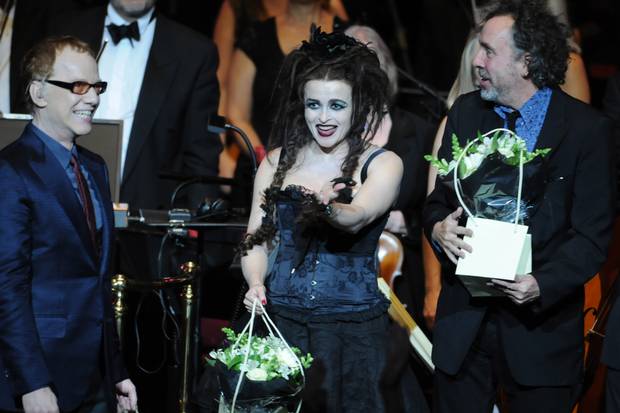
Until Monday 8 October 2013, I’d never have thought that I’d celebrate a first at the same time as Danny Elfman, but there you are. That night was the first time I’d ever attended a world premiere concert, and that night marked the first time he’d had a concert devoted to his music for film rather than as a member of the Mystic Knights of the Oingo Boingo.
Danny Elfman’s Music From The Films Of Tim Burton (surprisingly not sponsored by Ronseal) premiered to a packed audience at the Royal Albert Hall before going to Leeds, Glasgow and Birmingham, and hopefully the punters there had as glorious a time as most of those attending the RAH.
In the first of today’s two LFF updates, Ricky Young reflects on a handsome restoration of an ugly film
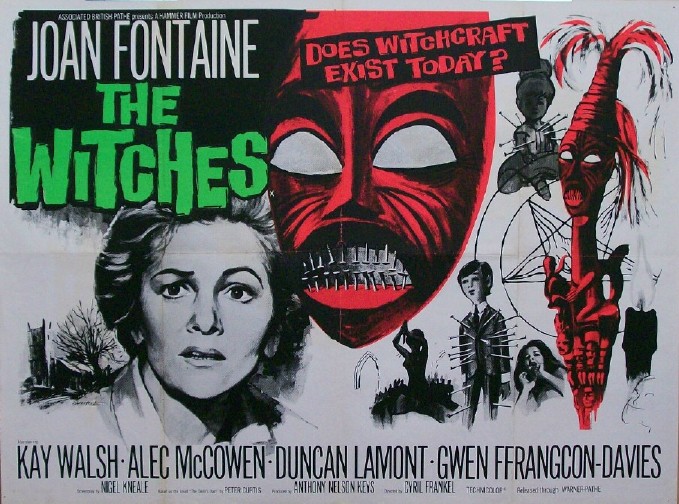
Today sees the LFF unveiling of the restored version of overlooked Hammer potboiler The Witches. Directed by Cyril Frankel and written by Nigel Kneale, it stars Hitchcock Oscar-winner Joan Fontaine in what would turn out to be her last cinematic role.
The Witches rarely gets much of a mention when discussing Hammer’s output – none of the big Hammer names or stars are involved – and despite the admittedly glorious-looking restoration, it’s not hard to see why. Even at their tackiest, the Hammer greats always had a spark of audience-pleasing oomph at their core. The Witches’ most exciting moment features six seconds of runaway livestock. Make of that what you will. Continue reading London Film Festival: The Witches
Caulorlime watches out for smokies with a can on his back. Come on!

“I don’t know where to start with this” is a terrible cliché. It’s used by lazy writers to suggest bewilderment at the oddness of a concept that usually turns out, after a little unpacking, to be utterly mundane. It’s apt here, though, because trying to write about Convoy, the 1978 Sam Peckinpah movie about lorry drivers that was based on a novelty song, left me with, literally, too many choices about where to start.
I’m a smart-arse. That should really go without saying. Being a smart-arse is sort of my thing*. It didn’t serve me well here. Every time I started writing about this film I ended up ridiculing a different aspect of the weirdness, and that didn’t work. You can’t just pick this thing apart and mock its constituent pieces. You need to try and mock it as a whole. Convoy isn’t really a product of the paranoid seventies**, or a product of right-wing America***, or of an occasionally great director phoning it in****. It isn’t even a cautionary tale about attempting to construct a coherent narrative out of a three minute pop song sung/rapped in a baffling slang*****. I mean, it’s all of those things, but it’s also much, much less. Continue reading “Ain’t she a beautiful sight?”
Federico Fellini’s Satyricon gets a rare public screening in London next week. Niall Anderson welcomes it back.

Little dates faster than cinematic representations of the future; except perhaps cinematic representations of the past. Federico Fellini’s Satyricon (or, to use its pettifogging official title, Fellini-Satyricon) is ostensibly set in and around Nero’s Rome, but it couldn’t be more 1969 if it quoted Shelley while opening a big hamper of dying butterflies in Hyde Park.
A rarefied episodic adventure involving witches, cannibalism, mutilation and at least one character becoming a god, Satyricon is so committed to modish 60s estrangement techniques that the viewer is sometimes distracted from what’s really strange about it. Not the nudity, the gore, the jump-cuts, the spikily intrusive score, or the scenes that end mid-sentence; rather the bizarre calmness of the cinematography and a casual scenic beauty that constantly upstages the actual drama. Satyricon doesn’t play these aspects off against each other so much as it keeps piling them on, layer after layer. For all the deliberate dreamlike elaboration of its technique, Satyricon comes across as a very different dream to what Fellini may have intended. Continue reading A Science Fiction of the Past
Spank The Monkey hails a film festival with a twist.
Remember cinemas? They used to be good, didn’t they? And now they’re not. Many people have offered their solutions to the problem, but the only thing we can agree on is that we should ignore anyone who uses the phrase ‘second screen experience’ without an accompanying ‘wanker’ hand gesture. So what can be done?
Maybe we should look at the example of one of the best cinemas. Between 1981 and 1993, the Scala was a London cinema club with a wildly eclectic approach to programming. Its twelve-year mission to introduce audiences to the most extraordinary films on the planet was celebrated in a 2011 festival called Scala Forever, which I reported on at the time. It was a great way to commemorate a long-gone icon, but it wasn’t quite a permanent monument. An upcoming festival called Scalarama, on the other hand, has much larger ambitions. Continue reading Scalarama
James Deen! Lindsay Lohan! Bret Easton Ellis! Paul Schrader! Yes, it’s The Canyons. What, wonders Niall Anderson, could possibly go wrong?
The Canyons begins with scenes of boarded-up cinemas in Hollywood. The historic home of movies is now inhospitable to them. A little later, a friend asks Lindsay Lohan’s Tara why she’s cooled off on a particular film project. ‘When was the last time you saw a movie that really meant something to you?’ she replies. The answer is a dodge for all sorts of reasons particular to Tara, but it nicely incarnates both the epic self-indulgence of The Canyons and its ambivalent sadness about the end of Hollywood as dream factory.
Most of the pre-release notices of The Canyons have focussed on its sensational behind-the-scenes aspects: the stunt casting (porn star James Deen; teen-starlet-turned-trainwreck Lindsay Lohan), the Kickstarter campaign to fund it (which didn’t actually kickstart anything), and the unholy alliance between nihilist author Bret Easton Ellis and moralist director Paul Schrader. The most sensational thing about the film turns out to be how exactly it maps to your expectations: The Canyons is, in several respects, a film you don’t need to see. Continue reading Dismay of the Locust
 MostlyFilm