Niall Anderson looks at Sergei Bondarchuk’s epic 1967 recreation of War and Peace, which is showing at London’s Renoir cinema on 7 October at 10am.
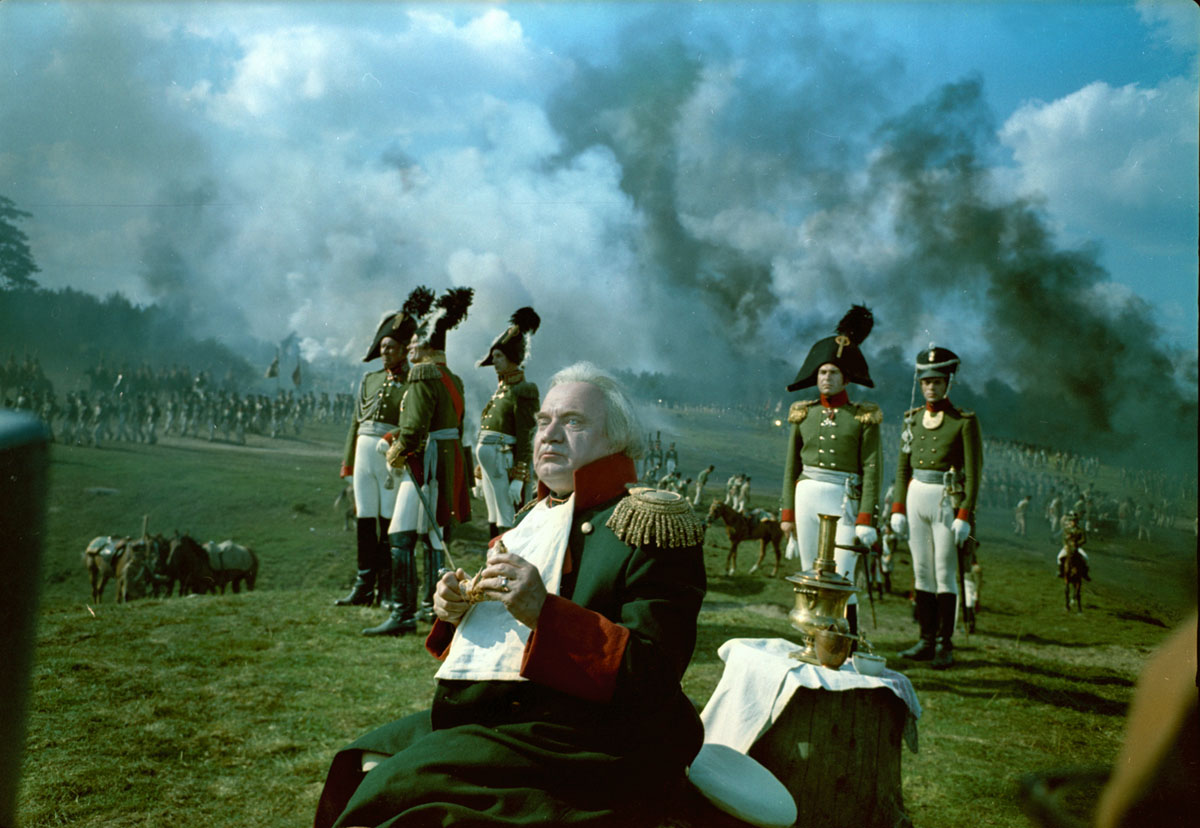
Like the novel it adapts, the single most extraordinary thing about Sergei Bondarchuk’s War and Peace is that anybody had the nerve, skill and patience to bring it off. Granted, Bondarchuk had a technically unlimited budget and the full coercive weight of the Soviet Ministry of Culture behind him (he could, and did, call in 15,000 mounted cavalry to restage the Battle of Borodino), but the politics of the film’s production don’t get close to explaining the surreal attention to detail of the resulting film – nor the fervour with which it tries to animate even the smallest of Tolstoy’s fancies.
Take, for instance, the bear. Readers of the novel will recall that one strand of the plot begins with a policeman being strapped to the back of a bear and thrown into the Neva River as part of a bohemian jape. It would have been easy for the film to just refer to this incident in passing, or to do away with the bear altogether (surely a drenched copper proves the point, whatever he’s strapped to). This is not Bondarchuk’s way. Tolstoy wrote that there was a bear, so there must be a bear. And indeed there he is, unremarked at a dining table during a loud party: one extra among a hundred.
A scene like this could easily be dismissed as a stunt, or – maybe worse – as evidence of a slightly crazed literalism. But there are too many such stunts across the film’s seven-and-a-half hours for that word to carry the necessary weight, and the literalism comes to seem like a shrewd recognition that an epic is really just the magnification of the intimate. So it was in Tolstoy’s hands, anyway, and Bondarchuk seems to have realised that to compromise on the small details would have been to compromise the whole Tolstoyan vision – and his own. Continue reading Time and Patience



 MostlyFilm