The Kid With a Bike (Jean-Pierre Dardenne, Luc Dardenne, 2011)

Sunshine! Beethoven! Cécile de France!
The Kid With a Bike (Jean-Pierre Dardenne, Luc Dardenne, 2011)
Sunshine! Beethoven! Cécile de France!
Damsels in Distress (Whit Stillman, 2011)

Sandra Hebron’s last choice as LFF surprise film proved hilariously divisive. As the cast, shot in gauzy cheap-looking HD video, deadpanned the first lines of Stillman’s arch, absurdist dialogue over Mark Suozzo and Adam Schlesinger’s preposterously kitsch underscore, I could feel the hostility in the room boiling over almost instantly. And, to be fair, Stillman’s film is deliberately alienating – challenging you to be on its decidedly obscure wavelength with an unpredictable mix of ultra-precious whimsy, deliberately unconvincing characters (most of whom, irony piling upon irony, are ineptly playing false roles within the film’s narrative), hilariously cheap gags and gimpy musical numbers (just to give you a flavour: Adam Brody and Greta Gerwig appear to dance on water in a fountain, to Gershwin’s Things Are Looking Up (from the P.G. Wodehouse-penned Fred Astaire movie, A Damsel in Distress) but the cheap-looking platform they are actually dancing on is right there in plain view). Although Stillman’s previous films were somewhat mannered and artificial, they also had one foot in reality, a concept which Damsels in Distress has no particular time for.
So, fair warning: Your Mileage May Vary. But I had a great time.
Wild Bill (Dexter Fletcher, 2011)
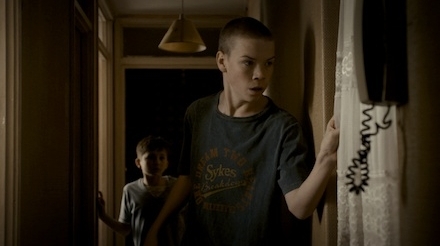
A 35-year on-screen veteran of film and TV, Dexter Fletcher makes his writing and directing debut with a warm, funny and tightly-plotted East End drama that adeptly mixes crime and family plot strands. Charlie Creed-Miles plays the Bill of the title (“More like Mild Bill,” as one wag obligatorily but unwisely observes at one point) – coming out of prison on licence after an eight-year stretch for a veritable portfolio of offences accrued while working as a low-level drug dealer, to find that his children, 15 year-old Dean (Will Poulter) and 11 year-old Jimmy (Sammy Williams), are fending for themselves after having being abandoned by their mother, who has run off to Spain with her new man, and don’t really want to know him. Soon, Bill finds himself besieged on all sides: his probation officer (Olivia Williams) and the police want him to steer clear of his old crew; the old crew want him to slot right back into his old life or get the fuck out of Dodge; social services (represented by Jaime Winstone and Jason Flemyng) want him to stick around and take responsibility for his kids. And there are further complications as Jimmy finds himself sucked into the life his father is trying to leave behind.
Lotus Eaters (Alexandra McGuinness, 2010)

An object lesson, in the perils of writing what you know, if what you know is partying with the young, rich, beautiful and boring, Lotus Eaters cares less about its story (apparently beefed up from McGuinness’s almost plotless first draft by co-credited Brendan Grant) and more about hanging out with its characters as they hop from bacchanalian party to Notting Hill café to gallery opening, in the hope that we’ll eventually come to feel their pain.
Oslo, August 31st (Joachim Trier, 2011)

I adored Joachim Trier’s last film Reprise, a brilliant, understated drama about an academic rivalry between a pair of close friends in Oslo. His follow-up, Oslo, August 31st, is an equally impressive effort, again about some of the difficulties of educated, middle-class living.
Like Reprise, Trier’s new film stars Anders Danielsen Lie. Lie gives an astonishing performance as a recovering heroin addict, who has been in rehab for nearly a year. The film opens with him attempting suicide, before being allowed out into Oslo for a job interview. He takes the opportunity to see friends and family members.
The film is almost unbearably tense: we know he’s in terrible shape, yet his counsellors, friends and family don’t. We know his life is potentially at risk, and that he isn’t free of the demons that led to his addiction. We know that August 31st, in Oslo, is the day that will define his life.
Weekend (Andrew Haigh, 2011)

Weekend tells the story of two people. In the coming months it will be labelled and marketed as a gay movie, and it is – and probably the first time contemporary gay life has been depicted with such accuracy and sensitivity – but first and foremost, it’s a story of these two specific people, at this specific time in their life, and what transpires between them.
Where do We Go Now? (Nadine Labaki, 2011)

Nadine Labaki’s first feature, Caramel, was a pretty crude but fairly likeable sitcom/soap – a Beirut-set Cutting It or Beauty Shop, notable mostly for being the rare middle-eastern film seen in the UK that doesn’t primarily deal with the region’s volatile politics. Her deeply silly follow up, which won the People’s Choice award at this year’s Toronto Festival (thereby joining a recent lineage of really lousy movies that people – and Oscar voters in particular – really love: the previous two winners were Slumdog Millionaire and The King’s Speech) finds her turning her attention to Christian-Muslim sectarian tension in Lebanon, through the story of one unnamed village, and finds her massively overmatched by her subject material.

I Wish is an absolute delight. It tells the story of two young brothers whose parents have split up; the mother took the elder brother to live with her parents, leaving the father and younger brother behind. The split was acrimonious, and so the boys must communicate by phone, in secret. The mother’s family live in a town across the water from an active volcano; its looming presence fills the sky and ash falls more or less all the time, coating the town in a dull film that has to be constantly cleaned up. It’s a state of depressed limbo that reflects the lives of the family; things are unresolved. The film centres around the elder boy’s desire to bring the family back together; he decides that if the volcano exploded it would resolve things once and for all by forcing an evacuation of his town, and his parents to reunite. He ends up leading an expedition of children, each bringing a desire of their own, on a quest to reach a magic place where two Shinkansen trains will pass each other for the first time, which the kids believe will create enough energy to make wishes come true.
The Giants (Bouli Lanners, 2011)
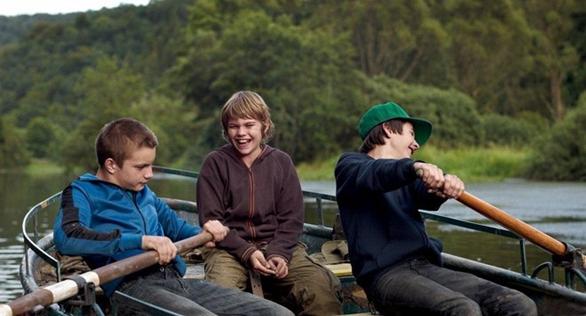
A joy, from the first frame to the last. Director Bouli Lanners will be familiar to LFF audiences from his apearance as a transsexual assassin in Gustave de Kervern and Benoît Delépine’s anarchic Louise-Michel, and his last film, Eldorado, was one of our recommended obscure gems.
by Indy Datta

The festival opener, Fernando Mereilles’ 360 – a reimagining of La Ronde written by Peter Morgan and starring an embarrassment of top global thesping talent (Eminem and Jude Law, together at last! Or cosmically connected at last, or something) is digitally unspooling to the first night audience right about now (I’m writing this the evening before publication).
We should be bringing you a review of 360 in the next few days, along with reviews of other films playing in the first days of the festival. In addition, you can follow our Twitter feed for our instant reactions to films and retweets of other writers’ reactions throughout the festival. In additional addition, we’re still on the lookout for people to send in their own reviews, as previously noted. And in addition to that, why not join in in our comments section? You know you want to.
 MostlyFilm