Category Archives: Film Festivals

Raindance Film Festival 2011

By Indy Datta

Up front, an apology for the films, I didn’t see at this year’s Raindance Film Festival, whether because I couldn’t get in to the screening, because I got the time of the screening wrong by two hours, because I got stuck at the office, or because Westminster City Council decided at the last minute that that freaky Cuban movie would warp my fragile little mind. It takes, you might argue, some kind of special incompetence to spend the bulk of one’s spare time at a film festival for a week and yet not see a single one of the festival prize winners, but this is the hand I have to play.

With that out of the way, let’s get to the reviews, in the order I saw the films.

Continue reading Raindance Film Festival 2011

Ten Highlights of the 2011 San Sebastian Film Festival

by Matthew Turner

Be still, my beating heart!

I’ve been going up to Edinburgh every year for the Edinburgh Film Festival since 2001 but until four weeks ago I had never been to an international film festival. Every year, when the San Sebastian Film Festival rolls around (just a few weeks before the London Film Festival but, crucially, not clashing with anything else) and fellow film reviewers come back raving about it I am consumed with jealousy, so this year I thought I’d take the plunge and go. I left it all till the very last minute (including a nail-biting emergency passport renewal) but I got a great hotel  recommendation from a friend, and the nice lady at the festival’s travel bureau sorted me out with a cheap flight, so I was good to go. Needless to say, I’m glad I did. It’s a wonderful festival in a beautiful city and I will be going back every year for the rest of my life. After the jump, my ten highlights from this year’s Donostia (that’s what they call San Sebastian in San Sebastian).

Continue reading Ten Highlights of the 2011 San Sebastian Film Festival

London Spanish Film Festival 2011

By Susan Patterson

Pa Negre (Black Bread)

Aside from Almodóvar, Spanish films barely get a look-in in the UK outside of festivals, and sometimes not even then (there are four Spanish films at the forthcoming London Film Festival and there were none at Edinburgh this year). Fans of Spanish film should be grateful, then, for the London Spanish Film Festival, now in its 7th year.

Continue reading London Spanish Film Festival 2011

London Film Festival 2011 – MostlyFilm Needs You

by Indy Datta

The London Film Festival starts in just over a week. MostlyFilm will be going big on coverage of the festival, bringing you daily reports for the duration. We’re doing this for many reasons, but one reason is that, in a way, MostlyFilm owes its existence to the LFF. Many of our contributors first met on the LFF messageboards over a decade ago, which went on to become the Guardian’s film talkboards, where more of us joined. This blog was started when the Guardian closed those talkboards earlier this year. We’re sentimental about the LFF.

So here’s the thing – we want our readers to be part of the festival coverage as well. We want MostlyFilm to be the first place you come to during the festival to get our writers’ reactions on the films and events, but also to be the first place you’ll come to share your reactions.

What we’re looking for is capsule reviews. 200 to 500 words. We’ll be running as many as we sensibly can every day, no deadlines, so you can send your first reactions or let things percolate a bit before you write. We’ll happily run more than one review of films that are worth talking about, so don’t worry about what we’ve already got; write about what inspires you (positively or negatively). We’d love to run reviews from “pro” critics who might have something their main outlets can’t use, but if you’ve never reviewed a film before, we’d love to run your work too.

Boring T&Cs stuff. We can’t pay (or get you into screenings, or reimburse you for tickets), but you retain the copyright in your work. We don’t promise to run everything submitted.

Drop me a line, then, if you fancy getting involved? Or just send me your reviews. Either way, the address is editor@mostlyfilm.com and I’m looking forward to hearing from you.
The London Spanish Film Festival: Preview

In the next two months, Mostly Film will be covering a number of major film festivals in depth, including the BFI London Film Festival, the Raindance independent film festival and the London Korean Film Festival.

Susan Patterson kicks off this series with a look at the London Spanish Film Festival, which starts today.

Andrucha Waddington's 'Lope'

Spanish is the first language of some 400 million people on earth, but in 2009 only 12 Spanish-language films were released in the UK.

The 7th London Spanish Festival is previewing a handful of films that will get a general UK release (such as tonight’s gala film at the Ciné Lumière, Andrucha Waddington’s Lope), but more striking is that almost every film in the core programme is a UK premiere. And in many cases it will be your only chance to see these films on a big screen. Continue reading The London Spanish Film Festival: Preview

Assignment: Terror

Gareth Negus creeps from behind the couch to let us know about the best and worst of FrightFest 2011

“But … but – where are the bees?” Britania Nicol in The Wicker Tree

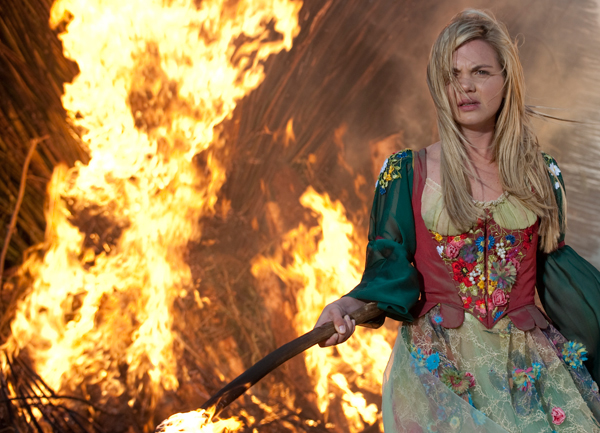
Horror is a broad church, and the FrightFest 2011 programme reflected that.  37 films, mostly British or American in origin but with a solid international selection, meant most people could reasonably expect to find something to upset or repulse them. Continue reading Assignment: Terror

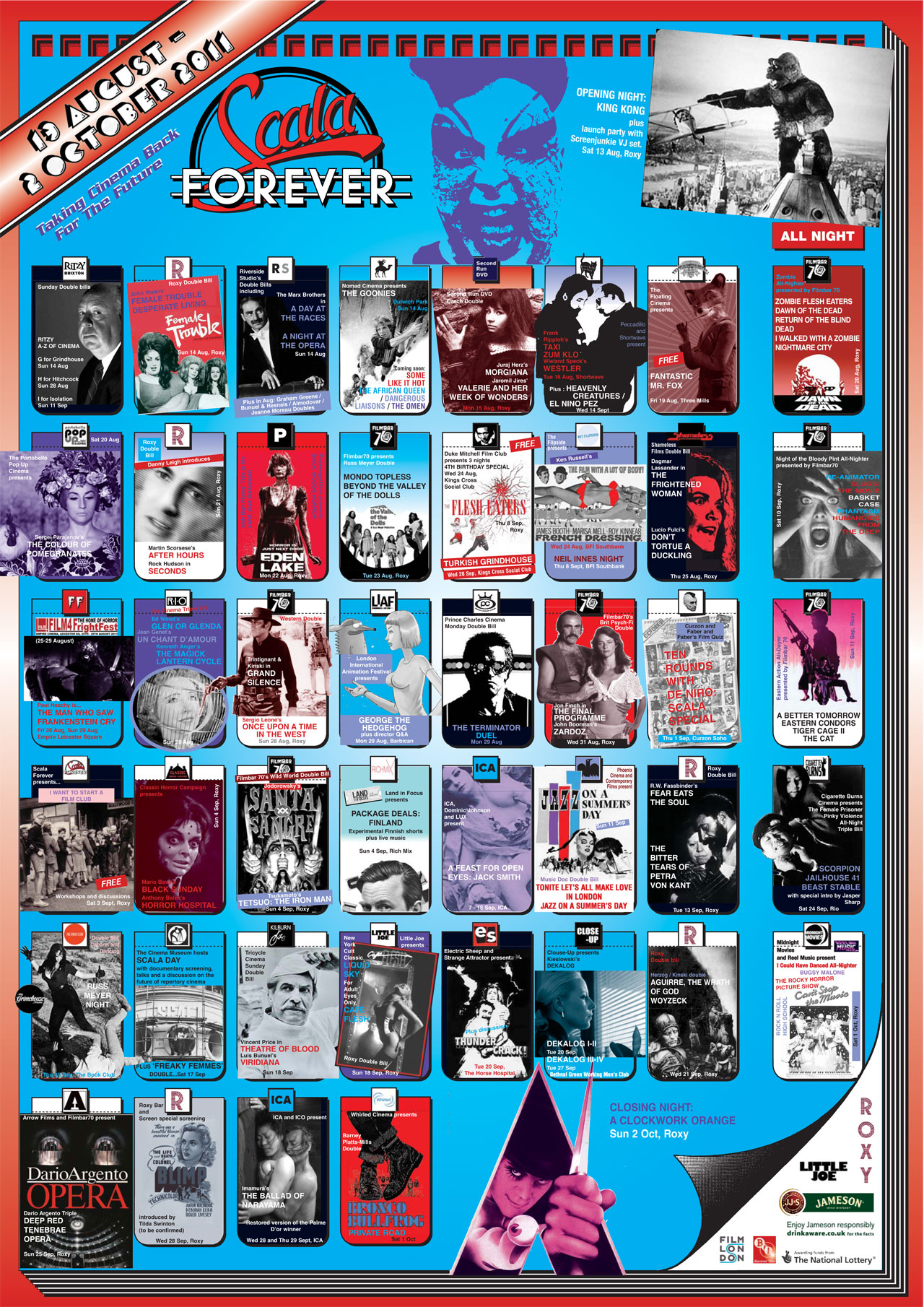
Scala Forever*

*(well, 1985-1993)

Spank The Monkey introduces the Scala Forever season by looking back at the history of one of London’s most-beloved fleapits

Trust me, this is one picture you really need to click on to enlarge

Screw Proust and his madeleines: that picture there takes me back a quarter of a century, and it doesn’t require a tea chaser in order to do it. Twenty-five years ago, I virtually lived at the Scala cinema in King’s Cross, and eagerly awaited the monthly arrival of a programme flyer very much like the one shown above.

The Scala was possibly the greatest of London’s repertory houses, back in the days when the capital had around a dozen of them. As the London-wide festival Scala Forever commemorates the opening of the cinema thirty years ago, I’ve been looking back fondly at the time I spent there watching all the underground greats. Russ Meyer. John Waters. Herschell Gordon Lewis. Jörg Buttgereit. Tsui Hark.

So it annoys me a little to be reminded that the first film I saw there was Garry Marshall’s The Flamingo Kid. Continue reading Scala Forever*

London Indian Film Festival 2011

by Indy Datta

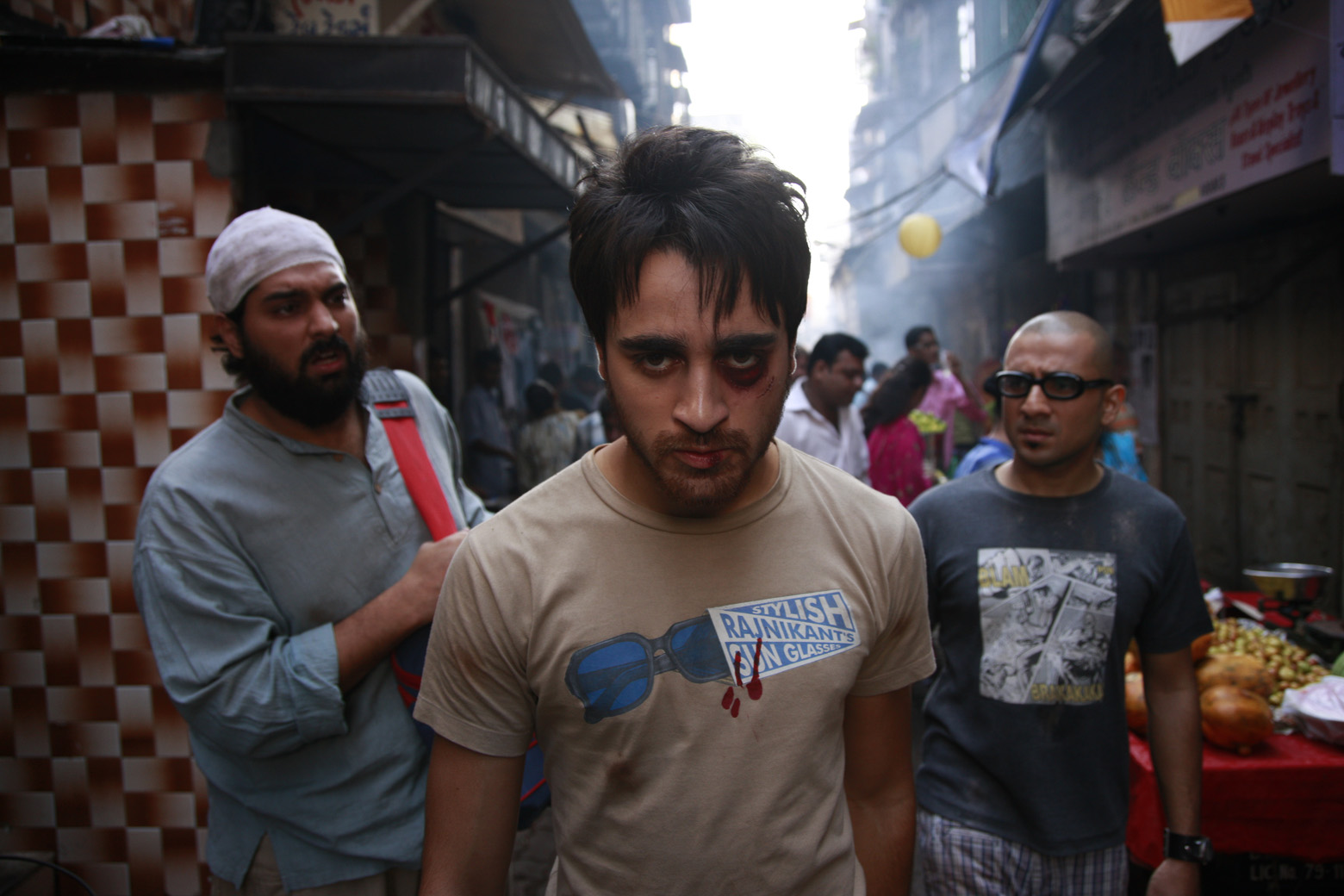
Although it has always been wrong to characterise Indian film as a monoculture, the western perception that there’s nothing more to it than Bollywood and Satyajit Ray is understandable. Although there are regional film industries, most notably working in the Kannada, Tamil and Bengali languages, few arthouse filmmakers from the “parallel cinema” tradition have broken through to international acclaim. Other than the work of Ray, Indian art film has not been widely released on home video in the West. And while India’s commercial cinema has historically been competitive with Hollywood in the developing world, it’s never been more than a niche concern in the West.

But as India changes, consciously growing into its role as one of the economic powers of the coming century, Indian film is changing. As the population becomes more urban, as the censorship regime progressively relaxes (although it remains capricious, and there is still the rather archaic presumption enshrined in the law that film needs to be more strongly censored than other art forms, for the good of the populace), as multiplexes replace the grand picture palaces where masala classics like Sholay and Naseeb played to audiences of over a thousand (rickshaw-wallahs and doctors in the same theatre), as satellite TV and the internet massively increase the exposure of Indians to everything from Harry Potter to pornography, the increasing diversity, frankness and boldness of Indian films reflects the increasingly fractured and unpredictable experience of modern India.
Continue reading London Indian Film Festival 2011

The land of the Bolsheviks: early Soviet cinema at the BFI

BY JOSEPHINE GRAHL

Eisenstein's Fantasia: a scene from Ivan The Terrible Part I

How would you go about making film propaganda in support of a new, revolutionary state? The Russian revolution coincided with the rise of the cinema as mass entertainment, a cultural development which didn’t escape the attention of Lenin or the Soviet bureaucracy. In the 1920s, the Soviet film industry was state-sponsored and subject to state interference, its propaganda function for the new Soviet state accepted as a matter of course. But surprisingly, most of the films in the BFI’s Kino season of early Soviet films transcend the sort of didactic political preaching you might expect from that set-up. Continue reading The land of the Bolsheviks: early Soviet cinema at the BFI