Category Archives: Television

Citizen Clunge

Indy Datta puts The Inbetweeners Movie in context

Simon Bird remembers he has points on this movie

At the time of writing this piece, just before another Orange Wednesday evening swells the coffers further, The Inbetweeners Movie has taken about 28 million pounds at the box office in its first two weeks on release, making it the most successful launch ever for a live-action comedy in the UK. This also puts it on course to outgross films, such as Transformers 3, that probably cost a hundred times as much to produce. Rigorous statistical analysis proves that these figures show that every teenager in the country has seen it twice, and that it probably stopped the August riots. Newspaper journalists can’t see something unusual without pronouncing it a new trend, so we’ve seen a breathless rush of speculation that the British film industry will “learn the wrong lessons” from the success of Inbetweeners and unleash upon us a baleful tide of unwanted adaptations of sitcoms and teen telly shows. This would at least mean that they could take next summer off from whining about the preponderance of sequels and comic book adaptations to instead complain that the multiplexes were being monopolized by the likes of My Family: the Movie, Misfits: the Movie and/or Roger & Val Have Just Got In: the Movie.

But how much of an outlier, really, is the success of Inbetweeners, viewed in the context of British comedy film?

Continue reading Citizen Clunge

It’s Just A Name These Days

Ricky Young has 33 questions about Torchwood that Russell T. Davies MUST ANSWER

"The plot of the fourth series is written ... here!"

Oh, what exquisite pain it is to be a Torchwood fan. You’ve certainly put us through the wringer over the years, Mr. Davies. Designed as a taboo-busting, Who-flavoured love-letter to US genre shows, Torchwood has survived on its energy and charm, all the while maintaining fairly elastic relationships with taste, sense and quality. From body-horror one week to existential pondering the next, the first two series were the very best sort of mixed bag, going from thrilling to infuriating, often in the space of one episode.

The third series, Children of Earth, amplified this tendency, shooting for epic and very nearly making it, before the last episode drowned in a sea of belm. For the latest series, Torchwood is now a co-production with the US cable network Starz, and at the end of the sixth of ten episodes, even the most ardent fan could be forgiven for having a few questions about – and yeah, in true Torchwood style, we won’t hold back here – what the living fuck is going on. So here’s just a few… Continue reading It’s Just A Name These Days

Sauce for the Gander

Niall Anderson looks at the knotty history of sex and nudity on television

"I thought love would last forever ... I was wrong." Lucy Lawless and John Hannah from Spartacus: Blood and Sand

Note: This article contains spoilers for The Wire and The Sopranos

In an earlier life, I used to catalogue DVDs. My duties were to look at the contents of the box, view the contents of the disc, and make sure the details matched. I’d check the technical specifications (region code, aspect ratio, audio set-up) and enter all the details in the catalogue. I never had to watch a whole film, and only ever did on flat Fridays or when I wanted to waste time.

Quite a number of these films – say 5%, conservatively – were pornographic; usually the semi-hardcore things you find gummed to the front of skin mags (which I was also cataloguing). These films feature real sex you can never quite see. There is a lot of sound, and circumstantial evidence of fury, but they signify literally nothing.

I bring this up because whenever I came to match the contents of the pornodisc with those of the pornobox, I could almost never do it. If the box promised you ten chapters, you’d only get five. If the box promised you a certain performer, it was touch and go they would actually appear. On one occasion, only a few weeks apart, I saw the same porno under two different titles with completely different listings for cast and crew. From this I learned that almost everything to do with filmed sex is based on lies. Continue reading Sauce for the Gander

WE’LL SEE YOU NEXT TIME!

Ricky Young revisits the gonzo variety shows of yore thanks to Challenge TV

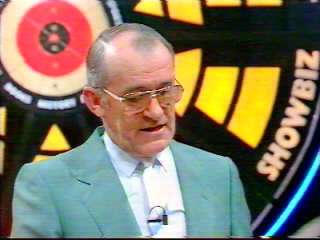
The irony here is that Jim’s face is actually made out of molecules of purest anti-showbiz

Given the unpredictability of my Humax PVR, and its tendency to withhold or distribute channels based on what appears to be little more than malice, it recently came as a very pleasant surprise to be given telly’s number-one receptacle for obsolete game-shows, Challenge TV. Zooming forward through the days on the EPG was a delight, promising hours and hours of shiny-floored fun.

I’ve always loved a game-show. The natural buffer between the news/human-interest of the early-evening and the drama or comedy of 8pm onwards, game-shows were something light, something flashy, something you could have your tea in front of, something you could watch with your gran. Something that could get you involved without being too taxing.  Something with questions, and prizes.

Little slices of glamour beamed directly into your home in half-hour chunks; a perky theme, flashy titles, charismatic host, inventive format, gags, quiz, games, raucous outro – the works! Incredibly plain people given a quick glimpse of the good life, to which the tanned, funny man in the nice suit held the door. Primary-coloured sets edged with glitter. Scoreboards, prize-funds and running totals of cash won. Glamorous assistants and jokes about the missus. Lordy, I watched them all. Game-shows were great!

These days game-shows exist in prime-time only as post-modern revivals or teatime grinds, their place in the schedule taken by stranded soaps and chiding instructionals. Continue reading WE’LL SEE YOU NEXT TIME!

GAME OF THRONES: THE VERDICT

BY YASMEEN KHAN

Peter Dinklage as Tyrion in HBO’s Game of Thrones

WARNING: THIS POST CONTAINS MAJOR SPOILERS FOR THE ENTIRE SERIES OF GAME OF THRONES

“What you suggest is treason.” “Only if we lose.”

Ten hours of TV from an 800-page book. Put like that, it doesn’t sound so arduous. Allowing for credits and an average episode length of 55 minutes, that’s about a page and a half per minute. Sure, you’d have to keep the pace up, but it’s doable, right? But adapting George RR Martin’s A Game of Thrones sounded like a daunting task. The epic scope, the long history, the complicated politics, the vast geography, the cast of hundreds. And yet, after a flawed but promising start, HBO’s first series of Game of Thrones turned out to be a remarkable achievement in storytelling and adaptation. A lot happens on a George RR Martin page, but it doesn’t feel like the book’s been filleted, and the result was a show that appealed to newcomers and aficionados alike. It’s kept expanding its world and scope, and it’s managed to do it without feeling rushed. So how did they pull it off? Continue reading GAME OF THRONES: THE VERDICT

‘I’d Hate to End the Universe by Mistake’

by Ricky Young

'Oh, Christ I’ve left the iron on.'

On October 29th, 1969, computers at Stanford and UCLA connected for the very first time, on a system known as Arpanet. The initial message sent across this precursor of the World Wide Web was ‘Well, the ending of The War Games was a typical Malcolm Hulke clusterfuck, wasn’t it?’

Not really. Bare-faced lies like the one above only serve to highlight the difficulty in being critical about Doctor Who on the internet. There’s no shortage of keyboard warriors rushing to their computers as the credits roll, ready to pour vats of scorn upon the latest story, often in tones so hysterical only dogs can hear them. Dedicated blogs and sites exist solely to examine every possible facet of the programme, and take it apart mercilessly.

Telly + fans + internet = madness; nothing new there, but Who fandom is deeper and richer and older than most. It survived the dark days of cancellation, kept the flame alight when no-one else cared, then had to sit and watch and seethe as the Doctor became public property once more.

No wonder current show-runner Steven Moffat gets exasperated, to the extent that he publically berates ‘net geeks’ who traduce his work (even if he does sometimes miss the point of some articles entirely). But before we continue, please note that this author loves Doctor Who unreservedly. Especially when Doctor Who is thrilling, and fun, and whimsical, and scary, and funny, and audacious, and genuine, all of which Season Five was, to the most satisfying degree since the show returned in 2005. Loving something unreservedly, of course, means not acting blind when it starts showing signs of distress.

(There are spoilers after the jump for the recently-broadcast season)

Continue reading ‘I’d Hate to End the Universe by Mistake’

Great TV you’ve never seen: Man v. Food

by Mr Moth

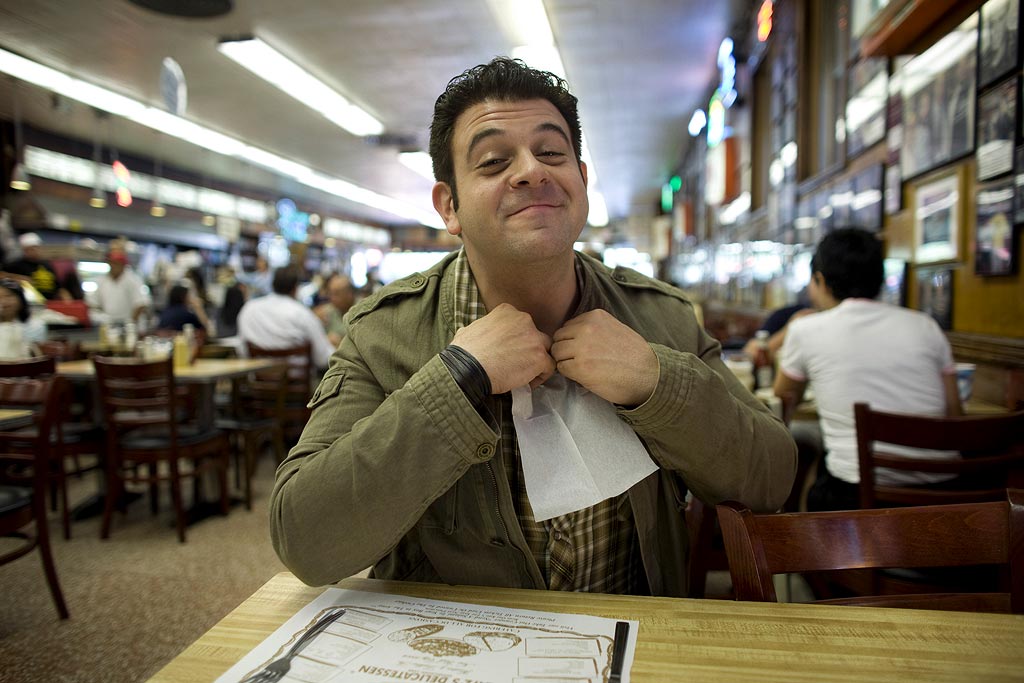
A crowd of hyped-up regulars, bemused tourists, small children (always small children), drunks and staff cheer relentlessly for a man they’ve never met performing a feat they’d never attempt for a prize they would never want. At one point a – probably drunk – young man steps up from the audience and whoops ‘Come on, you can beat this, you’re a MACHINE! WOO!’. If he was in a football stadium he would have his shirt off, and writing painted across his torso. If he was in a war, he would be charging at the enemy, balls-naked and armed only with a pocket knife. A pretty young woman – let’s be honest here, also drunk – dashes up to the man at the centre of the attention, kisses him and yells ‘You can do it, I believe in you!!’. The man at the table looks up, briefly, from his task, smiles like a man facing a firing squad and dives back in. Seconds tick by, minutes pile up, discarded husks of the man’s enemy pile up too. Something momentous is going to happen.

He’s going to win. The crowd’s belief, their simple willingness to cheer him on, has been rewarded. He stands on a chair to take in the final moment. His face a burning, greasy, sweating mask of triumph, he bites down on the last chicken wing and looks at the camera. ‘In the eternal battle of Man vs Food,’ he intones, his voice conveying the solemnity of the occasion – he is Adam, the first man, doing battle with Man’s oldest friend and most ancient enemy, Food – ‘this round GOES TO MAN!’

Then he is given a T-shirt.

Continue reading Great TV you’ve never seen: Man v. Food

Great TV you’ve never seen: Val Falvey, TD

by Niall Anderson

In the writing career of Arthur Mathews, “Father Ted” is beginning to look like a detour. Mathews first surfaced in the mid-80s at “Hot Press” magazine in Dublin, where he began writing a seasonal pull-out called “The Border Fascist”. This was an elaborately loving, surreal and bitter account of life in provincial Ireland through the medium of mock newspaper stories and adverts: ‘Soap! – They use it in Dublin’; ‘Tranvestitism in Cavan has lost one of its most beloved characters with the sad death of Fintan McSweeney (73) …’

“The Border Fascist” was the first time Mathews worked with Graham Linehan, his writing partner on “Father Ted” and much else. It ran till 2004, by which time Mathews had published his first novel, “Well-Remembered Days”, an elaborately loving, surreal and bitter account of life in provincial Ireland through the medium of the memoirs of a retired public servant.

While, post-“Ted”, Linehan has stayed in London, where his comedy has acquired an advancingly placeless and metropolitan feel, Mathews now spends most of his time in Ireland and has squirreled back into the ideas that started him off in comedy. It may seem slighting therefore to point out that his 2009 RTÉ sitcom “Val Falvey, TD” (written with Paul Woodfull) is an elaborately loving, surreal and bitter account of life in provincial Ireland, but it also happens to be maybe Mathews’ best and most inventive treatment of the theme. All the more reason to lament that the show ran for just six episodes and died on its arse.

Continue reading Great TV you’ve never seen: Val Falvey, TD

Great TV you’ve never seen: Friday Night Lights

by Preposition Joe

Warning – this post contains some spoilers.

There’s a passage in “Zen and the art of Motorcycle Maintenance” where a student is suffering from writer’s block. They have to write a five-hundred-word essay about the USA and they can’t get started. The teacher advises them to narrow it down to their home town. Still they can’t get going. How about the main street of their home town? Still blocked. Finally the teacher tells them, pick just one building on main street and start writing about it; start with the top left corner and go from there — start with the top left brick if you have to. The student comes back in a daze having written five thousand words.

“Friday Night Lights” began as a book in 1990, and the writer’s scope was narrow enough — to follow one Texas high-school football team for one season. The book led to a 2004 film of the same name, and the film led to a TV series which ran for five years.

If you like compelling TV drama, and if it’s not already too late because you stopped reading when you saw the word “football”, or maybe “Texas”, the best thing I can do for you is to tell you what the show is not about, then just step out of your way and let you plunge into it.

Continue reading Great TV you’ve never seen: Friday Night Lights

Great TV you’ve never seen: 32 Short films about Brian Limond*

* Oh, all right then, twelve

By Spank The Monkey

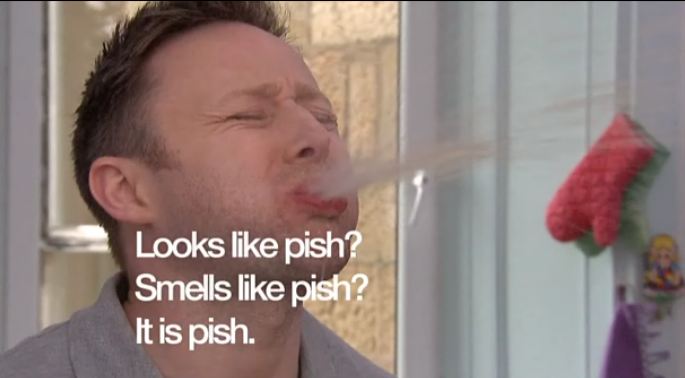
Limmy’s Show. Not pish

Remember that phrase you used to hear in continuity announcements, “…except for viewers in Scotland, who have their own programmes”? Limmy’s Show is one of those programmes. Up until a few years ago, a comedy show broadcast solely on BBC2 Scotland wouldn’t have raised even a flicker of interest south of Hadrian’s Wall. But technology’s moved on: thanks to a combination of comedy blogs, Twitter, BBC iPlayer, YouTube and those Sky channels that come just after the porn, Brian Limond’s sketch show has developed a small non-Scottish following.

Limmy has written, directed and performed in twelve episodes of his Show so far – six in the winter of 2010, and another six one year later. It would be far, far too easy to just link to a handful of YouTube sketch clips and let you work it out for yourself. So I’m a little embarrassed that this is exactly what I’m going to do. But let’s take a structured approach – one sketch from each episode, in chronological order – and use it to decide whether Limmy’s current relative obscurity is justified or not.

Continue reading Great TV you’ve never seen: 32 Short films about Brian Limond*