All posts by Indy Datta

Unknown's avatar

About Indy Datta

Indy's opinions are not those of his employer, your mum, or Sir Van Morrison.

Man of Steel

Indy Datta only saw the new Superman film last night, so this review will be small, and we can’t promise it will be perfectly formed.

man-of-steel-sequence

Zack Snyder’s Man of Steel is, in almost every way, the epitome of the contemporary fantasy comic-book blockbuster, assembled with enormous skill and craft – but also witless, repetitive, thoughtlessly cacophonous, artlessly pretentious. There’s an hour of throat clearing exposition before anything of any interest happens. The plot, on pretty much every conceivable level, makes no sense. Film and director seem needlessly cowed by the source material (the crazy Snyder grandiosity of 300 and Sucker Punch is entirely absent, and yeah, I miss it), yet also simultaneously Nolanishly embarrassed by its inherent silliness (the one time a character says the word “Superman”, it’s an inadvertently delivered punchline). Henry Cavill, in the lead, is given little scope to be anything more than a sixpack on a stick.

Not unusually for superhero movies, it’s down to the villain to save the day.

Continue reading Man of Steel

After Earth

by Indy Datta

First, my son, you must conquer fear. Only then will you be able to battle the evils of bad compositing.

Imagine what Jack Vance could have done with this. The main action of After Earth is an inverted planetary romance – the father and son team of Cypher and Kitai Raige (Will and Jaden Smith respectively) marooned on a future earth abandoned by humanity and now purportedly transformed into a world as thrillingly alien as any other, a world they must negotiate and conquer in order to survive. The scope thus given for a writer to reimagine our familiar world is endless, that act of imaginative transformation as close as anything can be to the very essence of science fiction. But, like so many ostensibly science fictional films, After Earth does nothing more than borrow genre clothes as a kind of drag: and it has no wonders to show us because its mind, such as it is, is on other things.

Continue reading After Earth

Engine Notes on Camp*

Indy Datta reviews Fast & Furious 6

A Ford Escort, you guys? Seriously?

The Fast and the Furious, the flaccid 2001 Point Break ripoff directed, sort of,  by Rob Cohen (with hot rod street racing taking the place of surfing in the Bigelow film; and why don’t I know of more movies that just copy Point Break but with a different minority sport? Where is the Point Break of Ultimate Frisbee, or  LARPing? You can have those for free, Hollywood, you’re welcome) was mainly notable for gravely miscalculating the magnitude of Paul Walker’s screen charisma. About the only thing to be said for it was that it handily bettered Dominic Sena’s flashier, pricier petrolhead actioner of the previous year,  Gone in 60 Seconds (the honey-toned Bruckheimer A-pic to TF&TF’s scrappy B), which could not even be saved by the inclusion of Vinnie Jones playing a man called “Sphinx”.

Continue reading Engine Notes on Camp*

The 2012 London International Festival of Science Fiction and Fantastic Film

by Indy Datta

Best Friends Forever

Or, as festival director Louis Savy, or one of his good-natured and indefatigable team will inform you before almost every screening, Scifi London for short. I’ve been going to the festival since its inception in 2002; reviews after the jump of the films I managed to see this year.

Continue reading The 2012 London International Festival of Science Fiction and Fantastic Film

On Crap 2: On the Crapper

Indy Datta braves two of the year’s worst reviewed films in one weekend.

Run_for_Your_Wife__1647120a

The possibly mythical regular reader of MostlyFilm may remember that your correspondent has previously expressed a certain fondness for the runts of the cinematic litter: the shitty Britcoms raised on a diet of tax breaks and broken biscuits,  then barely released to the profound indifference of audiences everywhere, to the extent that one screening in a windblown suburban Cineworld before a chastened retreat to DVD can be accurately described as “everywhere”. Imagine my joy, then, when the review the editor had penciled in for me for today (Cloud Atlas, narrow-escape fans)  fell through, leaving him with a slot to fill and me with an excuse to see the latest Danny Dyer vehicle, Run For Your Wife.

Continue reading On Crap 2: On the Crapper

MostlyFilm’s Best of 2012: Dredd

by Indy Datta

dredd-movie

In 1995, the first movie outing for taciturn dystopian-future law enforcer Judge Joseph Dredd – a Sylvester Stallone vehicle directed by Danny Cannon – was released to scathing reviews. Although comic book adaptations were, even then, big box office (Joel Schumacher’s  grating, garish Batman Forever, released in the same year, was as big a hit as the two Tim Burton movies that preceded it), the sales pitch for Cannon’s film was all about Sylvester Stallone, still at that time one of the most bankable international movie stars. To the chagrin of the hardcore fans, the 1995 version of putting the money on screen meant putting all of Stallone’s face on the screen, even though Dredd’s face had in the pages of 2000 AD, jutting chin apart, been kept from view beneath his helmet since his first appearance in 1977. In the name of commerciality, the film traduced the source material in numerous other ways, big and small – from giving Dredd a love interest to, unforgivably, retaining the services of Rob Schneider as a comedy sidekick. Despite all the cynical pandering, Judge Dredd bombed. Fast forward to 2012, a world where comic book movies are the mainstream, with the latest incarnation of Batman not only hoovering up ridiculous amounts of cash, but demanding to be taken seriously. The makers of Dredd looked like they were doing everything right – the helmet would stay on, hiding star Karl Urban’s face throughout; Dredd’s creator John Wagner would be part of a creative  dream team including Danny Boyle’s go-to screenwriter Alex Garland; the violence wouldn’t be watered down to garner a kid-friendly rating; Rob Schneider (or his 2012 equivalent, Rob Schneider) would remain uncontacted. Despite all this, Dredd bombed.

Continue reading MostlyFilm’s Best of 2012: Dredd

Mostly Links – 23 November 2012

by Indy Datta

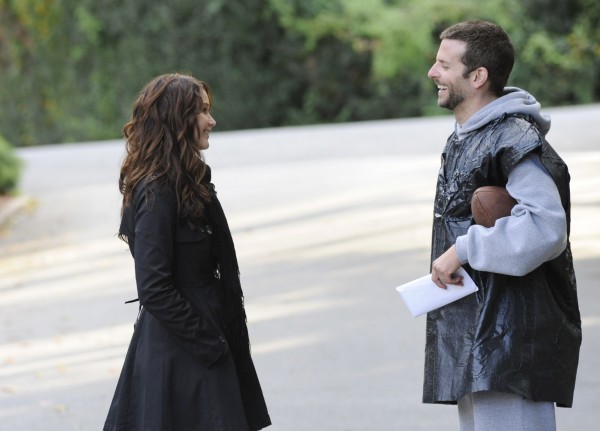
“Yeah, the bin bag really helped me connect with the character’s craziness.”

Mostly Links can’t lie to you, readers: the news this week hasn’t been particularly conducive to the wry sideways look at events we like to feel we have perfected, and we are dead centre in the film news dead zone, after all the festivals have been and gone, and before the critics’ groups and awards bodies start dishing out the gongs. And we can’t even be arsed to try and be amusingly snarky about the carnival of bollocks that is the week’s big new release, David O. Russell’s Silver Linings Playbook. So, in something of a break with Mostly Links tradition, the remainder of this week’s post will be given over to interesting recent film links.

Continue reading Mostly Links – 23 November 2012

Mostly BOO! Halloween Thoughts on The Shining and Room 237

by Indy Datta

Stanley Kubrick’s 1980 adaptation of Stephen King’s novel  The Shining is, courtesy of the BFI, getting a theatric rerelease this week (with previews tonight), in the longer US cut, previously little seen in Britain on the big screen. And last week saw the theatrical release of Rodney Ascher’s documentary, Room 237, a dense, impressionistic collage of varyingly outré interpretations of Kubrick’s film, narrated by the authors of the theories; simultaneously illustrated and undermined by Ascher’s selection and juxtaposition of images from the film and elsewhere. Some thoughts after I make you jump.

Continue reading Mostly BOO! Halloween Thoughts on The Shining and Room 237

Are You Still Alive?

On the eve of the world premiere at the London Film Festival of his debut fiction feature Kelly + Victor – a raw and intimate romantic drama with a dark side, set in an evocatively captured contemporary Liverpool  Indy Datta interviews writer-director Kieran Evans.

On the genesis of Kelly  + Victor

I came into film during the early days of acid house.  I was studying fine art, and acid house had just sort of crash-landed, and in that kind of great way that the e culture made happen, you try something different, so I picked up a film camera and found myself enjoying that much more, so I became an art school dropout, and moved to London with the idea of making films rather than becoming an artist.

Continue reading Are You Still Alive?

Through the Keyhole

Indy Datta reviews the new film from Guy Maddin, Keyhole.

The avant-garde Canadian film maker Guy Maddin has worked a consistent seam – in his narrative film work and as an art film maker – since before his first feature, 1986’s Tales From the Gimli Hospital. Fans will know what to expect from Keyhole, his latest narrative feature, and their expectations will be met, as Maddin serves up an instantly identifiable brew of early film pastiche, wild cut-up surrealism and endearingly lowbrow comedy.  And beyond the surfaces of his films, the personal nature of Maddin’s sensibility is also an identifiable thread running through his work, and one that is arguably getting stronger with time.  Maddin’s last feature, the sly, wry cinematic memoir of his youth and hometown that was My Winnipeg, was probably his most accessible work to date, and Keyhole is in many ways another return to the film maker’s roots – a riff on Homer’s Odyssey (crossed with classic Hollywood gangster films) set entirely in a Winnipeg home very like the one Maddin grew up in.

Continue reading Through the Keyhole