Laura Morgan watches the 50th-anniversary reissue of John Schlesinger’s Billy Liar
‘Genius – Or Madman?’ Billy Fisher as Hero of Ambrosia
There are lots of good things about going to the cinema alone. You can go and see anything you like without justifying your choice to someone else, and you don’t have to tell anyone what you thought of the film afterwards. You don’t have to share your snacks, or miss parts of a trailer – or, worse, the movie itself – because someone wants to have a conversation with you. Going to the cinema alone is a selfish and glorious way to spend a couple of hours. The only downside to it is that when a film makes you laugh until you weep – not the silent shoulder-shaking kind of laughter that you could just about get away with, but the hooting, spluttering kind that marks you out as a genuine lunatic – when that happens, being by yourself only makes matters worse. Fortunately for me I have only done this once: the first time I saw Billy Liar. Continue reading “Count to five and tell the truth”→
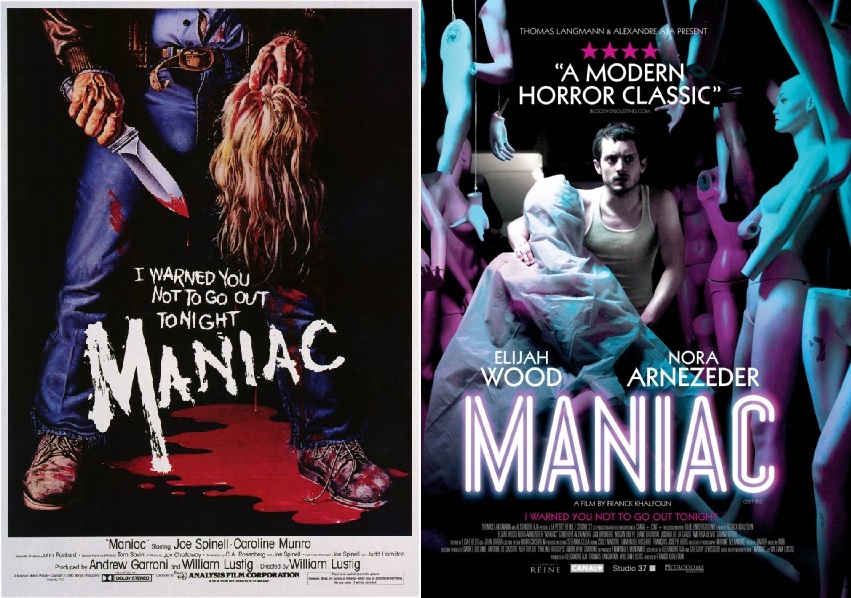
On the left, we have Maniac, directed by William Lustig in 1980. It’s a notorious horror movie, one which got caught up in the UK ‘video nasty’ moral panic of the time. It was banned by the BBFC until 2002, when it finally appeared on DVD with nearly a minute’s worth of cuts. It’s still not possible to buy the uncut version here.
On the right, we have Maniac, directed by Franck Khalfoun in 2012. It’s a remake co-written and produced by French horror director Alexandre Aja, who was also involved in the remakes of The Hills Have Eyes and Piranha. It has a bigger budget, a famous lead, and a clean bill of health from the British censor. It’s just disappearing from UK cinemas, after one of those blink-and-you’ll-miss-it releases that have become so fashionable nowadays – you might be able to catch it at the Prince Charles if you run.
What can we learn from watching both versions of Maniac back-to-back? Apart from ‘all women are evil and must be punished,’ obviously.
an unbiased view by the MostlyFilm poster known only as Ron Swanson
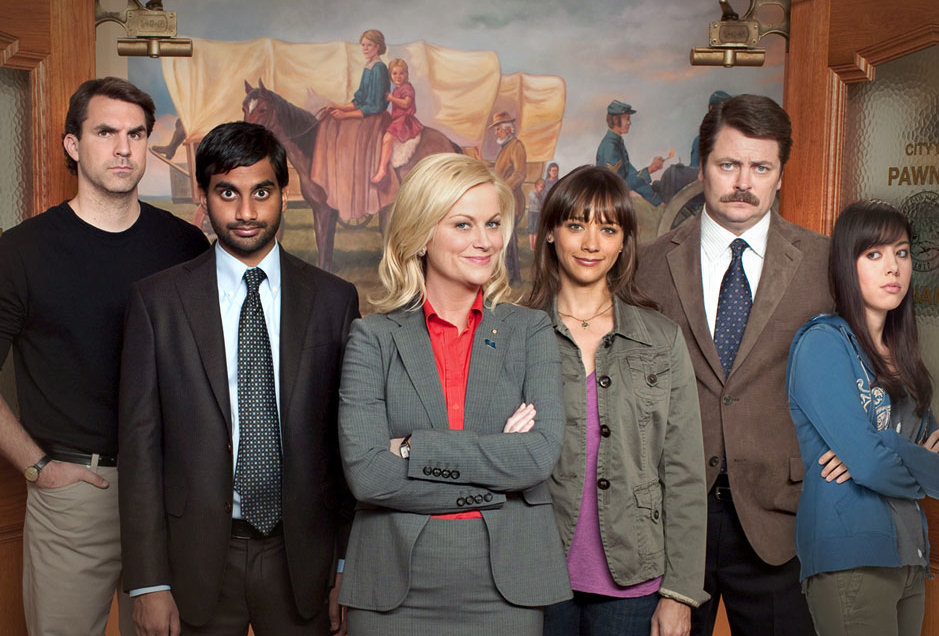
Good news everyone! Parks and Recreation begins this week on BBC Four. It kicks off with a double episode tonight (Wednesday) at 22:00, and is repeated on Sunday at 20:00. It is, quite simply, the best of the current crop of American TV comedy, and, thus, it’d be a terrible shame if you missed it.
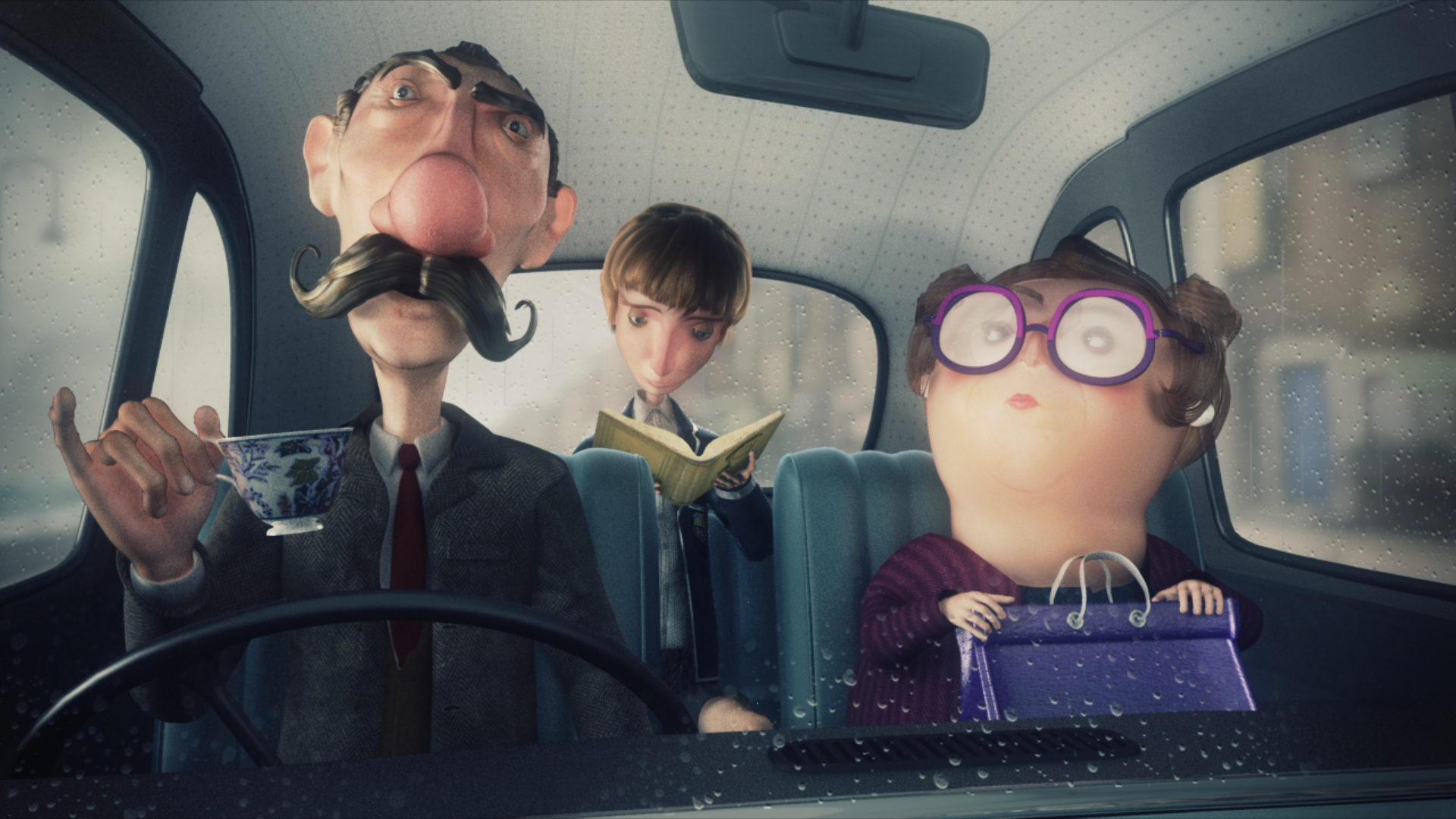
A Liar’s Autobiography: The Untrue Story of Monty Python’s Graham Chapman is based on Graham Chapman’s fictionalised autobiography which was first published in 1981. Chapman recorded an audio version of his book and this voice recording is used as the soundtrack to the film along with new voice recordings from John Cleese, Michael Palin, Terry Jones and Terry Gilliam. Eric Idle is the only no-show from the Monty Python team.
Fourteen different animation studios worked on the project, animating separate chunks of the film. “Creatively, the different styles reflect the stages in Graham’s life.” said one of the directors, Jeff Simpson, in an interview “Also, it saves us a lot of time.”
Chapman died at the age of 48 from throat cancer. The other members of Monty Python’s Flying Circus have forged successful careers as directors, Hollywood A-list actors and the like while Chapman never had much chance to establish a career post-Python. What with being dead and all.
In 1995, the first movie outing for taciturn dystopian-future law enforcer Judge Joseph Dredd – a Sylvester Stallone vehicle directed by Danny Cannon – was released to scathing reviews. Although comic book adaptations were, even then, big box office (Joel Schumacher’s grating, garish Batman Forever, released in the same year, was as big a hit as the two Tim Burton movies that preceded it), the sales pitch for Cannon’s film was all about Sylvester Stallone, still at that time one of the most bankable international movie stars. To the chagrin of the hardcore fans, the 1995 version of putting the money on screen meant putting all of Stallone’s face on the screen, even though Dredd’s face had in the pages of 2000 AD, jutting chin apart, been kept from view beneath his helmet since his first appearance in 1977. In the name of commerciality, the film traduced the source material in numerous other ways, big and small – from giving Dredd a love interest to, unforgivably, retaining the services of Rob Schneider as a comedy sidekick. Despite all the cynical pandering, Judge Dredd bombed. Fast forward to 2012, a world where comic book movies are the mainstream, with the latest incarnation of Batman not only hoovering up ridiculous amounts of cash, but demanding to be taken seriously. The makers of Dredd looked like they were doing everything right – the helmet would stay on, hiding star Karl Urban’s face throughout; Dredd’s creator John Wagner would be part of a creative dream team including Danny Boyle’s go-to screenwriter Alex Garland; the violence wouldn’t be watered down to garner a kid-friendly rating; Rob Schneider (or his 2012 equivalent, Rob Schneider) would remain uncontacted. Despite all this, Dredd bombed.
Partners in Crime (Associés Contre le Crime... ) (2012) is Pascal Thomas’ third adaptation featuring Agatha Christie’s detective duo Tommy, renamed Bélisaire for a French audience, and Tuppence, going by her full name of Prudence. Christie’s introduced the couple in 1922 in the Secret Adversary. They were a frothy, cheerful couple, who reappeared in Partners in Crime in 1929, a collection of short stories, and a further three novels, the couple ageing with the time passed between the books.
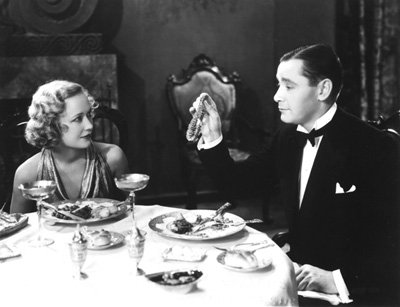
Some years ago, the National Film Theatre (as it was then) asked members to nominate a little-seen film for a Christmas-showing. The winner was Ernst Lubitsch’s 1932 romantic comedy, Trouble in Paradise. Co-written with Lubitsch’s regular collaborator, Samson ‘The Jazz Singer’ Raphaelson, Trouble in Paradise takes full advantage of the permissiveness that abounded before the enforcement of censor Will Hays’ Motion Picture Production Code in 1934. The script, which is heavy with sexual innuendo and irony, was considered too racy during the code era and re-issues were refused. The film wasn’t discovered again until the late 1960s.
Like a lot of early Hollywood comedies, the setting is old Europe: chic, cultured, decadent, gloriously wealthy. But Lubitsch doesn’t waste any time in making a central point (and a good visual gag). The garbageman we see in the very first shot is also an aria-singing gondolier, punting a heap of festering rubbish down the Grand Canal. Glamour, romance and escapism goes hand-in-hand with rottenness and filth. Continue reading Trouble in Paradise→
Stanley Kubrick’s 1980 adaptation of Stephen King’s novel The Shining is, courtesy of the BFI, getting a theatric rerelease this week (with previews tonight), in the longer US cut, previously little seen in Britain on the big screen. And last week saw the theatrical release of Rodney Ascher’s documentary, Room 237, a dense, impressionistic collage of varyingly outré interpretations of Kubrick’s film, narrated by the authors of the theories; simultaneously illustrated and undermined by Ascher’s selection and juxtaposition of images from the film and elsewhere. Some thoughts after I make you jump.
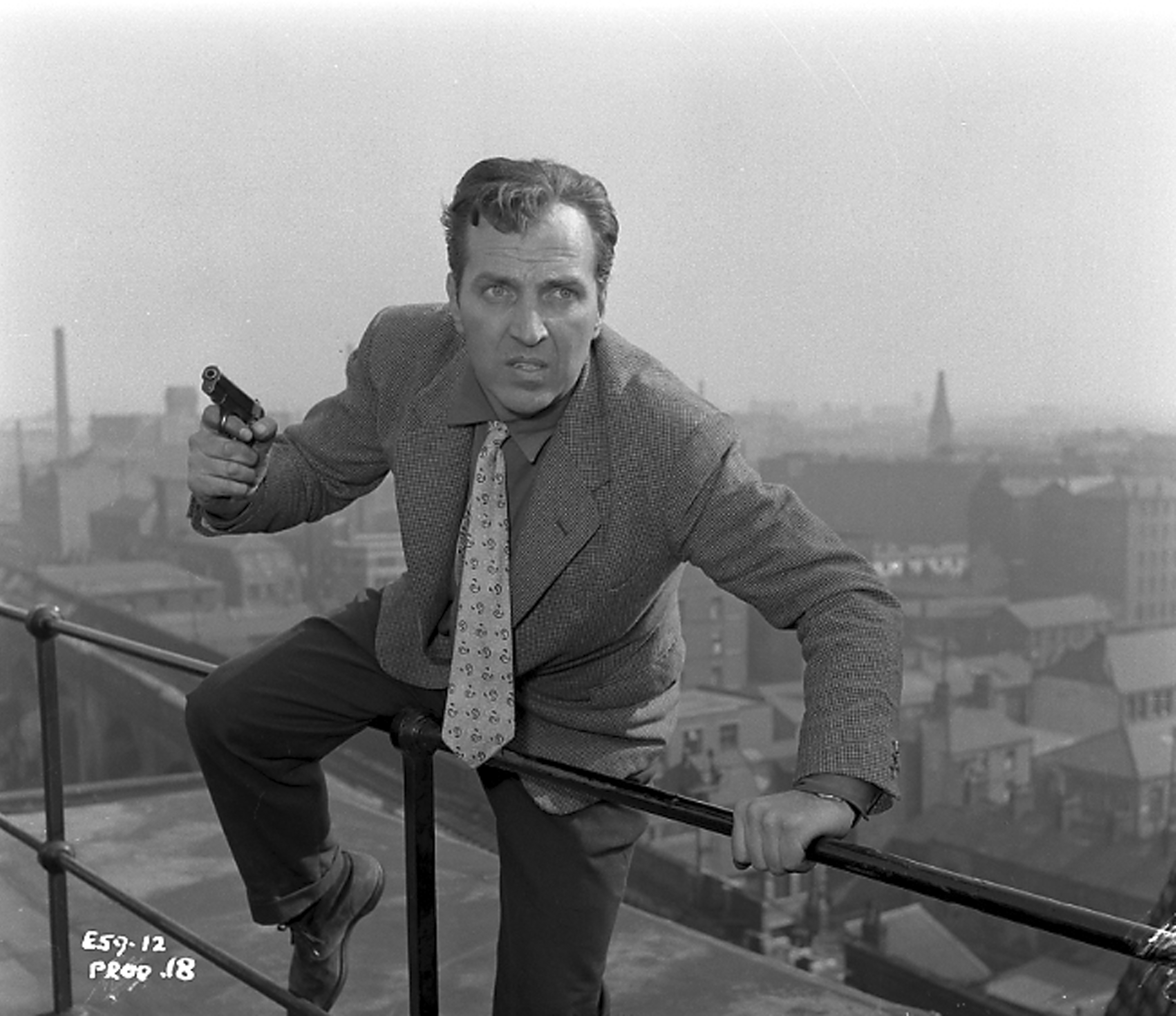
That title seems emblematic of film noir. In so many noirs the city is a malevolent presence, a place that seems both to warp and to be warped by the tortured psyche of the protagonist. If you had to send a telegram summarising the message of most film noir, the curt, four word missive: Hell Is a City, would be a pretty good way to get the job done cheaply.
But a part of what makes this film interesting are the other, non-noir traditions it draws upon. It’s British but it’s a markedly different work than the films I discussed in my MostlyFilm article on Brit Noir, back in March. Significantly, the three films I looked at then are set in London and the South. By contrast, Hell Is a City is set in Manchester. That shift north also brings with it a shift from a heightened reality to an emphasis on veracity. And along with that comes a more serious attempt to more authentically depict the lives of the British working-class.
The first table-read of ‘The Angels Take Manhattan’ goes as well as expected.
The Ponds throw themselves off a building, and appear alive in a familiar graveyard. For some reason.
Amy Pond: “Why always here?”
The Doctor: “Does it matter?”
—
Alright, I’m through with playing nice.
Here at Europe’s Best Website, our journey talking about Doctor Who began at a fortuitous moment – the Russell T. Davies era had wheezed its last and every fanboi’s wish had somehow come true; Steven Flippin’ Moffat had taken over as Executive Producer! In a genre far more inured to disappointment and mediocrity, here was an aligning of planets that just didn’t seem real – the writer of some of NuWho’s best-regarded moments being handed the reins of the BBC’s flagship show, to bend to his considerable will.
We tracked the first two of Moffat’s series; celebrated the highs, tutted at the lows, and ended last year with the hope that, having got a few issues with self-importance out of his system, the newly low-key Doctor could return to being quirky and fun and serious and clever and scary and exciting i.e why we still love it, 49 years after it began.
But, no.
If you happened to see Moffat being presented with a Special Achievement Award at this year’s BAFTA’s (where it was abundantly clear that if he were in fact made out of delicious chocolate, the entire audience was going home hungry), or touched upon his now-infamous ‘The Tweeter’ presence (Sample tweet: “Thanks for saying nice things about me! If you said a bad thing about me, I’m calling the police!”), you could be forgiven for pondering quite how much of his not-inconsiderable talent is in thrall to his not-inconsiderable ego.
Three months after the announcement of Moffat taking over Doctor Who, it was announced that he would also be acting as Co-Executive Producer and sometime writer on the BBC’s new version of Sherlock, in which the classic Victorian detective would be reincarnated for our times as a boring, bug-eyed bell-end. Cleverly, each broadcast of the second series seemed to hit the airwaves with a new and rediffusable form of Holmes’ beloved cocaine, such was the rapture that greeted the three episodes of arch, incoherent filler – indeed, discussing on the internet how Sherlock survived his final plunge became one of this year’s most short-lived sensations, up there with ‘caring about sport’, and that Korean man who thinks he’s a horse.
Perhaps it’s unfair to suggest that Moffat could be spreading himself too thin – I do not, after all, know the man and the demands of his work-life in the slightest – but since the first five episodes of Series 7 represent the weakest gruel since the show came back in 2005, am I mad to ask for fewer damn ‘tease-words’ about next year’s Sherlock, and more of the juice that made Series 5 such a pleasure?
So, let the half-hearted, whey-faced griping begin!





 MostlyFilm