Laura Morgan watches the 50th-anniversary reissue of John Schlesinger’s Billy Liar
‘Genius – Or Madman?’ Billy Fisher as Hero of Ambrosia
There are lots of good things about going to the cinema alone. You can go and see anything you like without justifying your choice to someone else, and you don’t have to tell anyone what you thought of the film afterwards. You don’t have to share your snacks, or miss parts of a trailer – or, worse, the movie itself – because someone wants to have a conversation with you. Going to the cinema alone is a selfish and glorious way to spend a couple of hours. The only downside to it is that when a film makes you laugh until you weep – not the silent shoulder-shaking kind of laughter that you could just about get away with, but the hooting, spluttering kind that marks you out as a genuine lunatic – when that happens, being by yourself only makes matters worse. Fortunately for me I have only done this once: the first time I saw Billy Liar. Continue reading “Count to five and tell the truth”→
After the success of the Twilight franchise, movie execs must have been up to their eyeballs in pitches for The Next Twilight. “It’s like Twilight but with yetis instead of vampires”, for example. Or with Merpeople. Or Robotic Monkeys. Or Parasitic Aliens!
The Host, on general release at the moment, has a better claim than most as The Next Twilight given that it shares Twilight’s author, Stephenie Meyer and is squarely pitched at the same fan base.
Like Twilight, The Host has an attractive teenage female protagonist, weird goings on and dialogue so clunky that I’m not sure Meyer has actually ever heard people speak. It’s not so bad when her words are said by centuries old vampires or alien species new to our language (and possibly the concept of speaking altogether) but it makes no sense for human characters to sound like they learnt English from 18th century gothic novels translated into Japanese and back again.
The promotional posters have emphasised the film’s central love triangle. In this case, given that there are two people inhabiting the same body it’s more of a love square. Or a virtual love square contained within a physical love triangle. Love geometry becomes complicated when your planet has been taken over by alien parasites.
As we join the start of another school year in suburbia, François Ozon opens his film Dans La Maison (In The House) with a clean and crisp montage of modern architectural lines, frosted glass, polished corridors, and crushing normality. In the first staff meeting, Germain (Fabrice Luchini – a shuffling, ill-dentured turtle of a man) learns that even with regards to the students’ dress, uniformity of thought is making a big comeback. A failed novelist and only-mildly-engaged literature teacher, we watch him deflate further than even he thought possible, then waddle off to his first class to set the traditional ‘What I Did This Summer’ paper and wait for the day to be over. His story ended some years ago, we imagine.
Marking his papers at home, however, he finds a surprisingly fruity submission from a new wrong-side-of-the-tracks pupil, Claude Garcia (Ernst Umhauer – like a fresher James McAvoy, but without that constant worry that his nose is about to drip), detailing his desire to get inside the house of a class-mate, for purposes as yet unknown. The essay ends with ‘To Be Continued’, leaving Germain and his art-dealer wife (Kristen Scott-Thomas – doing that suspicious ‘speaking-French’ thing again) hanging with a mixture of unease and prurience that threatens to spice up their comfortable yet boring existence. If, that is, they choose to let it.
Niall Andersonwatches the West End transfer of The Book Of Mormon
Joseph Smith, founder of the Church of Latter Day Saints, pops in on a little Colorado town
It goes without saying that Americans on the whole have a different view of religion than Europeans, and a lot of this has to do with how the two civilisations conceive of the rights of their individual citizens. To vulgarise slightly, in Europe rights are conceived of in negative: they’re the things that nobody can legally stop you from doing. In America, the connotation is largely positive when not outright libertarian. The expression of your individual rights as a citizen is precisely what marks you out as American; a tendency that in turn reinforces the notion of America itself as the great unindividuated home of personal freedom.
There are ironies galore here, but one thing there isn’t is actual irony. The sober Baptist in his New England chapel, the snakehandler in his revivalist’s tent, the dollar-mad televangelist in his sweaty megachurch: all are equally protected by the same Bill of Rights. This is a legalistic definition of equality, to be sure, but in a nation effectively founded by lawyers it has become something close to the cultural definition too. To suggest in the public realm that some manifestations of the religious impulse are kookier than others is held to be impolite; to suggest that religion as a whole might be a crock has the ring of sedition about it. When you mock the faithful, are you not also attacking their fundamental rights as citizens?
All of which perhaps explains the especial nervousness – and the especial atmosphere of heretical glee – that greeted the first Broadway run of The Book Of Mormon in 2011. A satirical musical about America’s foremost native religion, written and co-directed by America’s foremost native satirists (South Park honchos Trey Parker and Matt Stone), the advance word was so hectically positive that you almost thought they’d found a cure for religion through the medium of dancing and low sarcasm. In a probably unconscious echo of the missionary zeal the musical elsewhere mocks, The Book Of Mormon has evangelised itself into a number of touring productions, one which turned up in London last week. Far from home in an alien culture, how would Mormon get on in the godless hinterlands of Soho and Piccadilly? Continue reading Pull The Utah One, It’s Got Bells On→
Niall Andersonwatches two very different cinematic confidence tricks
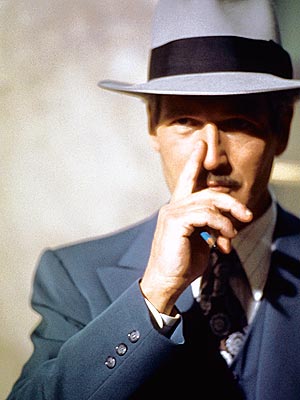
Paul Newman knows more than you know
As the old joke has it: on the internet nobody knows you’re a dog. But what kind of dog are you? Are you housetrained? Do you like children? Do you have any infectious diseases? Are you even, actually, a dog?
Hoaxes and confidence tricks have always been fertile ground for drama, but certain crops have withered in recent years. The clever confidence caper (epitomised by The Sting) doesn’t seem to flourish as it used to. If it hasn’t quite died out, it’s been genetically modified into something almost unrecognisable. The films of Christopher Nolan, for instance, are all confidence capers at root, but you wouldn’t know it to look at the overbearing foliage.
Besides, there’s a new harvest. Films about, for want of a better term, being a dog. Where once the cinematic conman played a short game, hoping to trick himself into money or out of danger, he now does what he does indefinitely and for no immediately intelligible reason. His first hope is that you’ll accept him as a dog. His highest hope is that you’ll accept him as a dog for a really long time. The usual pleasures of the cinematic con trick – whether and how he’ll get away with it – are replaced by the mopier issue of why he wants to be a dog in the first place.
Catfish (2010) remains the exemplar of this new tricky cinema. A transparent and risibly faked “documentary” about how social media allows people to disguise their real identities, Catfish takes callow New York brothers the Schulmans into the American heartland to discover that the hot twentysomething pixie one of them fancies is actually a dowdy middle-aged woman with no friends and a lot of Facebook accounts. There is shock, followed by hugging and learning. The Schulman brothers learned so much, in fact, that they felt compelled to franchise their wisdom into Catfish: The TV Show – an MTV production in which Nev Schulman spies on internet daters and exposes them if they’re not telling the truth.
This seems to me to be a fairly crippled notion of the truth. It is also a fairly obvious bit of reactionary posturing about the rise of online communication. But the note of paranoia – the idea that you can’t trust anybody till you see them in the flesh – feels authentic in both its fear and naivety. Everything will be all right once all the masks are dropped. Two films coincidentally released this week take on this idea in very different ways. Continue reading Ready to take your order→
On the left, we have Maniac, directed by William Lustig in 1980. It’s a notorious horror movie, one which got caught up in the UK ‘video nasty’ moral panic of the time. It was banned by the BBFC until 2002, when it finally appeared on DVD with nearly a minute’s worth of cuts. It’s still not possible to buy the uncut version here.
On the right, we have Maniac, directed by Franck Khalfoun in 2012. It’s a remake co-written and produced by French horror director Alexandre Aja, who was also involved in the remakes of The Hills Have Eyes and Piranha. It has a bigger budget, a famous lead, and a clean bill of health from the British censor. It’s just disappearing from UK cinemas, after one of those blink-and-you’ll-miss-it releases that have become so fashionable nowadays – you might be able to catch it at the Prince Charles if you run.
What can we learn from watching both versions of Maniac back-to-back? Apart from ‘all women are evil and must be punished,’ obviously.
Welcome back to Mostly Pop! Last time out it was all a bit tedious because it was old men trying to be pop stars even though their career was about ten, fifteen, thirty years ago and they’re mostly rock stars gone soft. Enough of that. We’re 4/5 female this time and it’s all about POP POP POP, in your face. No ballads, all bangers. Get comfy, turn your speakers up and click through as I attempt once again to not get too confused and angry in the face of music intended for people twenty years my junior.
When ABC’s Pan Am crossed the Atlantic in the fall of 2011, a Radio Times cover asked us if we were ready for the mile-high Mad Men and, in a move that her character Maggie would have frowned on, Christina Ricci invited us to fly her. On the face of it, there are some similarities with Mad Men: both shows are set in the 1960s with high production values and attention to period detail, but that is where the similarities end.
Part of an occasional series in which Spank The Monkey travels to foreign countries, watches films in unfamiliar languages, and then complains about not understanding them
A Guldbagge Award, yesterday
Sweden! Land of Bergman, Garbo and Abba The Movie. There are some countries where I struggle to find local films in the cinemas, but not here. Stockholm in January 2013 was packed full of ‘em: from the family-friendly fun ofSune i Grekland, to a theatrical outing for a Wallander that’ll probably be on BBC Four by 2014. All I needed was a way to filter out the good stuff from the bad.
By chance, I found that way on my first night in the country, as I turned on the telly to discover live coverage of the Guldbaggen, Sweden’s own film awards. (That golden bug thingy at the top of the page is the actual award itself.) Perfect! All I needed to do was grab the list of winners, pick the most interesting-looking ones, and get myself down to a cinema to see them. Unfortunately, everyone else in Stockholm appeared to be doing the same thing in the week after the Guldbaggen, with screenings of Swedish movies selling out all over the place. As a result, I couldn’t always see my first choice of film. Continue reading Monoglot Movie Club: The Guldbagge Variations→
Indy Datta braves two of the year’s worst reviewed films in one weekend.
The possibly mythical regular reader of MostlyFilm may remember that your correspondent has previously expressed a certain fondness for the runts of the cinematic litter: the shitty Britcoms raised on a diet of tax breaks and broken biscuits, then barely released to the profound indifference of audiences everywhere, to the extent that one screening in a windblown suburban Cineworld before a chastened retreat to DVD can be accurately described as “everywhere”. Imagine my joy, then, when the review the editor had penciled in for me for today (Cloud Atlas, narrow-escape fans) fell through, leaving him with a slot to fill and me with an excuse to see the latest Danny Dyer vehicle, Run For Your Wife.





 MostlyFilm